Best Teaching Strategies

Classroom Activities

Fron Our Resource

Assessment & Data-Driven Instruction Professional Development Teaching Strategies

What Does X Bar Mean in Statistics? A Teacher’s Guide to the Sample Mean

X-bar (written as x̄) represents the sample mean in statistics, calculated by adding all values in your data set and dividing by the number of observations. It’s one of the most fundamental concepts you’ll use when analyzing classroom data, from tracking student test scores to evaluating participation rates in school-wide initiatives.
Understanding x-bar empowers you to move beyond raw numbers and identify meaningful patterns in your educational data. When you collect information about reading levels, attendance, or assessment results, x-bar gives you a single, representative value that summarizes the entire group&#8217…

Educational Policy & Advocacy

Curriculum Development Associations: What They Do and How Educators Can Engage

A curriculum development association is a professional organization that brings together educators, administrators, and policy experts to research, design, and advocate for effective teaching standards and learning frameworks in K-12 schools. These associations serve as both knowledge hubs and advocacy networks, translating academic research into classroom-ready resources while lobbying for curriculum policies that reflect current educational priorities and diverse student needs.
For K-12 educators, these organizations offer far more than theoretical discussions. They provide tangible tools like model curriculum guides, professional…

Assessment & Data-Driven Instruction Classroom Activities Teaching Strategies

How to Teach Place Value: A Step-by-Step Framework for K-12 Educators

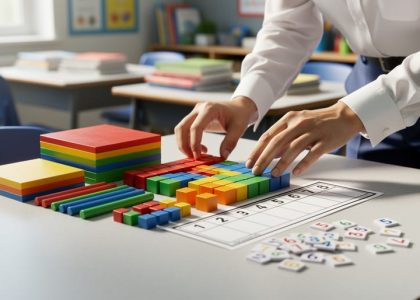
Teaching place value effectively means guiding students through a concrete-to-abstract progression that builds genuine number sense, not just procedural tricks. The most successful approach uses the Concrete-Representational-Abstract (CRA) model: students first manipulate physical objects like base-ten blocks, then work with visual representations such as place value charts, and finally transition to symbolic notation. This sequence typically takes 4-6 weeks for initial mastery in early elementary grades, though deepening understanding continues through middle school as numbers grow larger and decimals enter the picture.
The …

Early Childhood & Pre-K Education

How to Create High-Quality Early Childhood Environments That Inspire Learning

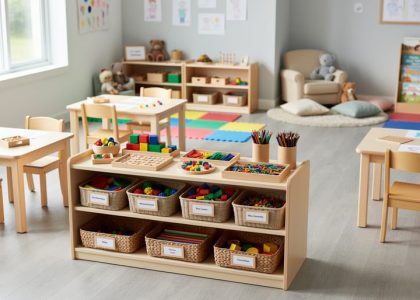
Creating a high-quality early childhood environment means designing a physical space that actively supports children’s development across all domains while keeping them safe and engaged. The most effective approach combines intentional zoning, age-appropriate materials at children’s eye level, and flexible layouts that adapt to different learning styles and group sizes. When done well, this setup takes about one to two weeks to complete and transforms how young learners explore, interact, and grow.
The difference between a standard classroom and a truly high-quality environment shows up in the details. Children should be…

Critical Thinking & Cognitive Development Student Development & Well-being Teaching Strategies

Why CJC-1295 (No DAC) Peptide Doesn’t Belong in K-12 Classrooms

CJC-1295 Ipamorelin no DAC is a synthetic peptide designed to stimulate growth hormone release in the body. As an educator, you may have heard students discussing it in conversations about fitness, athletics, or body enhancement. Understanding what this substance is and how it works equips you to respond thoughtfully when these topics surface in your school community.
CJC-1295 without DAC (Drug Affinity Complex) acts on the pituitary gland to increase production of growth hormone for short, controlled periods. Students might encounter information about it …

Assessment & Data-Driven Instruction Critical Thinking & Cognitive Development Interactive & Game-Based Learning

Safe Learning Through Play: Transform Math Lessons Without Risk

Transform your classroom into an engaging learning environment through strategic gamification in education. While platforms like poker games demonstrate gaming’s motivational power, educators can harness these mechanics responsibly for academic success.
Create achievement-based progression systems that reward mastery of mathematical concepts with digital badges, unlockable content, and special classroom privileges. Design collaborative quests …

Classroom Activities

What Are Class Review Games?

Classroom review games are interactive and engaging activities designed to help students review and reinforce the material they have learned in class, and with the advent of technology, many of these games can now be played online. The ability to play classroom review games online has expanded the accessibility and variety of these activities, making the review process even more enjoyable and effective. Online platforms offer a wide range of games that can be tailored to various subjects and learning objectives, providing an engaging way for students to prepare for…

Teaching Strategies

8 Game Based Learning Examples

In the interest of transparency, we earn a commission on some purchases made through links on this site.

Game-based learning is a teaching strategy that uses games to teach to help students learn. Students play games instead of just reading or listening to learn a topic. Game-based learning happens inside a game framework where we have clear lessons to teach and can see how well they’re learned. Educational games make learning fun and engaging. Examples of game-based learning include hybrid games, …

Professional Development

Tips for Strengthening Working Memory when Teaching

Enhancing your working memory holds the key to unlocking more efficient learning retention. Working memory, which is often likened to a mental sticky note, is a cognitive function critical for reasoning, decision-making, and formulating strategies. 
Harnessing the power of current research-based strategies, educators can optimize the learning process and empower students with the ability to process and retain information effectively…

Classroom Activities Classroom Management

Empowering Young Minds by Teaching Conflict Resolution to Young Teens

Conflict management is a crucial skill that helps people navigate disagreements effectively. In classrooms, workplaces, and life in general, conflicts can arise, making it important for students to learn how to handle these situations constructively.
Why Conflict Management Matters for Middle and High School Students
Middle and high school students often experience conflicts due to …

Teaching Strategies

Fostering Civic Engagement with English and Math Learning

Civic engagement lets students help their communities by getting involved in different ways. They can join their school’s student government to make improvements, or they can volunteer to clean up their neighborhood. 
Both formal and informal actions make a positive difference and teach students about the world around them.
What Makes it Important?
Fosters Empathy
Getting involved in civic engagement helps …