


Curriculum, assessment, and instruction work as one connected cycle, and formative assessment is the fastest way to link them. You decide what students need to learn (curriculum), check what they actually understand along the way (assessment), and adjust your next lesson based on what you find (instruction). Done well, this takes about five to ten minutes of planning per lesson and requires no special software, just a clear learning target and a quick way to see student thinking.
Why does this connection matter so much? When the three pieces drift apart, a class can cover every standard and still leave students confused. A unit might be taught beautifully but tested on skills nobody practiced. Or a quiz might reveal gaps that never change tomorrow’s lesson. Formative checks close that loop. They give you small, frequent signals so you can reteach, extend, or move on while there’s still time to act.
This guide walks you through a practical process you can start using this week, with examples for math and social studies classrooms. You’ll find the tools and materials you need, common pitfalls to avoid, and ways to confirm the process is working. Along the way, you can try Teach Find’s interactive tools to build aligned checks, and share what works with fellow educators in our community forums. Every classroom brings different learners and perspectives, so we’ve built in room to adapt each step to your students.
Why Curriculum, Assessment, and Instruction Work Best as One Cycle

Think of curriculum, assessment, and instruction as three parts of one conversation. Curriculum is what students are meant to learn: the standards, goals, and big ideas for a unit or year. Assessment is how you find out where students are right now in relation to those goals. Instruction is what you do in response, the lessons, questions, and supports that move students forward. Educators sometimes call the place where all of this meets the instructional core and it helps to picture it as a loop rather than a straight line.
Here is how the loop works. The curriculum tells you where you’re headed. Assessment tells you how far along each student is. Instruction then adjusts to close the gap, and the next round of assessment shows whether it worked. When one piece drifts, the whole loop wobbles. A lesson that doesn’t match the goal wastes time, and a quiz that tests something you never taught gives you muddy information.
That’s where formative assessment comes in. These are low-stakes, in-the-moment checks for understanding, like a quick whiteboard response, a one-question exit ticket, or a thumbs-up check. They’re not about grades. They give you a fast read on what students understand while there’s still time to do something about it. In other words, formative assessment is the link that keeps information flowing from the curriculum to the classroom and back again.
Once you see the cycle, the next questions are practical ones: what to gather, what to watch out for, and how to build it into your lessons step by step.
What You Need Before You Start: Tools and Materials
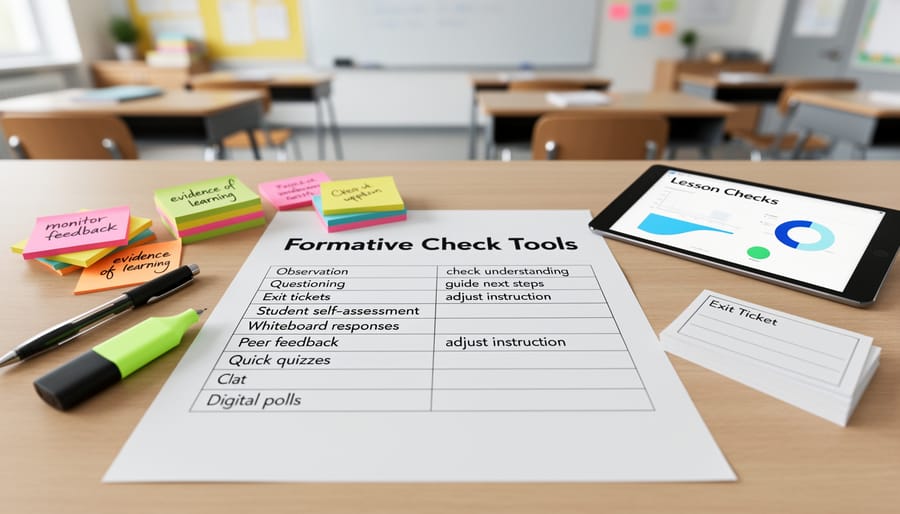
Before you connect curriculum, assessment, and instruction, it helps to have a few simple things within arm’s reach. You don’t need anything fancy. Most of this is probably already in your planning folder or on your shared drive.
Here’s your starting checklist:
- Your curriculum standards or scope-and-sequence documents, so every check ties back to a clear goal.
- Unit or lesson plans you can adjust, not rebuild from scratch.
- A few formative check tools, such as exit tickets, mini whiteboards, short quizzes, or an observation checklist.
- A simple evidence-tracking template, like a spreadsheet or a clipboard grid, to record what students show you.
- A colleague or team to compare notes with and sanity-check your targets.
A quick note on the tracking piece: keep it light. A single column for the learning target and a few quick notes per student is plenty. If it takes longer than a couple of minutes to fill in, simplify it.
The collaboration piece matters more than people expect. Talking through a standard with another teacher often reveals what mastery should really look like, and you’ll catch gaps you’d miss on your own. Instructional coaches and administrators can play this role too.
You don’t have to build everything yourself. Teach Find’s lesson plans and resources give you ready-made starting points, and our interactive tools let you customize templates to fit your grade level and subject. If you want to borrow a strategy that worked for someone else, the community forums are a friendly place to ask, share, and swap ideas with educators who’ve been in your shoes.
Safety Warnings: Common Pitfalls and When to Pause

Formative assessment works best when it protects students and your time. These cautions keep the process supportive, not stressful.
Keep checks low-stakes. Students only show what they don’t yet know when they feel safe doing so. Leave exit tickets, whiteboard checks, and quick polls ungraded, and say out loud that the point is to guide the next lesson, not to rank anyone.
Protect student privacy. Share patterns, not names, when you bring evidence to a team meeting. Store work samples in approved school systems, and remove identifying details before posting anything in an open space.
Don’t over-assess. Every check costs instructional minutes. If you’re collecting more evidence than you can review before the next lesson, you’re collecting too much. One well-chosen check per lesson usually beats three rushed ones. Planning with a backward-design framework like Understanding by Design helps you pick only the checks that match your learning targets.
Watch for bias. Check that tasks and feedback work for everyone. Multilingual learners may know the content but stumble on the wording, so offer visuals, sentence frames, or a chance to respond orally. For students with IEPs, honor accommodations during formative checks just as you would on any other task. Collaborative planning with colleagues is a great way to spot blind spots you might miss alone.
Simple stop conditions. Pause and adjust if you notice any of these:
– Students look stressed, rush, or guess to “get it over with.”
– The evidence is too unclear to act on.
– You can’t review it in time to change tomorrow’s teaching.
When that happens, shrink the check to a single question, switch to quick observation, or try a lower-pressure format like a thumbs-up self-rating. Then try again once students feel comfortable.
Step-by-Step: Connecting Goals, Checks, and Teaching

Formative Assessment Strategies in Math Classrooms
Error analysis is one of the quickest ways to see what students actually believe. Hand out a worked problem with a deliberate mistake, such as adding fractions by combining denominators, and ask students to find and fix it. Their explanations show whether the slip is carelessness or a real gap, and that tells you what to reteach tomorrow.
Whiteboard checks work well mid-lesson. Pose one problem, have everyone solve it and hold up their boards at once, then scan the room. If a third of the class lands on the same wrong answer, you’ve found a misconception worth addressing right away, before practice cements it.
Number talks give you a window into student thinking without any paper at all. Ask for different ways to solve 18 x 5, then listen. Students who only know one rigid procedure, or who guess, stand out, and you can plan strategies that stretch their flexibility.
Exit tickets with a single targeted problem keep the data manageable. Choose one problem tied directly to the day’s learning target, then sort the responses into three piles: got it, almost, and not yet. Those piles become your small groups for the next lesson.
Finally, ask students to explain their reasoning in a sentence or two. A correct answer with a shaky explanation signals fragile understanding, while a wrong answer with sound logic points to a small fix. Either way, you know where to start next time.
Formative Assessment Strategies in Social Sciences Classrooms
Social studies gives you plenty of ways to see what students understand and how they’re thinking. The best checks reveal two things at once: what students know about the content, and how well they reason with it.
Start with an evidence-based quick write. Ask students to answer a focused question in three or four sentences using at least one piece of evidence, such as “Why did the colonists object to the Stamp Act?” Skim the responses for accurate facts and for whether the evidence actually supports the claim. A student who cites a fact that doesn’t fit the argument needs help with reasoning, not recall.
Structured discussion works well too. Keep a simple observation sheet with student names and a few look-fors, like referencing a source, building on a peer’s idea, or asking a clarifying question. A few quick tallies and notes per discussion give you a clear picture of who is ready to move on.
For source analysis, hand students a short primary source and ask who created it, why, and what might be missing. Concept maps are another quick window, since the links students draw between ideas show whether they see causes and connections or only isolated facts.
Perspective-taking prompts add another layer. Invite students to explain how different groups might have experienced the same event, and welcome a range of viewpoints. Their answers reveal empathy and reasoning, and they help every learner see that their perspective has a place in the conversation.
How to Check That Your Alignment Is Working and What to Do Next
Once you’ve built the cycle, check whether it’s actually working. Start with four simple questions.
First, do your tasks match your learning targets? Pull up a recent exit ticket or quiz and read it next to the target you wrote. If the target says “explain why,” but the task only asks students to recall, the two are out of step.
Second, does student evidence change what happens next? If you collect responses and teach the next lesson exactly as planned, the evidence isn’t doing its job. Look for at least one small adjustment, such as a regrouped table, a quick reteach, or an extension for students who are ready.
Third, can students describe their own progress? Ask a few students, “What are you getting better at, and what’s still tricky?” Clear answers suggest your targets and feedback are landing.
Fourth, do summative results reflect what you taught? If many students struggle on a topic they seemed to grasp during formative checks, revisit how well your checks mirrored the final task.
For a simple routine, spend ten minutes at the end of each week reviewing one class set of evidence and noting one adjustment. Teams can do the same during planning time, bringing a single sample of student work and talking through what it shows.
Then pick your next steps:
– Share what you found with a colleague, including what didn’t work.
– Try one new formative strategy per unit rather than overhauling everything at once.
– Join the Teach Find community forums to swap ideas and hear how other educators adapt these practices for different grade levels and disciplines.
Small, steady adjustments add up, and you don’t have to figure it out alone.
Putting It Into Practice: Tools and Community Support
Teach Find’s interactive tools make it easier to turn alignment from an idea into a weekly habit. Customizable exit ticket and checklist templates let you tie each check directly to a learning target, so the evidence you collect actually informs your next lesson. You can adjust the wording, swap in your own standards, and save versions for different units or grade levels.
The community forums are where this work gets richer. Educators share discipline-specific formative strategies there, from math error analysis routines to social science source-analysis prompts. You can ask questions, borrow what fits your classroom, and adapt it for your own learners.
Administrators and instructional coaches can use these spaces for team learning too. Try pairing a forum thread with a short team meeting, or build your own professional learning communities around a single strategy each month. Small, shared steps keep curriculum, assessment, and instruction moving together.
Frequently Asked Questions About Aligning Curriculum, Assessment, and Instruction
Educators often ask the same handful of questions when they start connecting what they teach, how they check learning, and how they respond. Here are practical answers you can use right away.
How often should I use formative checks?
Aim for at least one quick check per lesson, placed at a natural pause point such as after you model a new idea. Short, frequent checks usually tell you more than one big check at the end of a unit.
How is formative assessment different from summative assessment?
Formative checks happen while learning is still in progress and help you decide what to teach next, so they stay low-stakes and ungraded. Summative assessments measure what students have learned at the end of a unit and typically carry a grade.
How do I manage the extra workload?
Start small with one strategy, like an exit ticket, and skim responses by sorting them into “got it,” “almost,” and “not yet” piles instead of grading each one. Sharing templates with colleagues, or borrowing from the Teach Find community forums, saves planning time too.
How can I adapt strategies for different learners?
Offer more than one way to show understanding, such as drawing, speaking, or writing, and provide sentence starters or visuals for multilingual learners. For students with IEPs, follow their plans and adjust the format, not the learning target.
How can administrators support teachers in this work?
Protect shared planning time, encourage low-stakes checks rather than extra reporting, and make space for teams to look at student evidence together. Visiting classrooms to learn alongside teachers, rather than to evaluate, helps build trust.
If your own question isn’t here, bring it to the Teach Find community forums. Chances are another educator has wrestled with the same thing and has an idea worth trying.
Curriculum, assessment, and instruction work best when they move together as one steady cycle. Your standards set the destination, quick formative checks show where students are right now, and your teaching responds with exactly what they need next. Whether you’re watching students explain their reasoning in a math problem or weigh evidence in a social sciences discussion, formative assessment keeps that cycle honest and alive.
You don’t need to overhaul everything at once. Pick one strategy, such as an exit ticket or a quick whiteboard check, and try it in a single lesson this week. Notice what the evidence tells you, adjust your next step, and let that small win build your confidence.
Then bring it to the Teach Find community. Share what worked, ask questions about what didn’t, and borrow ideas from colleagues teaching other grades and subjects. Every educator’s experience makes this work stronger, and yours belongs in the conversation.

