
K-12 edtech interoperability means your digital tools can talk to each other and share student data securely without manual re-entry or compatibility headaches. For most educators, this translates to one login for students instead of five, automatic roster updates when a new student joins your class, and assignment grades that flow directly into your gradebook without copy-pasting. The good news: you don’t need to become a database expert to benefit from data standards in your classroom.
Right now, thousands of schools are wrestling with what the field calls “the integration problem.” Your learning management system doesn’t sync with your assessment platform. Parent communication tools require separate logins. Student information lives in disconnected silos across a dozen different apps. This friction costs teachers an average of 90 minutes per week on administrative tasks that technology should handle automatically.
Data standards like LTI (Learning Tools Interoperability) and OneRoster solve this by creating a common language between systems. Think of them as universal adapters for educational software. When your district adopts these standards, smart tech integration becomes dramatically simpler because vendors build to the same specifications.
You might wonder if this affects your daily work or falls purely in the IT department’s territory. The answer sits somewhere in between. While technical implementation happens at the district level, understanding what interoperability means helps you advocate for better tools, protect student privacy, and make informed choices when selecting classroom technology.
This guide walks you through the concepts that matter for educators, clarifies who’s responsible for what, and provides concrete steps you can take whether you’re a classroom teacher or an administrator evaluating new platforms.
What EdTech Interoperability and Data Standards Are

Common Data Standards in K-12 EdTech
When you start exploring interoperability in your school, you’ll encounter four main data standards. Each solves a specific problem educators face daily.
OneRoster handles student enrollment and class roster data. Instead of manually entering student names, courses, and schedules into every new platform your district adopts, OneRoster automatically syncs this information from your student information system. When a new student enrolls or a teacher’s schedule changes, the update flows to all connected tools instantly. This means your learning management system, assessment platform, and digital curriculum provider all show the correct class lists without IT staff spending hours updating each one separately.
Learning Tools Interoperability (LTI) connects your learning management system to external educational tools. Think of it as a secure doorway: when students click on an interactive science simulation or writing feedback tool embedded in your LMS, LTI passes them through without requiring another login. It also sends grades directly back to your gradebook. Teachers spend less time managing passwords and more time teaching.
Caliper Analytics tracks how students interact with digital learning materials. When a student completes a reading assignment, watches a video, or attempts a practice quiz, Caliper captures that activity in a standardized format. Your district can then analyze learning patterns across different tools, spotting which students need intervention before they fall behind, rather than discovering struggles weeks later through a test score.
Ed-Fi creates a comprehensive data warehouse connecting your student information system, assessment results, attendance records, and instructional data. Administrators and educators can generate reports comparing intervention effectiveness, tracking progress across grade levels, or identifying achievement gaps without requesting custom reports from multiple vendors. One teacher described it as finally seeing the complete picture of each student’s learning journey in one place.

Who Benefits and Eligibility Requirements
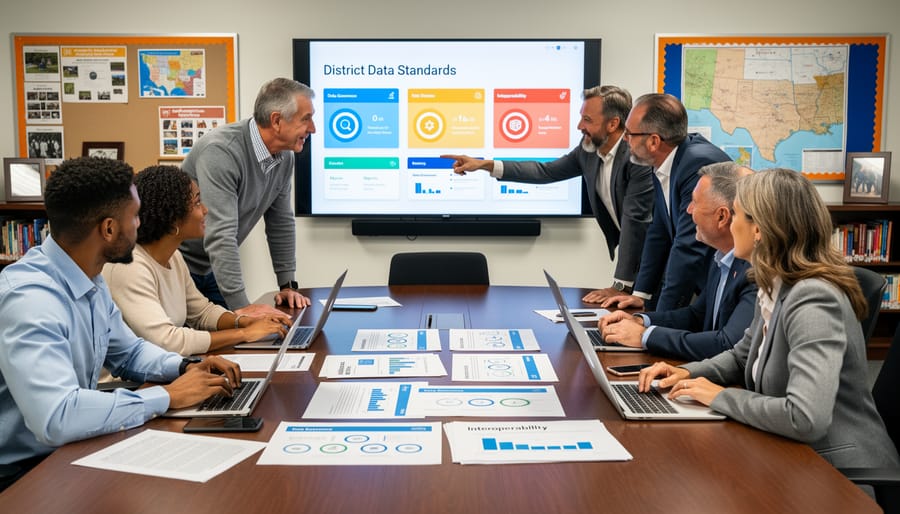
EdTech interoperability and data standards aren’t just for IT departments, they benefit everyone involved in K-12 education, from classroom teachers to students themselves. When systems connect seamlessly, the ripple effects touch every corner of school life.
Here’s who benefits and how:
- Teachers: Spend less time on manual data entry and roster updates, access student work across multiple platforms from a single sign-on, and see a complete picture of student progress without switching between disconnected tools.
- Students: Log in once to access all their learning management systems and apps, experience fewer technical disruptions, and benefit from teachers who have more time for instruction instead of administrative tasks.
- IT Administrators: Automate roster updates across platforms, troubleshoot issues faster with standardized data formats, and manage security more effectively with centralized user provisioning.
- Curriculum Coordinators: Track program effectiveness across different tools, make data-driven decisions about EdTech investments, and ensure learning resources integrate smoothly with existing systems.
- School Leaders: Reduce technology costs through efficient integration, demonstrate compliance with data privacy regulations, and allocate staff time toward instruction rather than data management.
The good news: there are no formal eligibility requirements or applications to adopt interoperability standards. Any K-12 school or district can start this process. However, successful implementation does require a few practical elements. You’ll need EdTech vendors willing to support common standards (most major providers already do), basic IT infrastructure to facilitate data exchange, and district or school leadership support for the transition.
Under-resourced districts shouldn’t assume interoperability is out of reach. Many standards are free to implement, and the long-term savings in staff time often outweigh initial setup costs. State education technology offices frequently offer technical assistance, and cloud-based systems reduce the need for expensive on-site servers. Starting with one or two key integrations, like connecting your student information system to a learning platform, builds momentum without overwhelming limited IT capacity.
How to Implement Interoperability Standards in Your School or District
Questions to Ask Your EdTech Vendors
Before you sign a contract or commit to a new EdTech tool, arm yourself with the right questions. Vendors should be transparent about how their platforms handle integrations and data and you deserve clear answers. Use this list as your starting point:
- Does your platform support OneRoster 1.2 or later for automated rostering?
- Which IMS Global standards (LTI, Caliper, etc.) does your tool comply with?
- What student data is shared during integration, and can we control what gets passed?
- How do you handle data security and encryption during transfers?
- Will your platform work with our existing SIS and LMS without custom development?
- Do you provide technical support during implementation, and is training included?
- Can you share case studies or references from districts similar to ours?
- What happens to our data if we discontinue the service?
Don’t hesitate to ask vendors to demonstrate interoperability live or provide documentation of their standards compliance. If a vendor can’t answer these questions clearly or tries to downplay the importance of standards, that’s a red flag. Your goal is to find partners who make integration easier, not harder, and who respect your time and your students’ data privacy.
Your Rights, Responsibilities, and Data Privacy Obligations
When you implement interoperability and data standards in your K-12 environment, you take on significant responsibilities around student data protection, but you also gain important rights to training, vendor transparency, and support.
Your primary legal obligation is to protect student data under the Family Educational Rights and Privacy Act (FERPA), which governs how educational institutions handle personally identifiable information. FERPA requires that you obtain parental consent before sharing student data with third parties, unless the vendor qualifies as a “school official” performing institutional services under your direct control. Many interoperable systems involve automated data sharing between platforms, so you must ensure that every vendor in your integration chain has a compliant data sharing agreement in place before any student information flows between systems.
State laws add another layer of protection. States like California, New York, and Colorado have enacted student data privacy laws that often exceed FERPA requirements, mandating specific data security measures, limiting how vendors can use student data (often prohibiting targeted advertising), and requiring clear data deletion policies. Before implementing any interoperability solution, check your state’s student privacy laws and confirm that your vendors comply with both federal and state requirements.
Your responsibilities extend to transparency with families. Parents and guardians have the right to know what data is collected, which systems it flows between, how it’s used, and how long it’s retained. When you adopt new interoperable tools or change how data moves between systems, communicate these changes clearly in language families can understand, not technical jargon.
As an educator or administrator, you have rights too. You’re entitled to training on how interoperability works in your environment, what data protections are in place, and how to identify potential privacy issues. You have the right to question vendors about their security practices, request audits of data handling, and insist on accessible tech tools that meet both interoperability standards and legal requirements. Don’t accept vendor claims at face value, ask for documentation, compliance certifications, and references from other districts.
Your IT team should conduct regular audits of data flows between integrated systems, monitor who has access to student information, and maintain logs of data exchanges. If you discover a data breach or unauthorized access, FERPA and state laws typically require prompt notification to affected families and, in some cases, state authorities.
Students have fundamental rights to privacy and security that must guide every interoperability decision you make. Their data belongs to them and their families, not to school systems or vendors. Build your integration strategy around minimizing data collection, limiting access to those with legitimate educational need, and ensuring that interoperability serves student learning, not vendor profit.
Where to Get Help and Support Resources
When you’re ready to implement interoperability standards, you don’t have to figure it out alone. A robust network of official organizations, technical resources, and educator communities exists to guide K-12 schools through the process. Start with the standards organizations themselves: IMS Global Learning Consortium (also known as 1EdTech) provides comprehensive documentation, certification programs, and implementation guides for standards like LTI and OneRoster. The Ed-Fi Alliance offers detailed technical specifications, data models, and case studies from districts that have successfully deployed their data management framework.
| Organization/Resource | Type of Support | How to Access |
|---|---|---|
| 1EdTech (IMS Global) | Standards documentation, certification, technical guides | |
| Ed-Fi Alliance | Data standards, implementation frameworks, community forums | |
| State Education Technology Offices | Local compliance guidance, funding information, regional partnerships | Contact your state department of education |
| Teach Find Community Forums | Peer support, implementation experiences, vendor recommendations |
Your state education technology office can be invaluable for understanding local requirements and connecting you with regional implementation partners. Many states maintain lists of approved vendors and offer technical assistance grants specifically for interoperability projects. Professional learning communities and virtual learning communities provide peer-to-peer support where educators share real implementation experiences, troubleshoot challenges, and recommend vendors who have proven responsive.
Teach Find’s community forums host active discussions about EdTech integration where you can ask questions, find districts similar to yours who have completed implementations, and get honest feedback about what works. Many educators find that connecting with a peer district, one that’s already navigated the standards adoption process, provides the most practical, reassuring guidance as they begin their own journey.
How to Apply or Complete the Process
Unlike traditional grant applications or certification programs, implementing EdTech interoperability standards doesn’t require submitting formal applications to a central authority. There’s no official process to “complete” in that sense. Instead, you’re adopting technical standards that your vendors build into their products.
The practical steps involve working directly with your EdTech providers and district IT team. Start by requesting documentation from your current vendors about their standards compliance, specifically whether they support OneRoster, LTI, or other relevant standards. Many vendors list this information on their websites or will provide it upon request.
Next, coordinate with your district’s technology department to configure the integrations. This typically involves IT staff setting up secure connections between systems, mapping data fields, and testing the flow of information. Teachers and administrators don’t usually handle the technical setup directly.
For new vendor contracts, specify standards compliance as a requirement during the procurement process. Include language about data standards in your RFPs and vendor agreements.
The “completion” happens when your systems successfully exchange data without manual intervention. You’ll know you’re there when roster updates flow automatically, grades sync seamlessly, and you’re no longer copying student information between platforms.
Common Questions About K-12 EdTech Interoperability
Educators exploring interoperability for the first time often have similar concerns about feasibility, cost, and support. Here are answers to the most common questions we hear from teachers and administrators starting this journey.
How long does implementation typically take?
A phased rollout usually takes 6-12 months from initial assessment to full adoption, though you’ll see benefits from early integrations within the first few months. Schools that start with a single integration between their SIS and one learning platform often complete that pilot in 8-12 weeks.
Do we need to replace all our current EdTech tools?
Not at all. Most districts start by connecting existing tools that already support standards, then gradually phase out non-compliant systems as contracts renew. You’re building bridges between tools, not tearing down everything you’ve invested in.
What if our district has limited IT support?
Many small districts successfully implement standards by leaning on vendor support teams, state education technology offices, and peer networks. Starting with vendor-hosted integrations that require minimal local configuration makes adoption manageable even with a lean IT team.
How much does standards implementation cost?
Costs vary widely, but many districts find that interoperability reduces long-term expenses by eliminating duplicate data entry and streamlining workflows. Initial setup might range from minimal (if vendors handle integration) to several thousand dollars for consulting support, while ongoing costs are typically covered within existing vendor contracts.
One concern we hear repeatedly: “Can small schools with tight budgets really do this?” Absolutely. Standards aren’t just for large, well-funded districts. In fact, small schools often see faster wins because they have fewer systems to connect and more agile decision-making. If you’ve managed to implement 1:1 on a budget you already have the resourcefulness needed for this work.
The key is starting small. Connect your student information system to one frequently used platform, measure the time savings, then expand from there. You don’t need a massive technology overhaul or a dedicated interoperability team. What matters is asking the right questions when you renew vendor contracts, choosing new tools that support standards, and connecting with other educators who’ve walked this path. Many schools discover that the biggest barrier wasn’t technical complexity or cost, it was simply not knowing where to begin.
Adopting interoperability and data standards in your K-12 school isn’t reserved for tech-savvy districts with unlimited budgets. It’s a practical, achievable goal for any school willing to take thoughtful, incremental steps. You don’t need to overhaul every system overnight. Start with one integration that solves a real pain point, perhaps connecting your learning management system to your gradebook, or automating roster updates between your student information system and a reading platform. Each small success builds momentum and demonstrates value to your colleagues and administrators.
The educators who’ve successfully implemented these standards share a common insight: the upfront effort pays dividends in time saved, frustration reduced, and data that actually serves student learning rather than creating busywork. Your students benefit when you spend less time manually entering attendance and more time personalizing instruction. Your stress decreases when systems talk to each other instead of forcing you to be the translator.
You’re not alone in this process. Connect with fellow educators in Teach Find’s community forums to learn from those who’ve navigated implementation in schools similar to yours. Ask questions, share concerns, and discover practical solutions that work in real classrooms.
View interoperability as what it truly is: an investment in your professional capacity and your students’ educational experience. The technical details matter less than your commitment to reducing friction and increasing impact. Take that first step today, assess one integration opportunity, reach out to a vendor, or join the conversation with peers. Your future self, and your students, will thank you.