
A basis in linear algebra is a minimal set of vectors that can be combined to create every vector in a given vector space. Think of it as the essential building blocks: just as primary colors mix to create any color, basis vectors combine through addition and scalar multiplication to generate all possibilities within their space.
For educators, this concept matters because it underpins how we teach students to break down complex problems into simpler parts. When a student learns that any point on a plane can be described using just two perpendicular directions (like x and y axes), they’re working with a basis. The same principle scales to three dimensions, abstract spaces, and eventually to data science applications where students analyze trends using hundreds of dimensions.
This article walks you through what makes a set of vectors qualify as a basis, how bases function in different mathematical spaces, and why understanding this concept prepares students for advanced mathematics and real-world problem solving. We’ll explore standard bases like coordinate axes alongside more abstract examples, showing you how to spot linear independence and span (the two requirements that define any basis). You’ll also find teaching strategies designed for classrooms where students are encountering vector concepts for the first time, along with practical examples that connect to physics, computer graphics, and data analysis.
Whether you’re introducing vectors in a high school algebra course or supporting students headed toward STEM fields, grasping what a basis does (and doesn’t do) gives you the language to make abstract mathematics feel concrete and purposeful.
What a Basis in Linear Algebra Means

A basis is the set of directions you need to describe any location in a mathematical space. Think of it like the cardinal directions (north, south, east, west) on a map: with just those reference points, you can describe where anything is by saying how far to go in each direction. In linear algebra, a basis is independent and spans the entire vector space, meaning it provides the minimum set of building blocks needed to construct every possible vector in that space.
- Basis
- A set of vectors in a vector space that are linearly independent and span the entire space. Every vector in the space can be written as a unique combination of these basis vectors.
- Vector Space
- A collection of objects (called vectors) that can be added together and multiplied by numbers (scalars) in ways that follow specific rules. Examples include two-dimensional coordinate planes or three-dimensional physical space.
- Linear Independence
- A property where no vector in a set can be created by combining the others. In practical terms, each vector contributes something new and necessary to the collection.
- Span
- All possible vectors you can create by combining basis vectors in different ways. If a set of vectors spans a space, you can reach any point in that space using just those vectors.
- Dimension
- The number of vectors in a basis for a space. A plane has dimension 2 (needs two basis vectors), while physical space has dimension 3 (needs three basis vectors).
Two essential properties define every basis. First, linear independence means none of the vectors are redundant. You cannot make any basis vector by combining the others, just as you cannot create “north” by mixing “east” and “west” on a compass. Each vector adds a genuinely new direction. Second, the span property means these vectors together cover everything in the space. Using different amounts of each basis vector, you can reach any point, similar to how latitude and longitude coordinates let you specify any location on Earth using just two reference directions.
This minimal-yet-complete quality makes bases powerful. They eliminate redundancy while ensuring nothing gets left out, giving educators a framework for helping students understand how complex spaces can be described through simple, fundamental components.
How a Basis Works in Vector Spaces

Standard Basis Examples
The standard basis provides the most familiar example of how bases work, it’s the coordinate system students already use when graphing points on a plane or in space.
In two dimensions, the standard basis consists of two vectors: i = (1, 0) and j = (0, 1). Think of these as directional arrows along the x-axis and y-axis respectively. When a student plots the point (3, 2), they’re actually building that location using the standard basis: three steps in the i direction, two steps in the j direction. This makes the standard basis perfect for introducing the concept because students can literally see and draw it.
In three dimensions, we add a third vector: k = (0, 0, 1), which points along the z-axis. Together, i, j, and k form the standard basis for 3D space. If you have blocks or manipulatives in your classroom, you can physically demonstrate this by moving one unit in each perpendicular direction, showing students how these three simple vectors can build any position in the room.
The standard basis is special because each vector has length 1 and points directly along one axis, making calculations straightforward and visual representations intuitive for learners.
Why Uniqueness Matters
When every vector in a space has exactly one representation as a combination of basis vectors, calculations become reliable and predictable. This uniqueness property prevents ambiguity and ensures that mathematical operations yield consistent results.
Imagine if students could describe the same location in a classroom using multiple contradictory sets of directions. Problem-solving would become chaotic. Similarly, if a vector could be expressed as different linear combinations of the same basis vectors, we’d lose the foundation for consistent computation. Matrix operations, systems of equations, and transformations all depend on each vector having a single, definite representation.
This uniqueness stems directly from linear independence. Because no basis vector can be written as a combination of the others, there’s no redundancy in the system. Each coefficient in the linear combination carries precise, non-overlapping information about the vector’s position.
For educators, this concept connects to teaching coordinate systems. When students plot points using x and y coordinates, they intuitively understand that each point has one ordered pair, not multiple possibilities. The uniqueness property of bases formalizes this intuition and extends it to higher dimensions and more abstract vector spaces, giving students a reliable framework for advanced mathematical reasoning.
Different Types of Bases and Their Components
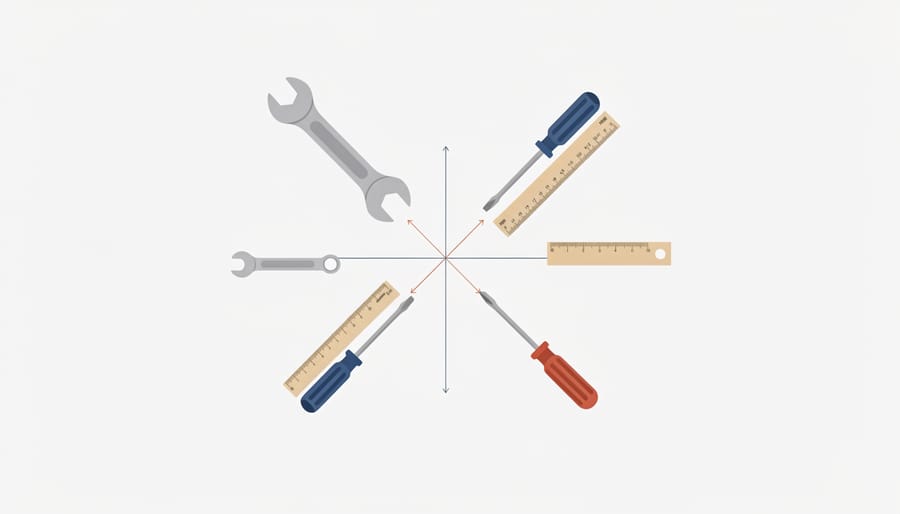
Not every basis looks the same, and understanding the different types helps you choose the right tools for specific problems. Linear algebra offers several categories of bases, each with distinct properties that make it suited to particular tasks. Recognizing when and why mathematicians prefer one type over another gives you insight into how the field works, and offers practical entry points for classroom instruction.
The standard basis is the simplest and most familiar. In two dimensions, the standard basis vectors are (1,0) and (0,1), pointing along the x-axis and y-axis respectively. In three dimensions, you add (0,0,1) for the z-axis. These vectors are easy to visualize, align with everyday coordinate grids, and make calculations straightforward because each vector isolates a single dimension. When students first encounter coordinate systems, they’re working with a standard basis without realizing it. This type serves as the default reference frame in most introductory contexts.
Orthogonal bases take things further by requiring that every pair of basis vectors meet at right angles. Imagine two perpendicular rulers on a desk, each one points in a direction completely independent of the other, with no overlap in their orientation. Orthogonality simplifies many operations, particularly projections and decompositions, because the vectors don’t interfere with each other geometrically. You can compute components along one basis vector without worrying about contributions from the others. In physics and engineering, orthogonal bases reduce complexity when analyzing forces, signals, or spatial data.
Orthonormal bases refine orthogonality by adding a length requirement: each basis vector must have magnitude one. Think of unit vectors pointing along perpendicular axes. This normalization makes calculations even cleaner, because you avoid scaling factors when expressing vectors or computing dot products. Orthonormal bases are the standard in computer graphics, where rotation and projection matrices rely on consistent, unit-length directions. They’re also essential in statistics and data science, where techniques like principal component analysis use orthonormal bases to reveal patterns in high-dimensional data.
Polynomial bases extend the concept beyond geometric vectors. Functions can form vector spaces too, and a polynomial basis consists of powers of a variable: 1, x, x², x³, and so on. Any polynomial can be written as a combination of these building blocks. When teaching students about function spaces or approximation methods, polynomial bases offer a bridge from familiar algebraic expressions to the abstract structure of vector spaces. They show up in calculus (Taylor series), numerical methods (interpolation), and computer science (curve fitting).
Each type of basis serves a purpose, and the choice depends on the problem at hand and the simplicity you need.
Where Bases Are Used in Mathematics and Beyond
Understanding why bases matter starts with seeing where they show up beyond the chalkboard. Bases aren’t just abstract mathematical machinery, they’re the invisible framework behind technologies, scientific models, and analytical methods educators and students encounter every day.
In coordinate geometry, the concept of a basis gives us the familiar x-y-z axes we use to locate points in space. Every position you plot on a graph, every map coordinate, every GPS location relies on expressing vectors as combinations of basis vectors. When students graph a line or find the distance between two points, they’re implicitly working within a coordinate system defined by a basis.
Computer graphics and animation depend entirely on bases to render images on screens. Every pixel position, every rotation of a 3D model, every zoom and pan operation involves transforming coordinates between different bases. Game designers and animators constantly shift between bases to achieve realistic movement, lighting effects, and camera angles, all built on the same linear algebra foundation educators can introduce in high school.
Across mathematics, science, and technology, bases provide the essential structure for representing complex information:
- Coordinate geometry: Plotting points, measuring distances, defining shapes in 2D and 3D space
- Computer graphics and animation: Rendering images, transforming objects, creating visual effects
- Signal processing: Decomposing sound waves and radio signals into frequency components using Fourier bases
- Quantum mechanics: Representing particle states and observable properties in different basis systems
- Data science and machine learning: Reducing dimensionality, extracting features, compressing information through principal component analysis
- Engineering systems: Analyzing vibrations, electrical circuits, and control systems by choosing bases that simplify calculations
In data science, choosing the right basis can reveal hidden patterns. Principal component analysis identifies a new basis that highlights the directions of greatest variation in a dataset, making it easier to compress images, analyze customer behavior, or detect anomalies. This same principle helps Netflix recommend shows and doctors analyze medical imaging.
Physics students studying waves learn that any complex waveform can be built from simpler sine and cosine waves, another basis at work. Engineers use this Fourier basis to filter noise from audio recordings or analyze structural vibrations in bridges. The flexibility to switch bases transforms difficult problems into manageable ones, a strategy educators can frame as choosing the right perspective for the task at hand.
Teaching Basis Concepts in K-12 Classrooms
Introducing basis concepts requires meeting students where they are and building gradually. In middle school, start with coordinate grids. When students plot points on x-y axes, they’re already using a basis without knowing it, every point is a unique combination of horizontal and vertical distances. Ask them to describe locations using only those two directions, then pose the challenge: could we use a different pair of directions? This plants the seed that coordinate systems are choices, not fixed truths.
High school algebra introduces vectors, creating a natural bridge. Start with displacement vectors in physical contexts, walking three blocks east and two north. Show how any movement can be broken into east-west and north-south components. Then introduce the idea that these two independent directions form a basis. Students can experiment with graph paper, choosing different pairs of non-parallel vectors and expressing target vectors as combinations of their chosen basis.
Hands-on activities work better than abstract lectures. Give groups of students different sets of vectors on cards and have them determine which sets could serve as a basis for 2D space. They’ll discover through trial that parallel vectors fail, while independent pairs succeed. Physical manipulatives like straws or string help spatial learners visualize spanning and independence. For advanced students, building 3D models with sticks demonstrates how three non-coplanar vectors span space.
Interactive digital tools amplify understanding. Desmos and GeoGebra let students manipulate basis vectors dynamically and watch how the coordinate grid transforms. These platforms show in real time what happens when basis vectors stretch, rotate, or become dependent. You can also incorporate math review games that challenge students to express vectors in terms of different bases, or explore math VR concepts that immerse them in 3D vector spaces.
Connect to curriculum standards explicitly. When teaching transformations, point out that matrices represent changes between bases. When discussing linear functions, note that slope-intercept form uses the standard basis. Encourage metacognitive strategies by having students explain why certain vector sets qualify as bases, articulating reasoning deepens understanding.
Common Questions About Bases in Linear Algebra
When educators first encounter bases in linear algebra, a handful of questions come up repeatedly, both in personal learning and during classroom preparation. Addressing these head-on helps build confidence and clarity.
Can a vector space have more than one basis? Absolutely. Any vector space of dimension two or greater has infinitely many possible bases. The standard basis is just one convenient choice; you can rotate it, scale it, or choose entirely different vectors as long as they remain linearly independent and span the space. This flexibility is powerful in applications, different bases reveal different properties of the same space.
How do you test if vectors form a basis? You need to verify two properties: the vectors must be linearly independent, and they must span the entire vector space. In practice, for a finite-dimensional space, if you have the right number of vectors (matching the dimension) and they’re linearly independent, they automatically span the space, a result known as spanning and independence equivalence. For instance, three independent vectors in three-dimensional space always form a basis.
What happens when vectors are linearly dependent? They cannot form a basis. Linear dependence means at least one vector is a combination of the others, so the set is redundant, it includes more vectors than needed to span the space, or it fails to span the entire space. Catching these dependencies early prevents common linear algebra mistakes students make when setting up coordinate systems.
Why does dimension equal the number of basis vectors? The dimension of a vector space is defined as the number of vectors in any basis for that space. This number stays constant regardless of which basis you choose, a two-dimensional plane always requires exactly two basis vectors, whether you use the standard basis or any other linearly independent pair.
Can a vector space have more than one basis?
Yes, every vector space with dimension two or greater has infinitely many possible bases. Any linearly independent set of vectors that spans the space qualifies as a basis.
How do you check if vectors form a basis?
Verify that the vectors are linearly independent and that they span the entire space. If you have the correct number of vectors for the dimension and they’re independent, they automatically span.
What’s the relationship between basis and dimension?
The dimension of a vector space is the number of vectors in any of its bases. This number remains the same for all bases of that space.
Why can’t we just use the standard basis for everything?
While the standard basis is simple and familiar, other bases often simplify calculations or reveal structure. For example, orthogonal bases streamline projections, and problem-specific bases can turn complex equations into straightforward ones.
Understanding these core questions equips you to anticipate student confusion and address it proactively, whether you’re introducing vectors in middle school or diving into transformations at the high school level.
Understanding what a basis is in linear algebra opens doors for both you and your students. This foundational concept connects abstract mathematical ideas to tangible classroom applications, from coordinate systems students already use to more advanced vector spaces they’ll encounter later. When you grasp how bases work, you can guide learners through challenging material with clarity and confidence.
The tools and community at Teach Find support your journey in making these concepts accessible. Explore interactive demonstrations that bring vector spaces to life, and join forums where fellow educators share proven strategies for teaching linear independence and span. You’re not alone in navigating advanced topics or adapting them for younger learners.
Every time you break down a complex idea like a basis into understandable pieces, you’re building mathematical confidence, not just for your students, but for yourself. Teaching challenging material strengthens your own understanding and equips you to handle questions you didn’t anticipate. Your willingness to engage with linear algebra, even when it feels outside your comfort zone, models the persistence and curiosity you want students to develop. That’s the real power of teaching: growth happens on both sides of the lesson.