A calculus bridge isn’t a mathematical concept connecting derivatives and integrals. It’s a thick, hardened band of dental plaque that forms across multiple teeth, creating a literal bridge of tartar buildup. If you’re an educator reading this, you’ve likely discovered this term the same way many of your students have: while searching for help with calculus homework and landing on unexpected dental hygiene content instead.
This confusion presents a surprising teaching opportunity. When students type “calculus bridge” into a search engine expecting formulas and theorems, they encounter graphic images of severe dental neglect. The mix-up reveals something important about today’s digital landscape and how easily search algorithms can mislead learners looking for academic support.
The phenomenon isn’t random. The word “calculus” appears in both mathematics and dentistry, though the meanings couldn’t be more different. In dental terms, calculus refers to mineralized plaque, and when it spreads across several teeth in a connected formation, it creates what dentists call a calculus bridge. This condition requires professional removal and signals serious oral health issues.
For educators in 2026, this naming collision offers more than a moment of student bewilderment. It creates a practical entry point for teaching digital literacy, helping students refine search strategies and evaluate source relevance. The confusion also opens conversations about context clues, homonyms in specialized fields, and why adding specific terms like “mathematics” or “dental” to searches matters.
Rather than dismissing the mix-up as a simple error, you can transform it into a classroom lesson that builds essential research skills while addressing a common student frustration.
What Students Are Actually Finding: The Dental Calculus Bridge Explained
When your students type “calculus bridge” into a search engine expecting math help, they’re likely encountering some startling images of oral health issues. Understanding what they’re actually finding will help you address their confusion and turn it into a meaningful learning moment.
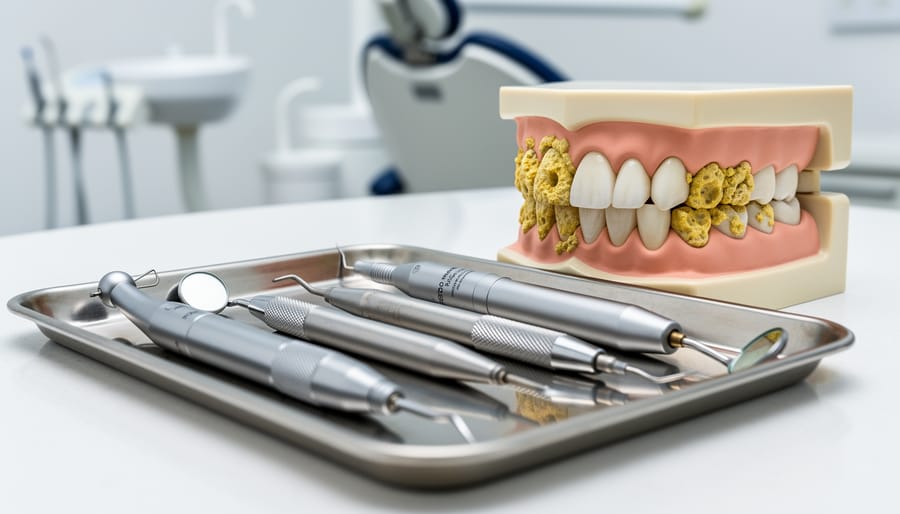
A calculus bridge is a thick, hardened layer of tartar that spans across multiple teeth, typically forming along the gumline. Imagine a crusty, yellowish-brown deposit that literally creates a continuous “bridge” connecting several teeth. It’s the result of hardened dental plaque that has been allowed to accumulate over time without proper dental care.
To grasp what students are seeing, it helps to understand a few key terms:
- Plaque
- A soft, sticky film of bacteria that constantly forms on teeth throughout the day. It feels fuzzy when you run your tongue over unbrushed teeth.
- Tartar (Calculus)
- Hardened plaque that has mineralized on the tooth surface through petrification of dental plaque biofilm. Unlike plaque, you can’t remove it with regular brushing.
- Calculus Bridge
- An extensive buildup of tartar that connects multiple teeth in a continuous formation, usually along the lower front teeth where saliva minerals accelerate hardening.
- Ultrasonic Scaler
- A dental tool that uses high-frequency vibrations to break apart and remove hardened calculus during professional cleanings.
The images your students encounter often show extreme cases where oral hygiene has been neglected for months or years. The buildup appears rough and discolored, sometimes extending well above the gumline. While these pictures might seem shocking, they represent what happens when the normal process of plaque formation goes unchecked.
This buildup forms when bacteria in plaque interact with minerals in saliva, creating a hard deposit that bonds to tooth enamel. The lower front teeth are particularly susceptible because saliva glands are located directly beneath them. Once tartar forms, only a dental professional can remove it with specialized instruments.

Why the Same Word? Connecting Math and Medicine in Your Classroom
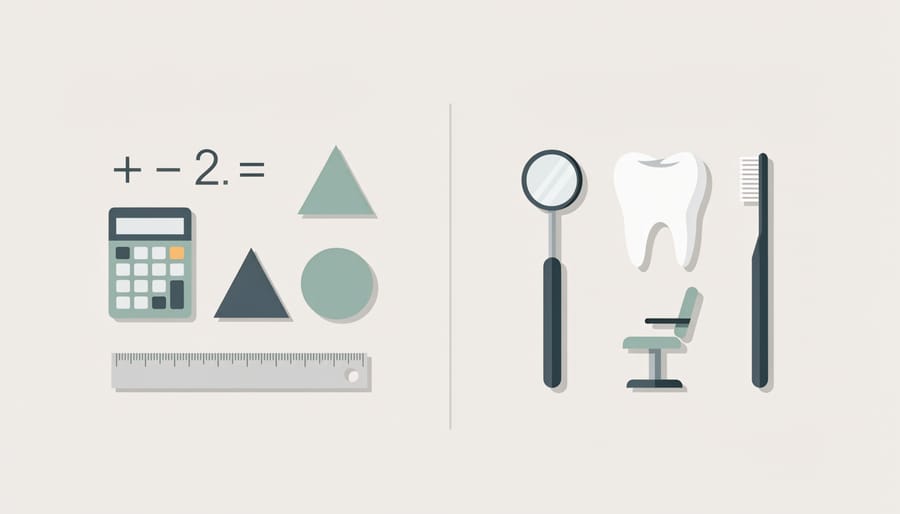
Here’s the shocking truth your students might find fascinating: the word “calculus” has nothing to do with math at its root. Latin ‘calculus’ means pebble or small stone, and both mathematical calculus and dental calculus bridge got their names from that ancient connection.
Ancient Romans used small stones on counting boards to perform calculations. When mathematicians in the 1600s needed a name for their new method of calculation, they reached back to those counting pebbles. Meanwhile, physicians observing hardened deposits on teeth noticed they looked and felt like tiny stones cemented to the enamel. Same root word, completely different applications, one computational, one physical.
This shared etymology creates a perfect classroom moment. The dental calculus bridge your students stumble upon is literally named for its stone-like qualities: hard, mineralized, and stubbornly attached. Mathematical calculus borrowed the same imagery because early arithmetic involved moving physical objects around to solve problems. Both require precision and careful attention to accumulated details, whether you’re building equations or explaining how plaque mineralizes over time.
For your classroom, this isn’t just trivia. It demonstrates how scientific and medical terminology often pulls from the same classical sources, creating overlaps that can confuse researchers. When students search “calculus bridge” and land on dental images, they’re experiencing firsthand why context matters in academic research. A middle schooler looking for help with derivatives needs different results than someone researching oral health, even though the root word connects both fields.
You can turn this into a mini-lesson on how words evolve across disciplines. Ask students to identify other terms that appear in multiple subjects, like “matter” in science and law, or “scale” in music and math. This builds vocabulary awareness while teaching them to read search results critically before clicking.
Turning Search Confusion Into Learning Opportunities
For Elementary Educators: Making Vocabulary Stick
When younger students encounter unfamiliar words with multiple meanings, it sparks natural curiosity, the perfect foundation for vocabulary development. The calculus bridge mix-up offers elementary educators a concrete, memorable example to teach how context shapes meaning.
Start by acknowledging that some words wear different hats depending on where they appear. Show students two images side by side: counting stones (the original meaning of calculus) and teeth with buildup. Ask them to identify what’s similar, both involve something hard and small collecting together. This visual connection makes abstract vocabulary concepts tangible.
Create a “Word Detective” activity where students investigate other everyday words with multiple meanings: bat (animal versus sports equipment), bark (tree covering versus dog sound), or ring (jewelry versus telephone sound). Let students draw or act out different meanings, reinforcing that smart readers use surrounding words as clues.
Turn this into a game by reading sentences aloud and having students identify which meaning fits. “The dentist removed the calculus from her teeth” versus “Ancient Romans used calculus for counting.” This playful approach builds critical thinking strategies while normalizing the idea that confusion is just a signal to look more carefully at context.
For Middle School Teachers: Digital Literacy Skills
Middle schoolers often hit search engines with quick, generic keywords and click the first result without checking context. The “calculus bridge” mix-up makes an excellent real-world case study for teaching smarter search strategies.
Start with search refinement. Show students how adding a single clarifying word transforms results: “calculus bridge” versus “calculus bridge math” or “calculus mathematics introduction.” Have them compare the first five results from each search and discuss what changed. This concrete exercise demonstrates that precise language matters when researching.
Next, teach context clue scanning. Before clicking, students should read the preview snippet and URL. Does it mention teeth, dental, or tartar? Wrong topic. Does it reference limits, derivatives, or mathematics? Probably right. Create a quick classroom challenge where students evaluate search results and identify which ones match their actual research goal before clicking through.
Verification becomes the final skill. When students land on a page, they need to confirm it matches their intent within the first paragraph. If they’re seeing gumlines and dentists instead of equations, they should recognize the mismatch immediately and return to their search rather than getting derailed.
These digital citizenship skills extend far beyond avoiding dental images. Students who learn to refine searches, scan for context, and verify content become more efficient researchers across every subject.
For High School Instructors: Cross-Disciplinary Connections
High school students benefit immensely when they discover how scientific terminology travels across disciplines. The calculus bridge confusion offers a perfect entry point for this exploration. Both mathematical calculus (from Newton and Leibniz’s work with infinitesimal change) and dental calculus (the hard tartar buildup on teeth) trace back to the Latin word for “small stone.” Ancient Romans used pebbles for counting, while kidney stones and dental deposits share that same stony quality.
Challenge your students to research other shared STEM terms: “culture” in biology versus sociology, “field” in physics versus mathematics, “solution” in chemistry versus algebra. This exercise demonstrates why precision matters in scientific communication. A biology student searching for “cell division” doesn’t want spreadsheet tutorials, just as your calculus students discovered when they encountered dental images.
Cross-curricular instruction thrives on these connections. Partner with your school’s health or biology teacher to create a joint lesson where students trace the etymology of ten shared scientific terms, then present how context determines meaning. Students gain deeper understanding of both subjects while building the analytical skills they need for college-level coursework, where interdisciplinary thinking becomes essential.
Classroom Approaches: Turning the Mix-Up Into a Lesson
In an elementary classroom, the calculus bridge mix-up can turn up during a science unit on measurement, when students searching for “calculus examples” come back puzzled and slightly disgusted. Rather than dismissing it, a teacher can turn it into an exploration of scientific vocabulary: students build a “word detective” chart tracking terms that appear in multiple subjects, ask the school nurse about dental health and the math teacher about the origins of calculus, and finish with posters explaining why precision matters when researching academic topics.
In middle school, the moment students start giggling over dental images is an opening for a candid discussion about search literacy. Projecting their search results on the board lets the class analyze why their queries returned dental content instead of math help, and identify missing context words like “math,” “equations,” or “limits.” A follow-up challenge has students compete to craft the most effective search queries for different calculus-related topics, documenting which keywords produce the best results, and keep a shared document of “search strings that actually work” for common assignment topics.
In high school calculus, the dental connection makes a memorable course opener. Displaying calculus bridge images alongside the fundamental theorem of calculus and asking students to explain the link sparks conversations about Latin roots, mathematical history, and the importance of terminology in STEM fields. Students can then research other examples of shared scientific vocabulary across disciplines, discovering how “axis” appears in math, anatomy, and political science, or how “differentiation” applies to both calculus and biology. The lesson emphasizes that confusion indicates curiosity, not failure.
With younger students, the topic fits naturally into health lessons. A visit from the school dental hygienist on oral health can connect the Latin “small stone” meaning to both tartar formation and ancient counting methods, so students leave understanding two concepts instead of one.
Building Better Search Habits: Resources for Your Classroom
Equip your students with practical tools that turn search frustrations into research success. Start with bookmark-worthy resources that help students distinguish between different meanings of the same term and verify they’ve landed on the right content.
Google’s Advanced Search page remains one of the most underused tools in education. Show students how to exclude terms (like “dental” when searching for calculus help) or specify domains (.edu for academic sources). Similarly, Boolean operators, AND, OR, NOT, transform vague queries into precise ones. A simple handout with search operators can live in student binders or as a desktop reference.
For younger learners, visual search literacy matters. Teach them to scan search results for context clues in titles and snippets before clicking. Create a classroom anchor chart comparing helpful vs. misleading search results using the calculus bridge example as a case study.
Consider these free tools to strengthen student research skills:
- Common Sense Media’s digital literacy curriculum with ready-made lessons on evaluating sources
- Google’s Be Internet Awesome program featuring interactive games about smart searching
- The News Literacy Project’s Checkology platform for middle and high school students
- Browser extensions like Highlighter or Hypothesis for annotating and questioning online sources
- Search refinement posters showing operators like quotation marks for exact phrases
Create a “search challenge” activity where students deliberately search ambiguous terms, then document their process for finding the correct information. This metacognitive exercise builds awareness about how they navigate confusion. Pair this with blended learning approaches where students practice online research skills with immediate teacher feedback.
Build assessment rubrics that reward search strategy, not just finding answers. When students explain how they distinguished mathematical calculus from dental calculus bridge content, they’re demonstrating the reasoning that makes student critical thinkers. Share successful lesson plans in the interactive tools section and community forums, where educators exchange what actually works in their classrooms.
The next time a student frantically messages you about finding “gross teeth pictures” while searching for calculus help, you’ll know exactly what happened, and exactly how to turn that moment into meaningful learning. These unexpected digital detours aren’t mistakes to brush past. They’re openings to teach students how language works across disciplines, how to evaluate what they’re seeing online, and why precision matters in academic searching.
Every confused search is a chance to build the critical thinking skills your students need far beyond your classroom. When they learn to pause, assess context, and refine their approach, they’re developing habits that serve them in every subject and every stage of learning.
We’d love to hear how you’ve turned search mix-ups into teaching wins. Share your stories and strategies in our community forums, where educators across the country swap practical solutions to everyday classroom challenges. And explore our interactive tools designed to help students master research skills and digital literacy, because the best learning often starts with a little productive confusion.