Transform your kindergarten classroom into a dynamic learning hub by blending traditional hands-on activities with AI-powered learning strategies that capture young minds and foster meaningful engagement. Today’s kindergarteners thrive in environments where digital tools enhance, rather than replace, essential developmental experiences.
Interactive smart boards now display colorful counting games while small groups practice hands-on math manipulatives. Digital storytelling apps record students narrating their own adventures, building confidence and language skills simultaneously. Motion-sensing technology transforms physical movement into learning opportunities, allowing children to jump, dance, and gesture their way through letter recognition and basic counting exercises.
Yet the most successful kindergarten classrooms maintain a careful balance: technology serves as one tool in a diverse educational toolkit. Sensory tables, building blocks, and dramatic play areas remain cornerstone elements that develop crucial social-emotional skills. This integrated approach meets modern learning standards while honoring the developmental needs of five- and six-year-olds.
By embracing both innovative digital tools and time-tested teaching methods, educators create an environment where every child finds their path to engagement and success. The key lies not in choosing between traditional and modern approaches, but in thoughtfully weaving them together to support each unique learner.
Creating an Interactive Digital Learning Environment
Selecting Age-Appropriate AI Tools
When selecting AI tools for kindergarten students, prioritize applications that align with their developmental stage and learning capabilities. Look for tools featuring colorful visuals, simple navigation, and clear audio instructions that young learners can follow independently.
Consider these key factors when choosing AI applications:
Safety and Privacy: Select tools with robust privacy settings and child-safe content filters. Ensure the application doesn’t collect unnecessary personal information or allow unsupervised external communications.
Age-Appropriate Interface: Choose platforms with large buttons, picture-based menus, and minimal text requirements. The interface should be intuitive enough for five- and six-year-olds to use with minimal adult assistance.
Educational Value: Focus on tools that reinforce kindergarten curriculum standards while maintaining an element of play. Look for applications that incorporate:
– Basic literacy and numeracy skills
– Pattern recognition
– Creative expression
– Problem-solving activities
– Social-emotional learning
Customization Options: Select tools that allow teachers to adjust difficulty levels and learning paths. This flexibility helps accommodate different learning styles and developmental stages within your classroom.
Remember to test any AI tool thoroughly before introducing it to your students. Start with free trials when available, and gather feedback from other kindergarten teachers who have implemented similar tools. Regular assessment of the tool’s effectiveness and student engagement will help ensure it continues to meet your classroom’s needs.
Setting Up Your Digital Learning Stations
Setting up effective digital learning stations in your kindergarten classroom requires thoughtful planning and organization. Start by designating clear, well-defined spaces for your tech centers, ensuring they’re easily visible from your teaching position. Choose sturdy, child-height tables and arrange devices so that screens face inward to minimize distractions for other students.
Consider creating a simple rotation system using picture cards or a digital timer to help students transition between stations smoothly. Establish clear rules for device handling and create visual guides showing proper care and usage. Label each station with both pictures and words to support emerging readers.
Keep your digital stations organized with color-coded headphones, numbered devices, and designated storage spots. Include physical materials that complement digital activities, such as writing tools, manipulatives, or art supplies. This helps bridge the gap between digital and hands-on learning experiences.
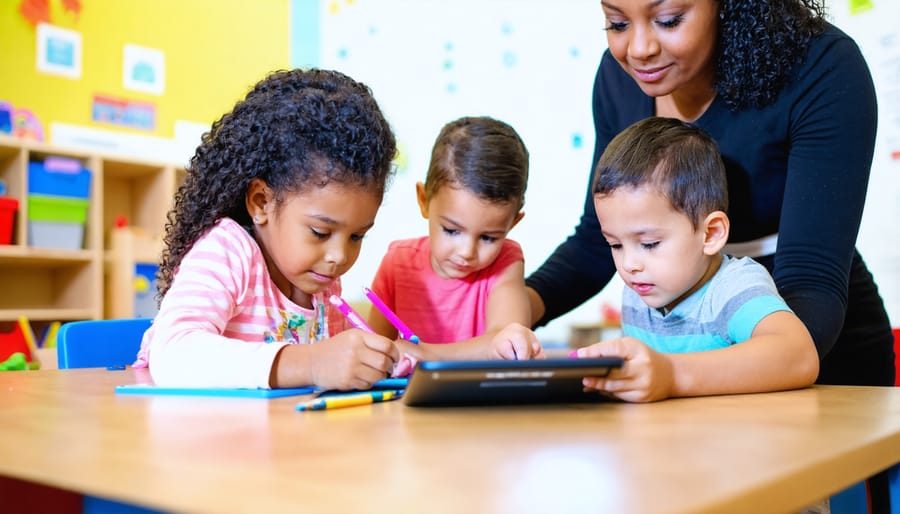
For optimal engagement, limit each digital station to 2-3 students and ensure activities are age-appropriate and align with your learning objectives. Create backup plans for technical difficulties by having alternative activities ready. Consider setting up a “tech helper” system where more experienced students can assist peers with basic troubleshooting.
Remember to regularly update and refresh digital content to maintain student interest while keeping activities aligned with your current curriculum goals.
Personalized Learning Through AI Assessment
Real-Time Progress Monitoring
Modern AI-powered tools have revolutionized how we track kindergarten student engagement in real-time. These user-friendly systems help teachers monitor participation, emotional responses, and understanding during classroom activities without disrupting the natural flow of learning.
Using simple tablet-based applications, teachers can quickly note student responses and engagement levels through easy-to-use interfaces. These tools often feature emoji-based reaction tracking, allowing educators to record student emotional states and participation patterns with just a few taps. The collected data creates visual representations of each student’s engagement journey throughout the day.
The real benefit comes from the immediate insights these tools provide. Teachers can identify which activities spark the most enthusiasm and which students might need extra attention. For instance, if several students show decreased engagement during story time, the teacher can adapt their approach by incorporating more interactive elements or changing their reading style.
Many of these monitoring systems also include helpful features like:
– Visual attention tracking during circle time
– Participation patterns in group activities
– Individual student engagement trends
– Class-wide activity effectiveness metrics
Remember that technology should enhance, not replace, teacher observation. Combine AI insights with your professional judgment to create a complete picture of student engagement. Regular review of this data helps inform lesson planning and ensures every child receives the support they need to thrive in the kindergarten environment.
Adaptive Learning Paths
In today’s kindergarten classroom, adaptive learning technology plays a crucial role in creating personalized learning experiences for young students. These intelligent systems continuously monitor each child’s progress and adjust content difficulty in real-time, ensuring that every student is appropriately challenged and supported.
When a student consistently succeeds at tasks, the system gradually increases the complexity of activities. For instance, if a child masters basic shape recognition, the program might introduce more complex geometric patterns or combine shapes with counting exercises. Conversely, if a student struggles with particular concepts, the system automatically provides additional practice opportunities and simpler versions of the tasks.
These adaptive paths consider multiple factors, including response time, accuracy, and pattern recognition. A student who quickly completes number sequencing activities might receive more challenging skip-counting exercises, while another student might benefit from additional practice with basic number recognition.
The beauty of this system lies in its ability to maintain engagement through appropriate challenge levels. Students neither become frustrated by overwhelming content nor bored by tasks that are too easy. Teachers can monitor these adjustments through detailed progress reports, allowing them to provide targeted support when needed and celebrate achievements as students advance through their personalized learning journeys.

Gamification Strategies with AI Support
Interactive Story Time
Interactive storytelling has evolved with AI-powered tools, offering kindergarten teachers new ways to captivate young minds. These digital platforms adapt stories based on student responses, creating personalized learning experiences that maintain engagement throughout the narrative.
Popular AI storytelling tools like StoryMaker and TaleWeaver allow teachers to customize characters, settings, and plot elements to align with curriculum objectives. Students can participate by making choices that influence the story’s direction, fostering critical thinking and decision-making skills. For example, children might help a character solve problems by selecting different approaches, with the AI adjusting the narrative accordingly.
To implement interactive storytelling effectively, start with simple stories that incorporate familiar themes from your classroom. Use the AI tools to generate questions that encourage student participation and reflection. Many platforms offer voice recognition features, allowing children to verbally interact with the story, supporting both language development and digital literacy.
Remember to balance screen time with traditional storytelling methods. Use AI stories as part of a mixed approach, perhaps introducing a topic with a digital story before transitioning to hands-on activities. This combination helps maintain student interest while ensuring developmentally appropriate practice.
For best results, preview AI-generated content before class and prepare follow-up questions to extend learning beyond the story. Consider creating small group sessions where students can take turns interacting with the story, promoting collaborative learning and social skills.

Educational Games and Rewards
Educational games powered by AI technology offer exciting opportunities to boost kindergarten engagement while maintaining a nurturing learning environment. By implementing effective game-based learning strategies, teachers can create an interactive atmosphere that naturally motivates young learners.
Consider implementing digital reward systems that celebrate both academic achievements and positive behaviors. Virtual sticker charts, digital badges, and interactive progress meters can make learning milestones more tangible and exciting for young students. These tools can track individual progress while maintaining a supportive, non-competitive environment.
AI-powered games can adapt to each student’s learning pace, automatically adjusting difficulty levels to maintain engagement without causing frustration. For example, letter recognition games might introduce new characters gradually, while number games could adjust complexity based on student responses.
Popular game mechanics include:
– Interactive storytelling with choose-your-own-adventure elements
– Digital puppet shows that respond to student participation
– Movement-based learning games using classroom displays
– Collaborative puzzle-solving activities that encourage peer interaction
Remember to rotate between digital and hands-on activities to maintain a balanced approach. Short gaming sessions (5-10 minutes) work best for kindergarten attention spans, and incorporating physical movement helps keep young learners actively engaged. Always celebrate effort and progress rather than focusing solely on achievement.
Maintaining the Human Touch
Teacher-AI Collaboration
Modern technology offers exciting opportunities for kindergarten teachers to enhance their teaching practices. Through effective AI classroom integration, educators can streamline routine tasks while maintaining meaningful connections with their young learners.
AI tools can assist with lesson planning by suggesting age-appropriate activities and providing creative ideas for differentiated instruction. For example, AI can generate personalized story prompts, sort students into balanced learning groups, or create custom worksheets that match individual skill levels.
Teachers can leverage AI for assessment tracking and progress monitoring, freeing up valuable time to focus on direct student interaction. These tools can analyze patterns in student engagement and suggest targeted interventions when needed, helping teachers make data-informed decisions about their teaching strategies.
However, it’s essential to maintain a balanced approach. AI should complement, not replace, traditional teaching methods. Use technology to enhance hands-on learning experiences, not as a substitute for vital social interactions and physical activities. Consider AI as your teaching assistant, helping with administrative tasks while you focus on what matters most – creating meaningful learning experiences for your kindergarteners.
Remember to regularly evaluate the effectiveness of AI tools and adjust their use based on your classroom’s unique needs and your students’ responses. Share successful strategies with colleagues and remain open to learning new ways to integrate technology meaningfully into your teaching practice.
Social-Emotional Learning Integration
When integrating AI tools into kindergarten classrooms, it’s essential to prioritize social-emotional learning (SEL) alongside academic growth. Interactive AI activities can be designed to foster empathy, self-awareness, and social skills through collaborative exercises and emotional recognition games. For instance, use AI-powered storytelling platforms that allow students to create narratives about feelings and relationships, encouraging them to express and understand emotions.
Create opportunities for peer interaction by pairing AI learning activities with partner work. Students can take turns being the “teacher” and “learner” while using educational apps, promoting communication skills and social awareness. This approach helps maintain the human connection that’s vital for kindergarteners’ emotional development.
Include regular check-ins and reflection moments during technology-enhanced lessons. Ask students how they feel about their learning experiences and encourage them to share their thoughts with classmates. This practice builds emotional vocabulary and self-expression skills while ensuring that technology use remains a positive experience.
Monitor students’ emotional responses to AI tools and adjust usage accordingly. Some children may need more support or different approaches to feel comfortable with technology. Maintain a balance between screen-based activities and hands-on social interactions, using AI as a complement to, rather than a replacement for, traditional social-emotional learning experiences.
Remember to celebrate both individual and group achievements in AI-enhanced activities, fostering a supportive classroom community where every student feels valued and included.
Engaging kindergarten students effectively requires a thoughtful blend of traditional and modern approaches, as we’ve explored throughout this guide. By implementing these strategies – from interactive morning meetings to technology-enhanced learning centers – you can create a vibrant, inclusive classroom environment that sparks curiosity and promotes active participation.
Remember that every classroom is unique, and it’s essential to adapt these strategies to suit your students’ specific needs and interests. Start small by incorporating one or two new engagement techniques into your daily routine, then gradually expand your repertoire as you become more comfortable. Pay attention to what resonates with your students and be prepared to adjust your approach based on their responses.
The key to success lies in maintaining consistency while remaining flexible enough to embrace teachable moments. Celebrate small victories and share your experiences with fellow educators – your successes and challenges can inspire and guide others on their journey to creating more engaging kindergarten classrooms.
As you move forward, continue to experiment with different combinations of hands-on activities, technological tools, and collaborative exercises. Remember that engagement isn’t just about keeping students busy; it’s about fostering a genuine love for learning that will serve as the foundation for their entire educational journey.
Take the first step today by choosing one strategy from this guide and implementing it in your classroom. Your students’ enthusiasm and growth will remind you why making kindergarten engaging is so worthwhile.