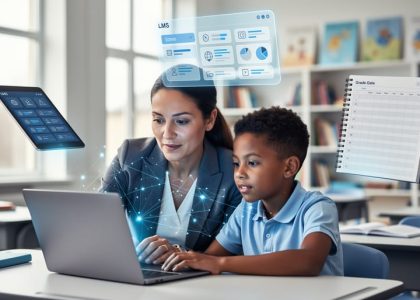
Artificial Intelligence is revolutionizing K-12 classrooms, transforming how students learn and teachers teach in ways previously thought impossible. From personalized learning platforms that adapt to each student’s pace to intelligent tutoring systems that provide real-time feedback, AI tools are creating more engaging, efficient, and equitable educational experiences. Today’s educators have unprecedented opportunities to harness AI’s potential, making learning more accessible and effective for diverse student populations while streamlining administrative tasks that traditionally consumed valuable teaching time.
As we stand at the intersection of education and technology, AI isn’t just another digital tool—it’s becoming an essential partner in modern education. Whether it’s analyzing student performance patterns to identify learning gaps, automating grading processes, or providing individualized practice exercises, AI is empowering teachers to focus more on what matters most: meaningful interactions with students and creative instruction. This transformation isn’t about replacing teachers; it’s about enhancing their capabilities and creating more dynamic, responsive learning environments that prepare students for an increasingly AI-driven world.
The real power of AI in education lies in its ability to democratize personalized learning while maintaining the irreplaceable human elements of teaching. For educators ready to embrace this change, the possibilities are both exciting and boundless.
Personalized Learning Experiences

Adaptive Learning Platforms
Adaptive learning platforms represent one of the most transformative applications of AI in K-12 education. These intelligent systems continuously analyze student performance and automatically adjust the difficulty level, pacing, and content delivery to match each learner’s needs.
When students interact with these platforms, the AI monitors their responses, completion times, and error patterns. This real-time data allows the system to create personalized learning paths that challenge students appropriately without overwhelming them. For instance, if a student excels at basic algebra but struggles with word problems, the platform will provide additional support and practice in problem-solving while maintaining an appropriate pace for computational exercises.
Many of these platforms also offer immediate feedback and alternative explanations when students struggle, preventing frustration and maintaining engagement. Teachers receive detailed insights about student progress, allowing them to identify learning gaps and provide targeted support where needed. This combination of personalized instruction and data-driven insights helps create a more efficient and effective learning environment for all students.
Smart Content Recommendations
AI-powered content recommendation systems are revolutionizing how students access learning materials in K-12 education. These intelligent systems analyze individual student performance, learning patterns, and preferences to suggest personalized educational resources that match their current learning needs and goals.
When a student completes assignments or engages with digital content, the AI tracks their progress and understanding of concepts. Based on this data, it automatically recommends relevant textbooks, videos, interactive exercises, and supplementary materials that can help reinforce learning or challenge students to explore topics further.
For teachers, these smart recommendations save valuable time in curriculum planning by suggesting appropriate teaching resources aligned with learning objectives. The system can identify gaps in student understanding and recommend specific materials to address these areas, enabling more targeted intervention and support.
Many platforms now offer adaptive content libraries that evolve with student progress. For instance, if a student excels in basic algebra but struggles with geometry, the AI will adjust its recommendations to provide more geometry-focused resources while maintaining engagement with algebraic concepts through integrated examples, possibly incorporating techniques from game-based learning to increase engagement.
This personalized approach ensures that each student receives content that’s neither too challenging nor too simple, maintaining optimal engagement and learning outcomes.
Automated Assessment and Feedback

Real-time Progress Monitoring
AI-powered progress monitoring tools are revolutionizing how teachers track and understand student performance in real-time. These systems continuously collect data as students work through assignments, quizzes, and learning activities, providing immediate insights into their understanding and progress.
Teachers can now view detailed dashboards that highlight individual student performance, identify learning gaps, and spot trends across entire classrooms. The AI analyzes multiple data points, including completion rates, time spent on tasks, error patterns, and learning pace, to create comprehensive student profiles.
What makes these tools particularly valuable is their ability to predict potential learning difficulties before they become significant challenges. When a student struggles with specific concepts, the system automatically alerts teachers and suggests personalized intervention strategies. This proactive approach ensures timely support and prevents students from falling behind.
The real-time nature of these monitoring systems also enables teachers to make data-driven decisions about lesson pacing and content delivery. By understanding which concepts need reinforcement and which students require additional support, educators can adjust their teaching strategies on the fly, creating a more responsive and effective learning environment.
Intelligent Grading Systems
Intelligent grading systems powered by AI are revolutionizing how teachers evaluate student work, saving valuable time while providing more detailed feedback. These advanced tools can automatically assess multiple-choice questions, analyze written assignments for grammar and content, and even evaluate mathematical problem-solving steps.
Teachers using these systems report saving an average of 6-8 hours per week on grading tasks, allowing them to focus more on personalized instruction and student interaction. The technology can identify common mistakes across the class, helping educators adjust their teaching strategies to address widespread learning gaps.
These systems also offer consistency in grading and can provide instant feedback to students, supporting their learning journey in real-time. Features like plagiarism detection, rubric-based scoring, and detailed analytics help maintain academic integrity while providing valuable insights into student performance patterns.
Many platforms now integrate with popular learning management systems, making it easy for teachers to implement these tools within their existing workflows. While AI grading assistants aren’t meant to replace teacher judgment, they serve as powerful allies in creating more efficient and effective assessment processes, aligning with strategies seen in how AI transforms K-12 classrooms.
Supporting Special Education

Assistive Technologies
AI-powered assistive technologies are transforming education for students with diverse learning needs, creating more inclusive and accessible classrooms. Text-to-speech and speech-to-text tools help students with visual impairments or dyslexia engage with learning materials more effectively. Smart captioning systems provide real-time transcription for deaf or hard-of-hearing students, ensuring they can fully participate in classroom discussions.
Predictive writing tools assist students with motor skill challenges or learning disabilities by suggesting words and helping with sentence construction. AI-driven screen readers now offer more natural-sounding voices and better comprehension of complex content, including mathematical equations and scientific notation.
For students with attention difficulties, AI tools can adapt content presentation and pacing to maintain engagement. Some platforms use machine learning to identify when students might be struggling and automatically adjust the difficulty level or provide additional support. These technologies not only support learning but also foster independence and confidence among students with disabilities, making education more equitable for all learners.
Personalized Intervention Strategies
AI-powered systems are revolutionizing how we identify and support individual student needs in K-12 education. These intelligent platforms analyze student performance data in real-time, tracking progress across subjects, assignment completion rates, and learning patterns to create detailed learner profiles.
When a student struggles with specific concepts, AI tools can automatically generate customized learning paths and recommend targeted resources. For example, if a student has difficulty with fractions, the system might suggest interactive visual demonstrations, practice problems at the right difficulty level, or game-based learning activities that reinforce the concept.
Teachers receive detailed insights about each student’s learning journey, enabling them to make data-driven decisions about intervention strategies. AI systems can also predict potential academic challenges before they become serious issues, allowing for proactive support. This early warning capability helps educators implement timely interventions, ensuring students receive the help they need when they need it most.
The personalization extends to learning pace, content format, and assessment methods, creating an inclusive environment that accommodates diverse learning styles and needs.
Administrative Support
Attendance and Scheduling
AI-powered attendance and scheduling systems are revolutionizing daily operations in K-12 schools, making administrative tasks more efficient and accurate. Smart attendance systems use facial recognition or digital check-ins to automatically record student presence, saving valuable instruction time and reducing manual data entry errors. These systems can instantly notify parents about their child’s attendance and generate detailed reports for administrators.
Intelligent scheduling tools help schools create optimal class timetables by considering multiple factors such as teacher availability, room capacity, subject requirements, and student needs. These systems can quickly adjust schedules when unexpected changes occur, such as teacher absences or special events, ensuring minimal disruption to learning.
Many platforms also integrate with existing school management systems to provide real-time insights into attendance patterns, helping identify students who may need additional support. This data-driven approach enables early intervention for attendance issues and helps schools maintain accurate records for compliance and planning purposes.
Data-Driven Decision Making
AI analytics tools are revolutionizing how schools approach data-driven decision making, offering unprecedented insights into student performance, engagement, and learning patterns. These tools can process vast amounts of educational data to identify trends, highlight areas needing attention, and suggest targeted interventions for individual students or entire classes.
School administrators can now track attendance patterns, academic performance, and behavioral indicators in real-time, allowing for quick responses to emerging challenges. Teachers receive detailed insights about their students’ learning progress, enabling them to adjust their teaching strategies proactively. The system can even predict potential academic struggles before they become serious issues, allowing for early intervention.
By analyzing historical data alongside current metrics, schools can make informed decisions about resource allocation, curriculum adjustments, and professional development needs. This evidence-based approach helps create more effective learning environments and ensures that educational strategies are continually refined based on actual results rather than assumptions.
Implementation Strategies
Teacher Training
Effective integration of AI in K-12 classrooms requires comprehensive professional development for educators. Teachers need training that goes beyond basic tool familiarization to include pedagogical strategies, ethical considerations, and practical classroom applications.
Professional development should start with foundational AI literacy, helping teachers understand core concepts and capabilities. This knowledge builds confidence and enables educators to make informed decisions about AI implementation in their lessons. Training programs should include hands-on experience with AI tools, collaborative learning opportunities, and ongoing support.
Key areas of focus for teacher training include:
– Assessment of AI tools for educational effectiveness
– Integration of AI into existing curriculum
– Data privacy and ethical considerations
– Differentiated instruction using AI
– Supporting student digital literacy
Schools should adopt a multi-tiered approach to professional development, offering both introductory sessions and advanced workshops. Mentorship programs, where tech-savvy teachers support their colleagues, can create sustainable learning communities within schools.
Regular feedback and reflection sessions help educators share experiences, challenges, and success stories. This collaborative approach ensures continuous improvement and helps identify areas where additional support may be needed. Schools should also provide access to online resources and professional learning networks to support ongoing development.
Choosing the Right Tools
When selecting AI tools for your classroom, start by identifying your specific educational objectives and student needs. Consider tools that align with your curriculum goals and can seamlessly integrate into your existing teaching methods. Look for solutions that offer user-friendly interfaces and clear educational value.
Evaluate the tool’s accessibility features, ensuring it accommodates diverse learning needs and provides multilingual support when necessary. Check for robust privacy and security measures, particularly regarding student data protection. The best AI solutions often include built-in progress tracking and assessment capabilities.
Consider your school’s technical infrastructure and budget constraints. Many quality AI tools offer free versions or educational pricing, making them accessible even with limited resources. Pilot programs can help you test effectiveness before full implementation.
Seek recommendations from fellow educators and review case studies from similar educational settings. Look for tools that provide comprehensive support resources, including training materials and responsive customer service. The most effective AI solutions often foster collaboration between students and teachers while maintaining appropriate oversight.
Remember to regularly evaluate the tool’s impact on student engagement and learning outcomes. The right AI tool should enhance, not replace, your teaching expertise while promoting active student participation and meaningful learning experiences.
Addressing Challenges
While implementing AI in K-12 education offers tremendous potential, educators often face several common challenges. Budget constraints frequently top the list, but schools can address this by starting small with free or low-cost AI tools and gradually expanding their implementation. Many educational technology providers offer scaled pricing models specifically designed for schools.
Technical infrastructure presents another hurdle, particularly in under-resourced districts. Schools can overcome this by conducting thorough assessments of their current capabilities and developing phased implementation plans that align with available resources. Partnering with local businesses or applying for technology grants can help bridge infrastructure gaps.
Teacher training and comfort levels with AI technology remain crucial concerns. Professional development programs, peer mentoring systems, and collaborative learning communities can help build confidence and competency. Many schools find success with a “champion teacher” model, where tech-savvy educators support their colleagues through the transition.
Privacy and data security concerns can be addressed through careful vendor selection, clear policies, and regular communication with parents about data protection measures. By taking a proactive approach to these challenges, schools can create a solid foundation for successful AI integration.
As we look ahead, the integration of AI in K-12 education represents a transformative force that continues to reshape how we teach and learn. The impact is already visible in personalized learning experiences, enhanced administrative efficiency, and improved student engagement across all grade levels. Teachers are finding themselves better equipped to meet individual student needs, while students are developing critical digital literacy skills essential for their future success.
The future outlook is promising, with AI technologies becoming more accessible and user-friendly for educational settings. We can expect to see more adaptive learning platforms, sophisticated assessment tools, and AI-powered tutoring systems becoming standard features in classrooms. These advancements will continue to support teachers rather than replace them, enhancing their ability to deliver high-quality education to diverse student populations.
However, successful implementation requires ongoing commitment from school communities, including professional development for educators, careful consideration of equity and access, and thoughtful integration of AI tools into existing curricula. As we move forward, it’s crucial to maintain a balanced approach that leverages AI’s benefits while preserving the irreplaceable human elements of education.
The journey of AI integration in K-12 education is just beginning. By embracing these technologies thoughtfully and purposefully, schools can create more engaging, effective, and inclusive learning environments that prepare students for the challenges and opportunities of tomorrow.