
Integrate multisensory reading activities into your daily routine by combining visual letter cards with tactile materials like sandpaper letters and auditory phonics drills, allowing dyslexic students to engage multiple pathways simultaneously while building decoding skills. Pair struggling readers with peers for collaborative word-building exercises where students manipulate magnetic letters to form CVC words, then progress to complex patterns, creating a supportive environment that normalizes diverse learning approaches. Implement problem-based learning approaches by designing real-world reading challenges—like decoding recipe instructions for a class cooking project or interpreting maps for a school scavenger hunt—which motivate students through authentic purpose while reducing the anxiety often associated with traditional reading tasks.
Structure your classroom with designated intervention stations where students rotate through targeted activities: a phonological awareness corner with rhyming games, a fluency station with recorded passages for repeated reading practice, and a comprehension zone featuring graphic organizers that help dyslexic learners visualize story elements. Provide assistive technology tools including text-to-speech software, audiobooks, and speech recognition programs that level the playing field, enabling students to access grade-level content while continuing to develop foundational reading skills. Assess progress through frequent, low-stakes check-ins using running records and informal reading inventories rather than high-pressure tests, giving you data to adjust instruction while building student confidence.
Create visual schedules and clearly labeled materials throughout your classroom so students know exactly what to expect and where to find resources, reducing cognitive load and allowing them to focus energy on reading itself. These interventions work best when embedded naturally into your existing framework, benefiting not just dyslexic learners but creating an inclusive environment where all students can thrive.
Understanding Dyslexia Through a Problem-Based Learning Lens

What Makes Dyslexic Learners Unique
Dyslexic learners bring remarkable strengths to your classroom that deserve recognition and nurturing. While dyslexia affects how the brain processes written language—making decoding, spelling, and reading fluency challenging—it often comes with exceptional abilities in creative thinking, problem-solving, and spatial reasoning. These students frequently excel at seeing the big picture, thinking outside the box, and making unique connections that others might miss.
Understanding these strengths transforms how we approach support. Dyslexic learners often thrive when information is presented through multiple pathways—visual, auditory, and hands-on experiences. They benefit from seeing patterns, working with concrete examples, and engaging in activities that connect learning to real-world contexts. This is precisely why problem-based learning approaches work so effectively; they allow students to leverage their natural curiosity and reasoning skills while building literacy competencies in meaningful ways.
Research shows that approximately one in five students has dyslexia, making it the most common learning difference you’ll encounter. Rather than viewing dyslexia as a deficit, consider it a different wiring that requires intentional, structured support paired with opportunities to shine. When you recognize and build upon these students’ innate talents while providing targeted interventions, you create an environment where all learners can succeed. Your awareness and proactive strategies make all the difference in helping dyslexic students develop confidence alongside skills.
Why Interactive Problem-Based Learning Works
Interactive problem-based learning naturally aligns with how many dyslexic students learn best. Rather than relying heavily on text-based instruction, this approach embeds learning within meaningful contexts that activate multiple pathways to understanding.
Students with dyslexia often excel when information connects to real-world situations. Problem-based learning provides this context automatically—whether students are designing solutions to community issues or investigating scientific phenomena, the purpose becomes immediately clear. This relevance reduces cognitive load and helps compensate for decoding difficulties that can make abstract concepts particularly challenging.
The hands-on nature of problem-based activities creates natural opportunities for multi-sensory engagement. Students might build physical models, create visual representations, conduct experiments, or engage in role-play scenarios. These tactile and kinesthetic experiences strengthen memory formation and provide alternative routes to content mastery that don’t depend solely on reading fluency.
Perhaps most importantly, problem-based learning shifts classroom dynamics in ways that benefit dyslexic learners. When students collaborate to solve authentic problems, diverse strengths become visible and valued. The student who struggles with reading comprehension might excel at spatial reasoning, creative thinking, or oral communication. This approach reduces stigma while building confidence, as all students contribute meaningfully to shared goals. Success becomes about problem-solving ability rather than reading speed, creating an inclusive environment where dyslexic students can genuinely thrive.
Practical Problem-Based Interventions for Reading and Decoding
Real-World Reading Challenges
Real-world reading challenges transform abstract decoding practice into meaningful experiences that engage students with dyslexia while building essential literacy skills. These authentic tasks help learners understand why reading matters beyond the classroom.
Recipe following offers an excellent starting point for practical literacy development. Provide students with simple, illustrated recipes they can actually prepare. Visual cues support text comprehension, while the sequential nature reinforces understanding of procedural language. Students practice reading ingredient lists, measuring instructions, and step-by-step directions. Consider partnering students or creating small groups where they can support each other through the process, reducing anxiety and promoting collaborative problem-solving.
Map reading activities develop spatial reasoning alongside decoding skills. Use school maps, neighborhood diagrams, or treasure hunt scenarios where students must interpret written clues and directional language. Start with simplified maps featuring clear labels and progress to more complex materials. This approach helps students see immediate consequences of accurate reading—they find their destination or discover the hidden item—which builds confidence and motivation.
Instruction interpretation tasks bridge classroom learning with everyday situations. Present students with real instructions for assembling simple items, playing new games, or completing craft projects. Break longer instructions into manageable chunks, and encourage students to underline or highlight key action words. Allow time for students to discuss their interpretations before attempting the task, creating opportunities for peer learning and self-correction.
These authentic challenges demonstrate that reading is a practical tool, not just an academic hurdle. When students successfully navigate real-world texts, they develop both competence and confidence in their emerging literacy skills.
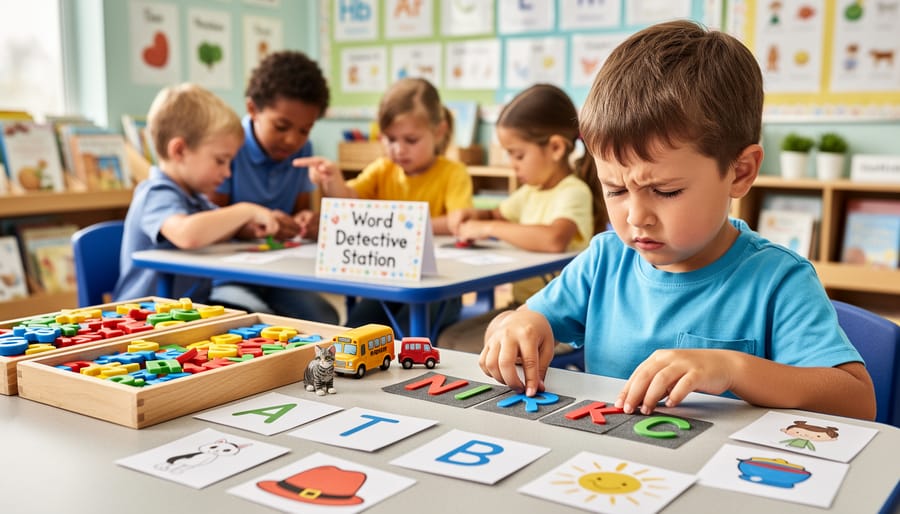
Collaborative Word Detective Activities
Group-based word detective activities transform phonemic awareness practice into engaging, low-stakes learning experiences that benefit students with dyslexia while strengthening the entire classroom community. These collaborative learning strategies shift focus from individual performance to collective problem-solving, significantly reducing the anxiety many struggling readers experience.
Start with pattern hunt partnerships where pairs search for specific phoneme patterns in shared texts. One student acts as the spotter while the other records findings, then they switch roles. This structure ensures equal participation and removes pressure from any single student to perform perfectly. Students with dyslexia often excel at recognizing visual patterns once anxiety decreases, making this approach particularly effective.
Word family detective teams work together to build word chains by changing one phoneme at a time. For example, starting with “cat,” students collaboratively transform it through “bat,” “bit,” “sit,” and beyond. Teams earn points for creating the longest chains, emphasizing persistence over speed. This game-like format celebrates creativity and allows students to contribute at their comfort level.
Sound sorting circles bring small groups together with word cards to categorize by phoneme patterns. Rather than individual desk work, students discuss their reasoning aloud, hear multiple perspectives, and self-correct through peer dialogue. Teachers observe and guide rather than direct, noting which students grasp concepts and which need additional support.
Mystery word challenges present jumbled letters or phoneme clues that teams decode together. The collaborative environment means students share strategies naturally, with stronger decoders modeling approaches without formal instruction. This peer teaching reinforces learning for all participants while building confidence in students who typically struggle.
These activities create supportive learning communities where dyslexic students contribute meaningfully, reducing isolation while systematically building the phonological skills essential for reading success.
Writing and Expression Through Problem-Based Projects
Project-Based Writing Opportunities
Project-based writing opportunities transform written expression from an isolated skill into a meaningful communication tool, which can significantly boost motivation for students with dyslexia. When writing serves a real purpose within a problem-based scenario, students better understand why accuracy and clarity matter.
Consider assigning students the role of classroom journalists documenting a science experiment or community issue. They interview peers, take photographs, and write brief articles for a class newsletter or blog. This authentic task naturally integrates research, organization, and revision while reducing anxiety since the focus remains on communicating important information rather than producing “perfect” writing.
Documentation projects work exceptionally well for hands-on activities. When students build a structure in a design challenge or conduct a math investigation, they create instruction manuals, photo-illustrated guides, or step-by-step tutorials for others to follow. This format allows for multimodal expression—combining visuals, diagrams, and concise text—which plays to the strengths of many dyslexic learners while still building writing skills.
Proposal writing offers another powerful context. Students might draft proposals for playground improvements, book purchases for the library, or solutions to school-wide problems. The persuasive nature of proposals helps students understand audience awareness and the importance of clear communication. Provide graphic organizers and sentence frames to scaffold the process, and encourage peer collaboration during drafting stages.
These authentic scenarios reduce the stigma often associated with writing intervention because all students benefit from purposeful, engaging tasks. When writing addresses real audiences and solves genuine problems, students with dyslexia discover their voices matter.
Scaffolding Written Expression
Students with dyslexia often possess strong verbal communication skills but struggle to transfer their thoughts into written form. You can bridge this gap through strategic scaffolding that reduces anxiety and builds confidence during writing tasks.
Graphic organizers serve as powerful visual frameworks that help students structure their ideas before writing. Story maps, Venn diagrams, and sequence charts transform abstract writing requirements into concrete, manageable steps. These tools work especially well within problem-based learning scenarios where students need to organize research findings or plan collaborative presentations. Many students find that visual planning reduces the cognitive load of simultaneous idea generation and sentence construction.
Speech-to-text technology offers immediate support for students who think faster than they can write. Tools like Google Docs voice typing or specialized applications allow learners to capture their ideas fluently, then focus on editing and refinement as separate tasks. This approach honors their intellectual capabilities while accommodating processing differences. Introduce these tools gradually and normalize their use across your classroom so students view them as standard learning resources rather than special accommodations.
Collaborative writing partnerships create natural peer support systems. When tackling problem-based projects, pair students strategically so they can share writing responsibilities based on individual strengths. One student might excel at brainstorming solutions while another handles transcription. Rotate these roles regularly to build diverse skills.
Sentence starters and writing templates provide additional scaffolding without limiting creativity. These frameworks guide students through complex writing tasks while allowing personal expression. Remember that scaffolds should gradually fade as students gain independence, always maintaining the balance between support and challenge.
Multi-Sensory Problem-Based Learning Stations
Designing Effective Stations
Creating successful stations begins with identifying specific skill areas where your students need support—decoding, fluency, comprehension, or vocabulary. Design each station around a concrete problem or challenge that requires students to apply these skills in meaningful ways.
Start with 4-6 stations that incorporate multi-sensory approaches. For example, a decoding station might include letter tiles, sand trays for tracing, and audio recordings. A comprehension station could feature graphic organizers, partner discussion prompts, and manipulatives for sequencing events.
Ensure each station includes clear task cards with visual supports and step-by-step directions. Build in choice where possible—students might select between creating a word map, recording themselves reading, or building words with magnetic letters, all targeting the same learning objective.
Plan for 15-20 minute rotations and include self-checking mechanisms so students receive immediate feedback. Color-code materials by difficulty level, allowing students to challenge themselves appropriately without drawing attention to different ability levels.
Keep materials organized in labeled bins with picture cues, and establish consistent routines for transitioning between stations. Test your stations with a small group first, gathering student feedback to refine instructions and ensure activities truly engage learners in problem-solving rather than just completion of tasks.
Station Examples Across Grade Levels
At the elementary level, design mystery word stations where students decode clues using phonics patterns to solve simple problems, such as figuring out which spelling strategy helps unlock a treasure chest scenario. Incorporate multisensory materials like sandpaper letters and manipulatives that make abstract concepts tangible.
Middle school stations benefit from real-world problem scenarios. Create a journalism station where students decode eyewitness accounts with challenging vocabulary to solve a historical mystery, or establish a science station requiring students to read procedural texts and follow multi-step directions to complete an experiment. These contexts reduce anxiety by shifting focus from reading struggles to problem-solving success.
High school stations should emphasize authentic applications. Set up a career exploration station where students analyze workplace documents with embedded supports like text-to-speech, highlighting tools, or graphic organizers. Another effective station involves collaborative case studies where students research current events, with each team member contributing according to their strengths while practicing targeted reading strategies.
Across all grade levels, ensure stations include choice in how students demonstrate understanding—through verbal explanations, diagrams, recordings, or written responses. This flexibility honors diverse learning profiles while maintaining high expectations. Rotate students through stations based on skill needs rather than ability grouping, promoting an inclusive environment where everyone engages in meaningful problem-solving.
Leveraging Technology and Interactive Tools
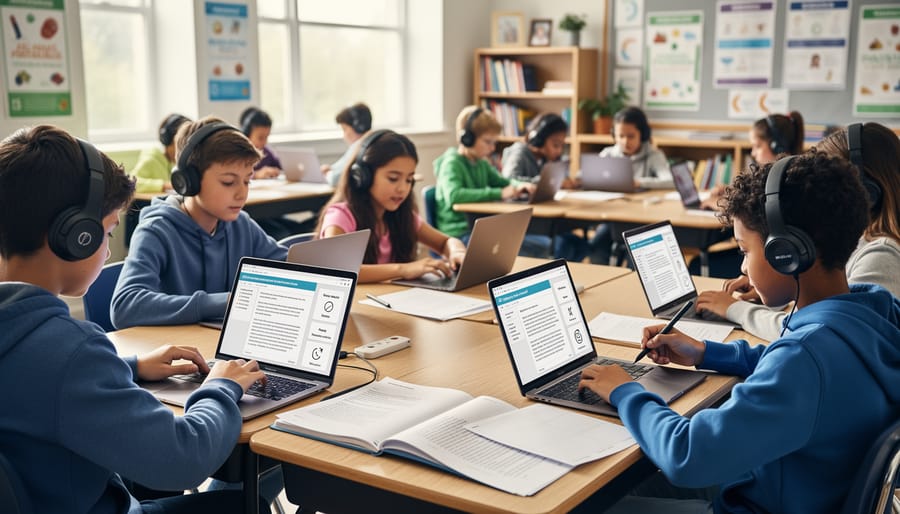
Technology has become an invaluable ally in supporting students with dyslexia, particularly when integrated into problem-based learning activities. Interactive digital tools can level the playing field, allowing dyslexic learners to engage fully in complex problem-solving tasks alongside their peers.
Text-to-speech software removes barriers to content access, enabling students to focus on critical thinking and problem-solving rather than struggling with decoding. Tools like Immersive Reader, Natural Reader, or built-in accessibility features on tablets allow students to listen to research materials, case study descriptions, or project requirements. This ensures they can participate meaningfully in group investigations without falling behind due to reading difficulties.
Interactive simulations and visual learning platforms bring abstract concepts to life in ways that particularly benefit dyslexic learners. Tools such as PhET simulations for science problems or virtual manipulatives for mathematics allow students to experiment and explore solutions through hands-on digital experiences. These platforms support the multisensory approach that research shows is effective for dyslexic students.
Collaborative platforms like Google Workspace, Padlet, or Flipgrid create opportunities for students to contribute their ideas through multiple formats. Students can record video responses, create visual presentations, or use voice typing to document their problem-solving process. This flexibility ensures that dyslexia doesn’t limit their ability to showcase understanding or contribute to team projects.
When integrating these tools, start small by introducing one technology at a time and providing clear tutorials. Create a classroom culture where assistive technology is normalized for all students, not stigmatized as remedial. Designate tech-savvy students as peer mentors to support classmates learning new tools. Remember that the technology should enhance the problem-based learning experience, not complicate it. Choose tools that genuinely support your learning objectives and are accessible within your school’s resources. With thoughtful integration, technology becomes a powerful enabler of inclusive, engaging dyslexia interventions.
Assessment and Progress Monitoring in Problem-Based Interventions
Measuring progress in problem-based dyslexia interventions requires flexible approaches that capture both academic growth and problem-solving development. Traditional testing often misses the authentic gains students make when engaged in meaningful learning contexts, so educators need assessment methods that reflect real-world literacy applications.
Formative assessment strategies work particularly well in problem-based settings because they provide ongoing feedback without disrupting the learning flow. Try embedding quick checks throughout project phases: have students explain their decoding strategies when researching community issues, or ask them to reflect on which word-attack skills helped them understand complex texts. These informal conversations reveal understanding better than isolated tests.
Observation becomes your most powerful tool. Create a simple tracking system noting when students independently apply phonics patterns, demonstrate improved fluency during presentations, or successfully tackle grade-level texts within project work. Focus on qualitative shifts like increased confidence, willingness to attempt challenging words, or improved self-correction habits alongside quantitative measures.
Documentation should honor each student’s unique pathway. Digital portfolios work wonderfully, allowing students to collect video reflections, annotated project samples, and before-and-after reading recordings. This creates a narrative of growth that celebrates incremental progress rather than comparing students to fixed benchmarks.
Consider using project rubrics that include literacy-specific criteria alongside content knowledge. For example, when students create community awareness presentations, assess both research quality and reading skills demonstrated: ability to decode multisyllabic words, reading comprehension of source materials, and application of vocabulary strategies.
Involve students in self-assessment through reflection prompts: What reading strategies helped you today? Which words were hardest and how did you figure them out? This metacognitive awareness accelerates progress while building ownership.
Remember that progress in problem-based contexts often appears nonlinear. Students might struggle with isolated phonics drills yet successfully decode similar patterns when motivated by authentic purposes. Your assessment should capture this authentic application, providing evidence that validates both student effort and your instructional approach.

Building a Supportive Classroom Community
Creating a classroom where every student feels valued begins with intentionally celebrating diverse thinking styles. Problem-based learning naturally supports this goal by offering multiple pathways to solutions, allowing students with dyslexia to contribute their often exceptional visual-spatial reasoning, creative problem-solving, and big-picture thinking abilities. When classmates witness these strengths in action during collaborative projects, they develop genuine appreciation for different approaches to learning.
Establish peer support structures that normalize asking for help and offering assistance. Partner students strategically during problem-based activities, pairing different strengths rather than ability levels. A student with strong reading skills might handle text-heavy research while a student with dyslexia contributes innovative design solutions or oral presentations. Rotate partnerships regularly so all students experience being both expert and learner, breaking down fixed mindsets about who is “smart” in your classroom.
Reduce stigma by openly discussing how everyone’s brain works differently, using age-appropriate examples from science and real-world achievers with dyslexia. Frame accommodations as smart tools that help people work efficiently, not as special treatment. When students use text-to-speech software or graphic organizers during problem-based projects, present these as options available to anyone who finds them helpful.
Create interactive opportunities for students to share their learning processes through community forums or classroom discussions. Ask students to explain not just what they discovered, but how they figured it out. This metacognitive practice helps all learners recognize that there are many valid paths to understanding, building empathy and reducing comparison-based anxiety.
Model inclusive language consistently, focusing on challenges students are working through rather than deficits they possess. Your supportive tone sets the standard for how students treat one another, transforming your classroom into a true learning community.
Getting Started: Your Action Plan
You don’t need to transform your entire teaching practice overnight. The most successful implementation of dyslexia interventions begins with a single, manageable step that builds your confidence and demonstrates results to your students.
Start by selecting one problem-based strategy from this article that resonates with your teaching style and current classroom dynamics. Perhaps it’s the community mapping project for younger students or the business pitch simulation for older learners. Implement this strategy with a small group first, even just three to five students. This allows you to refine your approach, troubleshoot challenges, and witness firsthand how problem-based learning engages students with dyslexia differently than traditional methods.
As you gain confidence, gradually expand your implementation. Add a second strategy to your repertoire, then integrate these approaches more broadly across your classroom. Remember that problem-based interventions benefit all learners, so you’re not creating separate instruction but rather making your teaching more universally accessible.
Collaboration amplifies your success. Connect with your school’s reading specialist, special education coordinator, or educational psychologist to share observations and refine strategies. These specialists can provide valuable insights into individual student profiles and help you customize interventions for maximum impact. Schedule brief check-ins rather than formal meetings—even ten-minute conversations during planning periods can make a significant difference.
You’re not alone in this journey. Join educator forums and online communities specifically focused on dyslexia support and problem-based learning. These platforms offer real-time advice, lesson plan ideas, and emotional support from teachers facing similar challenges. Many districts also provide professional learning communities where you can collaborate locally with colleagues implementing similar interventions.
Track your progress simply. Note which strategies work best for different students, what modifications prove most effective, and how student engagement evolves over time. This reflection not only improves your practice but also provides concrete evidence of impact when discussing student progress with families and administrators.
Begin tomorrow with one small change. Your willingness to adapt and grow creates transformative opportunities for students who learn differently.
You’ve taken an important step by exploring how problem-based approaches can transform dyslexia interventions in your classroom. The strategies outlined in this article aren’t just theoretical concepts—they’re practical tools that make learning more engaging and effective for students with dyslexia while benefiting your entire classroom community.
The beauty of problem-based learning is that it naturally reduces stigma by positioning all students as collaborative problem-solvers. When you embed reading and writing practice within authentic challenges, students with dyslexia develop skills without feeling singled out or different from their peers.
Starting can feel overwhelming, so choose just one strategy that resonates with your teaching style and classroom needs. Perhaps it’s introducing weekly mystery scenarios that require students to decode clues, or maybe it’s establishing a collaborative project where students research solutions to real community issues. Small, consistent steps create meaningful change.
Remember, you’re not alone in this journey. Our platform offers interactive tools designed specifically for implementing problem-based dyslexia interventions, allowing you to customize activities for your students’ unique needs. Connect with fellow educators in our community forums to share successes, troubleshoot challenges, and discover new approaches that work in real classrooms just like yours.
Every student deserves the opportunity to see themselves as capable learners. By implementing these evidence-informed, problem-based interventions, you’re not just teaching reading skills—you’re building confidence, resilience, and a genuine love of learning. Your commitment to supporting students with dyslexia creates ripples of positive impact that extend far beyond the classroom walls.