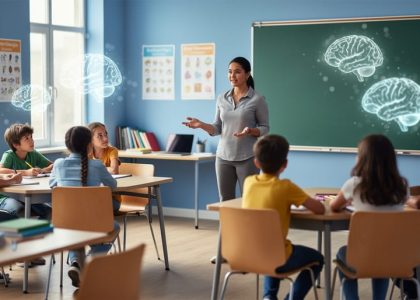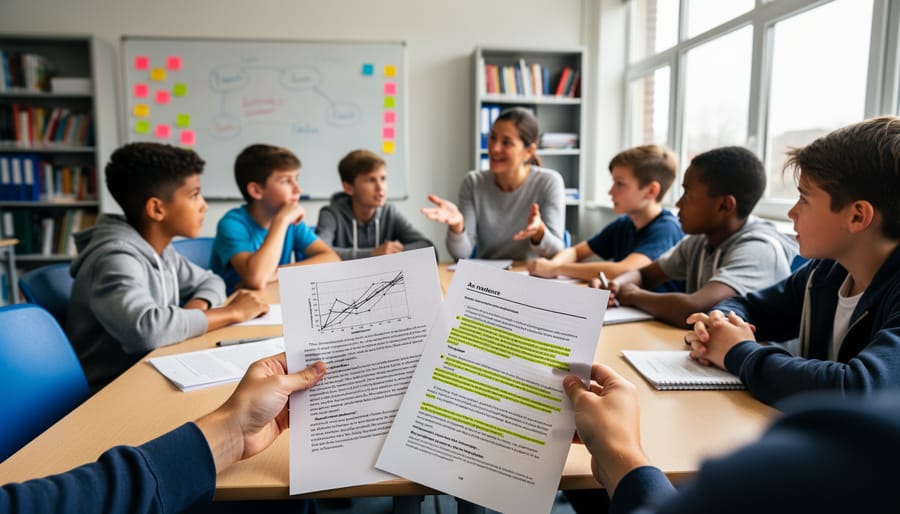
Ask students to defend not just what they think, but why they trust their sources of knowledge. When a middle schooler claims “everyone knows that,” push them to identify where “everyone” learned this information and whether those sources are equally reliable. This simple shift transforms passive critical thinking development into active epistemic awareness—the understanding that knowledge itself has quality levels, origins, and limitations.
Design classroom debates where the objective isn’t winning arguments, but evaluating which types of evidence carry more weight in different contexts. Have students rank evidence from personal anecdotes, expert testimony, peer-reviewed studies, and social media posts, then justify their rankings. This makes visible the invisible thinking processes students use to determine what’s true.
Create “knowledge source journals” where students track one claim across multiple sources over a week, documenting how their confidence in that claim changes as they encounter conflicting information, varying expertise levels, and different methodological approaches. This practice builds metacognitive skills that transfer across every subject area.
Model your own epistemic reasoning aloud during instruction. When presenting information, occasionally pause to explain why you trust particular textbooks over others, how you distinguish strong research from weak studies, or when you recognize the limits of your own expertise. Students rarely see adults wrestling with knowledge uncertainties, yet this transparency teaches them that sophisticated thinkers question their own certainty.
Epistemic cognition—how students think about the nature and justification of knowledge—directly determines whether your critical thinking instruction produces lasting change or temporary compliance. When students believe knowledge comes from authority figures and correct answers live in the back of textbooks, even well-designed critical thinking activities become exercises in guessing what teachers want to hear. But when students recognize that knowledge is constructed, evidence varies in quality, and expertise develops through disciplined inquiry, they become genuinely curious investigators rather than passive receivers.
The research is clear: students with sophisticated epistemic beliefs demonstrate stronger analytical skills, more persistent problem-solving, and greater academic resilience. Yet most curriculum skips this foundation entirely, jumping straight to critical thinking skills without addressing students’ fundamental beliefs about what makes something worth knowing.
What Epistemic Cognition Actually Means for Your Classroom
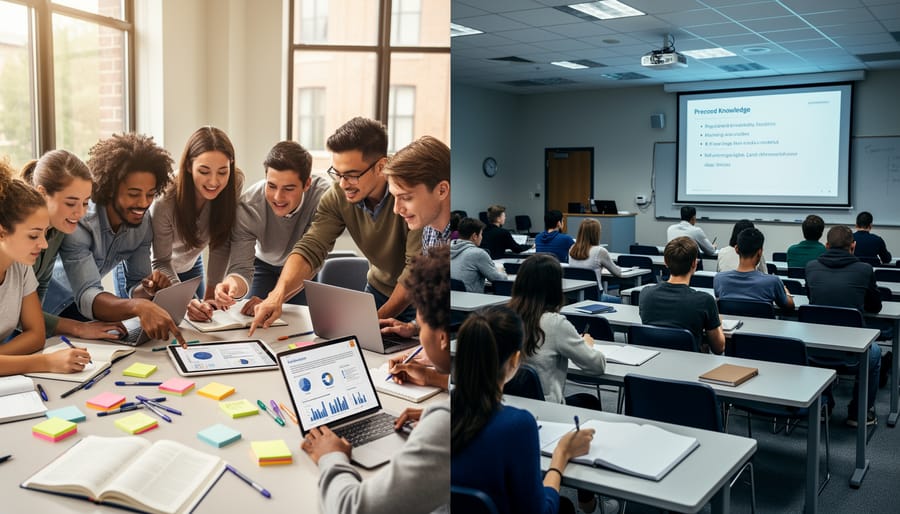
The Three Core Components Teachers Need to Know
Understanding epistemic cognition becomes much more manageable when you break it down into three core components that directly influence how your students approach learning every day.
The first component is beliefs about the certainty of knowledge. This refers to whether students view knowledge as fixed and absolute or as evolving and provisional. In your classroom, you’ll notice this when a student insists there’s only one right answer to an open-ended question or struggles when new information challenges what they previously learned. Students with more sophisticated beliefs recognize that knowledge can change as we gather new evidence, making them more adaptable learners.
The second component involves beliefs about the simplicity or complexity of knowledge. Some students see knowledge as isolated facts to memorize, while others understand that ideas connect in intricate ways. You might observe this when students ask surface-level questions versus those who explore relationships between concepts. A student who believes knowledge is simple might memorize a formula without understanding its applications, whereas one who appreciates complexity seeks deeper connections across subjects.
The third component centers on beliefs about the sources of knowledge. Where do students think knowledge comes from? Is it only from teachers and textbooks, or can it emerge from personal investigation, peer collaboration, and critical analysis? Watch for students who constantly ask “Is this right?” versus those who explain their reasoning and evaluate information independently.
These three components work together to shape how students engage with critical thinking tasks. When students believe knowledge is certain, simple, and comes only from authority figures, they’re less likely to question, analyze, or think deeply. Conversely, recognizing knowledge as uncertain, complex, and derived from multiple sources opens the door to genuine critical thinking. Understanding these components helps you identify specific areas where your students need support.
How It Shows Up in Different Grade Levels
Understanding how epistemic cognition develops helps you meet students where they are and guide them forward effectively.
In elementary grades (K-5), students typically view knowledge as concrete facts provided by trusted authorities like teachers and parents. A third-grader might say, “It’s true because my teacher said so,” or struggle to understand that scientists sometimes disagree. At this stage, incorporating age-appropriate critical thinking techniques means introducing simple comparisons between sources and acknowledging that people can have different perspectives on the same event.
Middle school students (grades 6-8) begin recognizing that knowledge can be uncertain and that experts sometimes disagree. However, they often swing to the opposite extreme, thinking all opinions are equally valid. You might hear, “That’s just your opinion” or “Everyone’s answer could be right.” This is a natural developmental phase where students need guidance distinguishing between evidence-based claims and unsupported opinions.
High school students (grades 9-12) can develop more sophisticated understanding, recognizing that while knowledge involves interpretation, some claims have stronger evidence than others. They’re ready to evaluate sources critically, understand how knowledge is constructed in different disciplines, and build reasoned arguments. Your role becomes facilitating deeper inquiry and helping them navigate complexity with discernment.
The Connection Between Epistemic Cognition and Critical Thinking Skills
When Students Think Knowledge Is Fixed vs. Constructed
When you observe students who view knowledge as fixed, you’ll notice distinct patterns in how they approach learning. These students tend to focus heavily on memorization and right-or-wrong answers. In a history class, they might insist there’s only one interpretation of a historical event, becoming frustrated when presented with conflicting primary sources. During science lessons, they may struggle with inquiry-based activities because they expect you to simply tell them the correct answer rather than guiding them through discovery.
In contrast, students who understand knowledge as constructed engage differently with learning. They ask questions like “How do we know this?” and “What evidence supports this conclusion?” In mathematics, rather than just memorizing formulas, they explore why mathematical principles work and consider multiple problem-solving approaches. During literature discussions, they naturally compare different interpretations of a text and build on each other’s ideas.
The learning outcomes differ significantly too. Students with fixed knowledge beliefs often perform well on recall-based tests but struggle with transfer tasks and real-world application. They may become discouraged when faced with complex, open-ended problems. Meanwhile, students who see knowledge as constructed typically demonstrate stronger critical thinking skills, adapt better to new situations, and show greater resilience when learning becomes challenging.
This distinction matters because you can actively help students shift from fixed to constructivist thinking through intentional instructional practices. Small changes in how you frame questions and assignments can make a meaningful difference in developing their epistemic understanding.
Why Some Students Question Everything (And Others Accept Anything)
Students arrive in our classrooms with vastly different beliefs about knowledge itself. These underlying beliefs, called epistemic cognition, shape how they approach learning and critical thinking. Some students view knowledge as certain and absolute, delivered by authorities like teachers or textbooks. These learners tend to accept information at face value, rarely questioning what they’re told. Others understand that knowledge can be uncertain, constructed through evidence and reasoning. These students naturally evaluate sources and claims, ask probing questions, and engage in deeper analysis.
This variation isn’t about intelligence or motivation. Research shows that epistemic cognition develops progressively, influenced by age, experience, and instruction. Younger students typically hold simpler views about knowledge, while adolescents can develop more sophisticated perspectives when supported appropriately. The encouraging news? These foundational beliefs aren’t fixed. When you create classroom environments that model uncertainty, encourage questioning, and demonstrate how knowledge is constructed through evidence, you help all students develop more advanced epistemic thinking. This shift transforms passive receivers into active, critical thinkers who can navigate complex information independently.
Practical Strategies to Develop Epistemic Cognition in Your Students
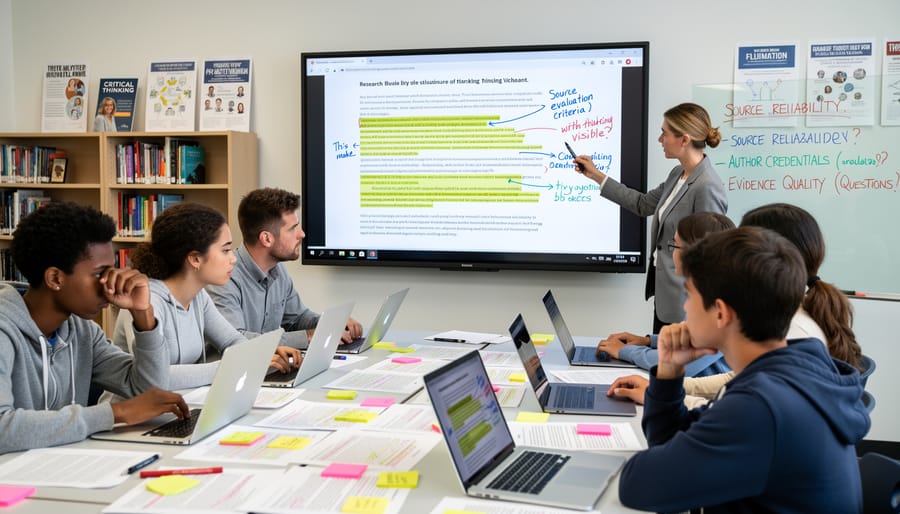
Model Your Own Thinking About Knowledge
Your students learn how to think about knowledge by watching how you think about knowledge. Making your epistemic reasoning visible transforms abstract critical thinking into observable practice.
Start with think-alouds during lessons. When presenting new information, verbalize your thought process: “I’m checking who published this study because the source helps me determine reliability” or “I’m noticing this claim contradicts what we learned yesterday, so I need to investigate further.” This demonstrates that knowledge evaluation is an active, ongoing process.
Embrace uncertainty authentically. Instead of presenting yourself as the all-knowing expert, say “I’m not sure about this—let’s examine the evidence together” or “I used to think differently about this topic until I encountered new research.” Students need to see that revising beliefs based on evidence is a strength, not a weakness.
Model source evaluation in real-time. When you encounter conflicting information, show students how you compare sources, check credentials, and look for supporting evidence. This pairs naturally with metacognitive strategies where students reflect on their own thinking processes.
Create opportunities for collaborative evaluation. When students ask questions you can’t immediately answer, investigate together. Search for sources, discuss how you determine credibility, and demonstrate how you construct understanding from multiple perspectives. This transparency builds trust while teaching essential epistemic skills.
Create Opportunities for Knowledge Construction
When students actively construct knowledge rather than simply receive it, their epistemic cognition flourishes naturally. The key is designing experiences where students must grapple with real questions, evaluate evidence, and build understanding through exploration.
Inquiry-based learning transforms your classroom into a space for genuine discovery. Instead of presenting conclusions first, pose authentic questions that spark curiosity. For example, rather than explaining why civilizations developed near rivers, provide maps, artifacts, and primary sources, then ask students to investigate patterns and develop their own explanations. This process helps students understand that knowledge comes from systematic investigation, not just authority.
Collaborative problem-solving pushes epistemic development even further. When students work together on complex challenges, they encounter different perspectives and must justify their reasoning to peers. Set up group projects where there’s no single correct answer—designing solutions to local environmental issues or analyzing multiple historical interpretations of the same event. These experiences teach students that knowledge is often constructed through dialogue and that conflicting viewpoints can lead to deeper understanding.
Authentic research experiences, scaled appropriately for your grade level, give students ownership of the learning process. Elementary students might conduct simple surveys and analyze results. Middle schoolers could design experiments to test real-world questions. High schoolers might contribute to citizen science projects or investigate community issues using research methods.
The shift from passive to active learning requires patience and scaffolding, but the payoff is significant. Students develop confidence in their ability to generate knowledge and begin viewing themselves as capable thinkers rather than information receivers.
Use Strategic Questioning Techniques
The right questions can transform your classroom into a space where students actively examine how knowledge is constructed. Rather than asking students what they think, try questions that probe why and how they’ve reached their conclusions.
Start with discipline-specific prompts that reveal epistemic differences. In science class, ask “How would we test whether this is true?” In history, try “Who created this source, and what might they have wanted us to believe?” For literature, consider “Can there be more than one valid interpretation of this passage? Why or why not?”
Cross-curricular questioning frameworks work beautifully too. The Evidence Chain helps students trace their reasoning: “What evidence supports this? Where did that evidence come from? How reliable is that source?” This simple sequence works across subjects and grade levels.
Try the Perspective Shift technique by asking “How might someone from a different background or time period view this information differently?” This challenges students to recognize that knowledge isn’t neutral or universal.
The Certainty Scale encourages metacognition about confidence levels: “On a scale of 1-10, how certain are you about this answer? What would make you more certain?” This helps students distinguish between opinion, belief, and justified knowledge.
Remember, these questions shouldn’t feel like interrogations. Frame them with genuine curiosity, creating a classroom culture where questioning how we know becomes as natural as sharing what we know.
Subject-Specific Applications Across the Curriculum
Mathematics: Beyond Getting the Right Answer
Mathematics offers a powerful context for developing epistemic cognition when students learn to view it as reasoning rather than memorization. Instead of presenting math as a collection of fixed procedures with single correct answers, encourage students to explore multiple solution paths to the same problem. When a student solves an equation, ask them to find at least two different approaches, then discuss which method they prefer and why. This helps students understand that mathematical knowledge is constructed through logical reasoning.
Create opportunities for mathematical argumentation by having students explain their thinking to peers. Use sentence frames like “I solved this by…” or “This strategy works because…” to support their explanations. When students present different solutions, guide the class in comparing approaches rather than simply identifying which is “right.” This shifts the focus from answer-getting to understanding the reasoning process.
Incorporate open-ended problems that have multiple valid solutions or approaches. For example, “How many ways can you arrange 12 items into equal groups?” encourages exploration rather than applying a memorized formula. Display student work showing various strategies, celebrating diverse thinking. Use community forums where educators share successful problem sets and discussion prompts. These practices help students recognize that mathematical understanding develops through exploration, justification, and collaborative sense-making, building stronger critical thinking skills.
Science: Developing Understanding of Scientific Evidence
Science classrooms offer rich opportunities for students to develop sophisticated understanding of how knowledge itself is created and validated. Rather than simply memorizing scientific facts, students can learn to think like scientists by engaging with the processes that generate scientific knowledge.
Start by having students work with competing hypotheses for real phenomena. When introducing a new topic, present two or three plausible explanations and ask students to consider what evidence would support or challenge each one. This helps them understand that scientific knowledge isn’t arbitrary—it’s built through systematic testing and reasoning.
Analyzing experimental design strengthens students’ ability to evaluate evidence quality. Guide students to identify variables, consider sample sizes, and recognize potential biases in studies. Even elementary students can compare two simple experiments and discuss which provides stronger evidence. As students progress, they can critique published research or design their own investigations.
Create opportunities for students to experience how scientific knowledge evolves. Have them examine historical cases where scientific understanding shifted, such as theories about disease transmission or planetary motion. This demonstrates that revision isn’t a weakness of science—it’s a strength that reflects our growing understanding.
Encourage students to distinguish between correlation and causation, recognize limitations in data, and understand that scientific certainty exists on a spectrum. These thinking patterns transfer across disciplines, building the critical reasoning skills your students need for informed decision-making in all areas of life.
Social Studies and Language Arts: Navigating Multiple Perspectives
Social studies and language arts offer rich opportunities to develop sophisticated epistemic cognition. These subjects naturally involve multiple perspectives and interpretations, making them ideal for teaching students that knowledge isn’t always black and white.
Start by making the interpretive process visible. When analyzing historical events, explicitly discuss how historians use evidence to build arguments. Ask students: “What sources did the author use? What perspectives might be missing?” This helps them understand that historical narratives are constructed from available evidence, not simply discovered facts.
Use primary source comparisons to highlight how different observers can report the same event differently. For example, comparing newspaper accounts from different regions during the same historical period shows students how context shapes interpretation. This exercise demonstrates that multiple valid viewpoints can coexist while still requiring evidence-based reasoning.
In literature discussions, embrace ambiguity while maintaining rigor. Questions like “How did you arrive at that interpretation?” and “What textual evidence supports your reading?” teach students that interpretations vary, but strong arguments require supporting evidence. Create space for disagreement by establishing classroom norms where students respond to each other’s interpretations with curiosity rather than judgment.
Develop comparison charts where students evaluate the strength of different interpretations based on evidence quality, logical consistency, and comprehensiveness. This reinforces that while perspectives differ, not all interpretations are equally valid—a crucial epistemic understanding for critical thinking.
Overcoming Common Challenges

When Students Resist Uncertainty
When students encounter ambiguity in their learning, some may feel anxious or frustrated. This resistance is normal—many have been conditioned to expect single right answers. Your role is to help them develop comfort with complexity gradually.
Start by acknowledging their feelings. Let students know that uncertainty can feel uncomfortable, and that’s okay. Share examples of real-world problems that don’t have simple solutions, helping them see that ambiguity is a natural part of learning.
Scaffold their experience with uncertainty through structured activities. Begin with low-stakes scenarios where multiple perspectives are clearly valid—like analyzing characters’ motivations in a story. Use sentence stems such as “One way to think about this is…” or “The evidence suggests…” to model how experts navigate uncertain terrain.
Create a classroom culture that celebrates productive struggle. When students ask “Is this the right answer?” respond with questions: “What makes you think that?” or “What evidence supports your thinking?” This shifts focus from seeking validation to building reasoning skills.
Gradually increase complexity as students grow more comfortable. Move from situations with two clear viewpoints to those with multiple nuanced perspectives. Provide frameworks like comparison charts or decision matrices that help students organize competing information without forcing premature conclusions.
Remember, building tolerance for ambiguity takes time. Celebrate small victories when students embrace complexity rather than shutting down. This patience pays dividends in developing deeper, more flexible thinkers.
Balancing Standards and Epistemic Development
You don’t have to choose between meeting standards and developing deeper thinking skills. The most effective approach integrates epistemic cognition into your existing curriculum rather than treating it as an add-on.
Start by identifying natural connection points. When teaching any content area, pause to ask students why we know what we know about the topic. During a science lesson on ecosystems, for example, you might ask: “How do scientists gather evidence about food chains? What makes their conclusions trustworthy?” These brief moments build metacognitive awareness without sacrificing content coverage.
Standardized test preparation actually offers rich opportunities for epistemic development. Rather than simply drilling answer choices, engage students in analyzing how test questions are constructed and what kinds of evidence support different answers. This approach helps students perform better while strengthening their reasoning abilities.
Consider embedding epistemic prompts into regular assignments. When students read a text, ask them to evaluate the author’s evidence and perspective. During problem-solving activities, have them explain not just their answer but how they know it’s correct.
The key is consistency over intensity. Brief, regular attention to how we know builds stronger epistemic habits than occasional deep dives. Your students will develop critical thinking skills that transfer across subjects while still mastering the content and skills your curriculum requires. Small shifts in questioning and discussion patterns create meaningful change over time.
Developing epistemic cognition in your students is a journey, not a destination. The strategies we’ve explored throughout this article represent pathways to transform how your students think about knowledge itself—helping them move beyond simply accepting information to thoughtfully evaluating sources, recognizing biases, and constructing well-reasoned arguments. This transformation doesn’t happen overnight, and that’s perfectly okay.
The most sustainable approach is to start small. Choose one or two strategies that resonate with your teaching style and subject area. Perhaps you’ll begin by incorporating think-alouds to model your own reasoning process, or maybe you’ll introduce question stems that encourage students to examine evidence more carefully. As these practices become natural parts of your classroom routine, you can gradually layer in additional approaches. Remember, even small, consistent efforts create meaningful change in how students engage with information and ideas.
The impact of this work extends far beyond test scores or immediate academic outcomes. Students who develop stronger epistemic cognition become more discerning consumers of information, better problem-solvers, and more engaged citizens. In our current information-rich environment, these skills are invaluable. You’re not just teaching content; you’re equipping students with thinking tools they’ll use throughout their lives.
You don’t have to navigate this journey alone. Our platform offers interactive tools designed to support your implementation of these strategies, along with community forums where you can connect with fellow educators, share successes, troubleshoot challenges, and discover new approaches. These resources exist to support you as you take on this important work. Your commitment to developing your students’ epistemic cognition is an investment in their future—and it starts with the very next lesson you teach.