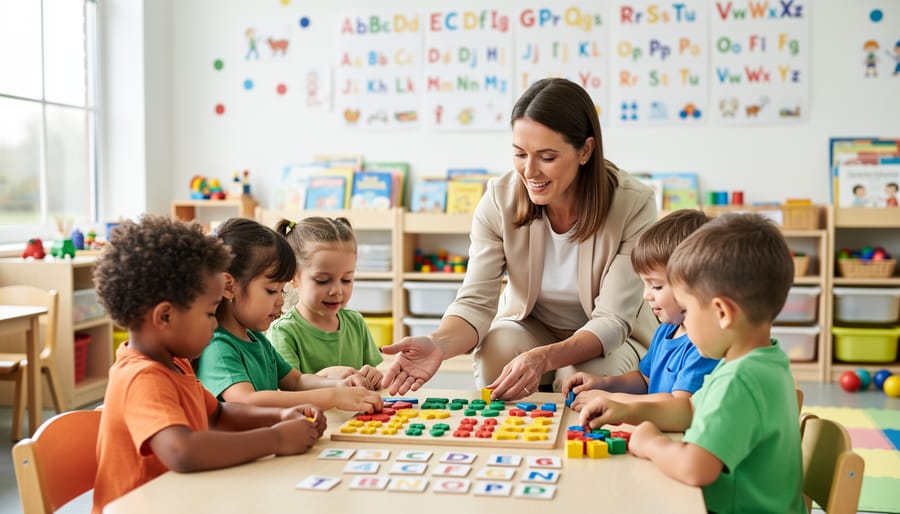
Kindergarten teacher professional development in game-based pedagogy is a structured process that transforms how you design and facilitate learning through play typically requiring three to six months of consistent practice and reflection to build competency. The core method combines self-directed experimentation with collaborative peer learning, allowing you to gradually integrate play-based strategies while honoring the developmental realities of five- and six-year-old learners.
The unique challenge of early childhood education means generic professional development rarely fits. Young children learn best through hands-on exploration, brief activity cycles, and authentic social interaction. Your professional growth needs to mirror these same principles. Rather than sitting through lecture-heavy workshops disconnected from your classroom, effective development happens when you test small game elements with your students, observe what works, and adjust based on real responses.
This approach respects where you are right now. Whether you’re just beginning to explore game-based methods or you’ve already experimented with centers and wonder how to deepen engagement, the pathway forward involves deliberate practice paired with support from others doing similar work. You’ll learn to recognize which game mechanics match your students’ attention spans, how to embed learning objectives without sacrificing joy, and when to step back so children can lead their own discovery. The goal isn’t perfection but consistent, manageable progress that genuinely improves how your kindergarteners experience school each day.
What You’ll Need to Get Started
Getting started with game-based pedagogy requires surprisingly little upfront investment, but a few essential resources will set you up for success. The core components fall into five categories: learning tools, planning materials, assessment frameworks, professional resources, and community connections.
Essential Tools and Materials
- Digital platforms: One device (computer or tablet) for exploring online educational games and participating in virtual professional learning communities
- Physical game materials: A collection of manipulatives, dice, cards, timers, and basic art supplies for creating classroom games
- Planning tools: A notebook or digital document system for lesson design, reflection notes, and student observation records
- Assessment materials: Simple observation checklists, photo/video capture capability (even just a smartphone), and a portfolio system for documenting student progress
- Curriculum resources: Access to your district’s kindergarten standards and at least one guide connecting games to early learning objectives
Many effective game-based resources cost nothing. Free platforms like PBS Kids and Starfall offer quality educational games aligned with kindergarten standards. You can build games yourself using cardboard, recycled materials, and printable templates available through teacher networks. A simple memory matching game or movement-based counting activity requires only paper, scissors, and creativity.
For community support, identify at least one colleague interested in exploring game-based learning alongside you. This peer partnership matters more than expensive materials. Professional learning communities thrive on shared experimentation, so a willing collaborator who teaches kindergarten creates accountability and fresh perspectives. If your school doesn’t have an existing group focused on play-based pedagogy, online forums and social media groups connect you with kindergarten teachers nationwide who are navigating similar challenges.
Budget-conscious teachers should prioritize versatile materials over specialized products. A set of colored counters serves dozens of game variations, while one-purpose items gather dust after a single lesson.
Important Considerations Before You Begin
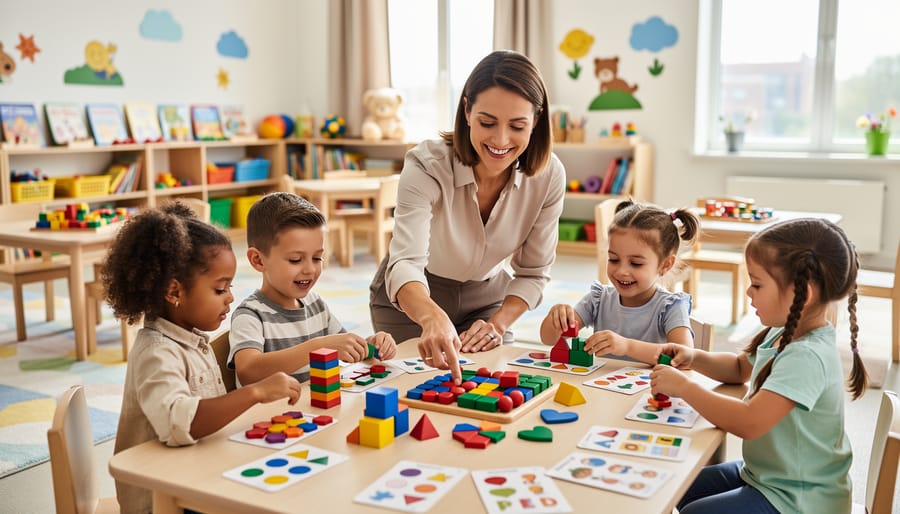
Before you invest time and energy into game-based professional development, pause to consider several critical factors that can make or break your success. Kindergarten learners have unique developmental needs that demand careful attention as you explore new teaching approaches.
Developmentally appropriate practice must anchor every decision you make about game-based learning. Five- and six-year-olds learn best through hands-on exploration, social interaction, and brief periods of focused attention. Games that work brilliantly with third graders may overwhelm or frustrate kindergarteners. Look for activities that match their fine motor abilities, reading levels, and capacity for rule-following. A game requiring complex multi-step instructions or extended independent work will likely fall flat, no matter how engaging it appears on paper.
Equity matters profoundly in kindergarten classrooms. Not all students arrive with the same exposure to games, technology, or play-based learning at home. Some families lack devices or internet access. Others may view games skeptically or prioritize different learning approaches. Your professional development should prepare you to create inclusive experiences that don’t penalize students for circumstances beyond their control.
Classroom management takes on new dimensions with game-based activities. Kindergarteners need explicit instruction on transitions, sharing materials, managing excitement, and handling both winning and losing. Without clear routines and expectations, game time can devolve into chaos rather than learning.
Finally, ensure your chosen games genuinely support your required learning standards rather than serving as entertaining diversions. Games should deepen understanding of literacy, numeracy, social-emotional skills, or other kindergarten objectives.
Step-by-Step Professional Development Implementation
Assess Your Current Teaching Practice and Readiness
Start by reviewing your current classroom routines and teaching methods. Look at a typical week and note how you already incorporate play, choice, and hands-on activities. Kindergarten teachers often use game-like elements without labeling them as such, centers, dramatic play areas, and movement activities all share characteristics with structured game-based learning.
Ask yourself these reflection questions: Do your students have opportunities to make decisions during lessons? How often do they work toward clear, achievable goals? When do they experience productive struggle followed by success? Notice which activities generate the most engagement and joy. These moments reveal where game-based approaches might naturally fit.
Examine your comfort level with technology and willingness to try new methods. Rate yourself honestly on a scale from “eager to experiment” to “prefer familiar approaches.” Neither end is wrong, but knowing where you stand helps you choose appropriate professional development starting points.
Document what you discover in a simple journal or digital note. Include one or two areas where you’d like to grow, such as incorporating more collaborative games or using digital tools to support literacy. This baseline assessment becomes your roadmap for targeted learning.
Select and Explore Age-Appropriate Game-Based Resources
Start by curating a small collection of games that align with your kindergarten learning objectives and developmental stage. Look for options that support emerging literacy, numeracy, social-emotional growth, and motor skills, not just entertainment. Browse vetted educational game libraries, ask colleagues for recommendations, and explore classroom game ideas that have proven successful with young learners.
Evaluate each game using these kindergarten-specific criteria: Can children understand the rules with minimal adult support? Does it allow for short play sessions (10-15 minutes) that match kindergarteners’ attention spans? Are there clear learning goals embedded in the play? Does it promote turn-taking, collaboration, or problem-solving? Test 2-3 games yourself before introducing them to students, play through the activity to identify potential confusion points, assess whether the difficulty level feels appropriate, and consider how you’ll scaffold participation for diverse learners. Keep notes on what works and what needs modification, as this hands-on exploration builds your pedagogical judgment for future game selection.
Participate in Collaborative Learning Communities
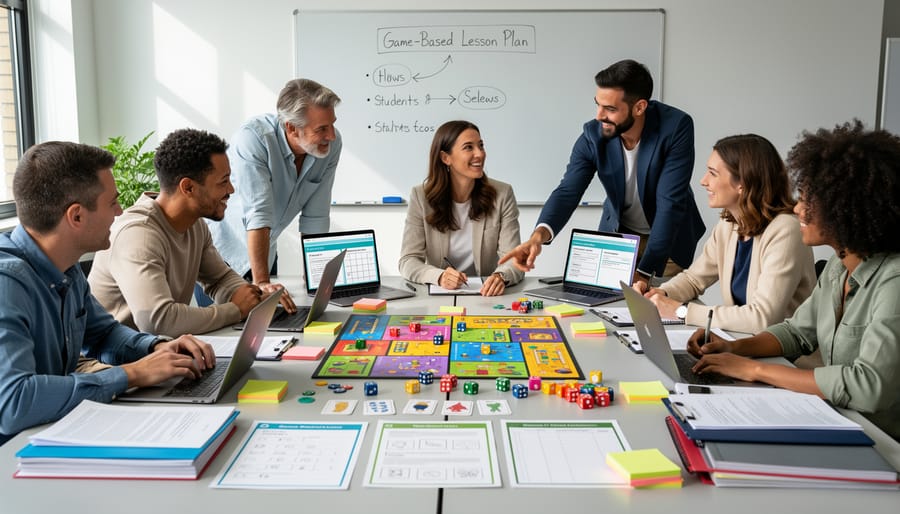
Collaborative learning transforms isolated trial-and-error into collective wisdom. Start by identifying existing professional learning communities in your district or state that focus on early childhood education or game-based pedagogy. Many regional education service agencies offer monthly meetups where kindergarten teachers share lesson plans and classroom videos.
If local options don’t exist, create your own small group with two or three kindergarten colleagues at your school or neighboring buildings. Schedule regular 45-minute sessions during planning time or after school, rotating host classrooms so you can observe each other’s game-based setups firsthand.
Establish norms that prioritize practical sharing over theoretical discussion. Dedicate each meeting to a specific focus: one session might involve watching a five-minute classroom video together and identifying what engagement strategies worked, another might center on co-planning a game-based math rotation for the following week.
Leverage online communities like the Teach Find forums or Facebook groups dedicated to kindergarten play-based learning when face-to-face collaboration proves difficult. These digital spaces offer access to teachers implementing games across diverse contexts, providing fresh perspectives beyond your immediate circle.
The goal isn’t perfection but honest reflection and incremental improvement supported by colleagues who understand kindergarten realities.
Design Your First Game-Based Lesson
Start with a single learning objective from your kindergarten standards, counting to ten, letter recognition, or color sorting work well for first attempts. Choose a game you’ve already explored that directly supports this goal, whether it’s a digital matching activity, a physical board game, or an active movement challenge. Write down three specific moments during the game when you’ll pause to ask questions or model strategies, ensuring intentional instruction frames the play rather than competes with it.
Create a simple lesson plan that includes a two-minute introduction explaining the game’s connection to what students are learning, eight to ten minutes of guided play where you circulate and support, and a three-minute reflection where students share what they discovered. Prepare observation notes on a clipboard with student names and space to jot engagement levels, peer interactions, and unexpected learning moments. Looking at real-world examples from other kindergarten classrooms can help you visualize how play and learning objectives successfully merge.
Document your plan with photos of materials, a simple flowchart of the lesson sequence, and your guiding questions written out. This preparation builds your confidence and creates a resource you can refine for future use.
Implement and Observe Student Engagement
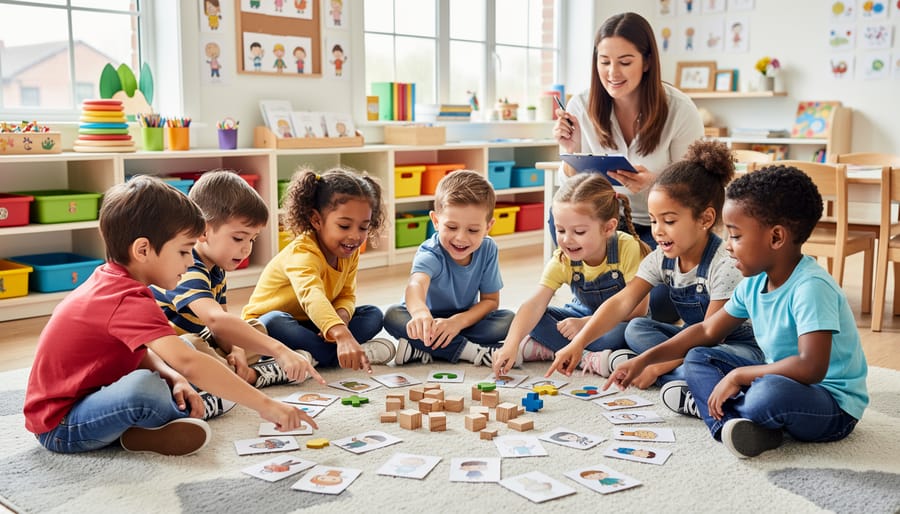
Launch your game-based lesson at a time when your kindergarteners are alert and receptive, typically morning hours work best. Position yourself where you can see all students while they play, moving between groups to observe engagement patterns rather than hovering over individuals. Watch for physical cues: Are children leaning forward? Making eye contact with materials or peers? Verbalizing their thinking? These signals reveal genuine engagement better than quiet compliance.
Keep a simple recording method nearby, a clipboard with student names or a tablet for quick notes. Jot down who masters concepts quickly, who struggles with game mechanics, and who demonstrates unexpected problem-solving. Notice which students collaborate naturally and which need redirection to stay on task.
For classroom management, establish clear game-start and game-stop signals before you begin. A rain stick or chime works better than your voice competing with excited chatter. Set a visible timer so children can self-monitor play duration. If chaos builds, pause the game, reset expectations, and resume rather than abandoning the activity entirely.
Reflect, Refine, and Share Your Learning
After implementing your game-based lesson, set aside 15-20 minutes for structured reflection while the experience is still fresh. Document what surprised you about student engagement, which children struggled or excelled, and how the game supported your learning objectives. Use a simple reflection framework: What worked well? What challenged students or disrupted flow? What would you change next time?
Review any photos, student work samples, or notes you captured during the lesson. Look for evidence of learning that might not have been immediately obvious, a quiet student who suddenly engaged, unexpected problem-solving strategies, or peer collaboration you hadn’t anticipated.
Share your honest insights with your professional learning community, including both successes and struggles. Other kindergarten teachers benefit enormously from hearing what didn’t go perfectly, as it validates their own challenges and sparks collaborative problem-solving. Contribute your lesson plan, modifications you’d recommend, and student response patterns to your shared resource library.
Based on your reflection, revise the lesson for your next implementation. Small adjustments, clearer instructions, different groupings, adjusted timing, often yield significant improvements in student learning and classroom management.
How to Verify Success and Plan Next Steps
Success in game-based professional development shows up first in your classroom practice, then in your students’ learning. Watch for shifts in how you plan lessons, are you naturally considering which concepts could work as games, or integrating review games without needing extensive prep time? Notice whether you feel more confident troubleshooting technical issues or adapting games mid-lesson when kindergarteners need a different approach.
Student engagement offers immediate feedback. Kindergarteners who are genuinely learning through games stay focused longer, ask to play again, and transfer game concepts to other activities. Document specific moments: a child who struggled with number recognition suddenly identifying patterns during a math game, or previously reluctant speakers using new vocabulary they learned through digital storytelling. Take photos, save work samples, and keep brief anecdotal notes that connect game experiences to curriculum standards.
For next steps, identify one area to deepen. You might explore more complex game mechanics, expand to a different subject area, or mentor a colleague just starting with game-based pedagogy. Share what you’ve learned at a staff meeting or through your school’s professional learning community. Request ongoing support, whether that’s dedicated planning time, access to new resources, or funding to attend a conference. Position yourself as a resource by offering to co-plan with teammates or lead a workshop on developmentally appropriate game selection. Professional growth compounds when you teach others what you’ve practiced.
Common Questions About Kindergarten Game-Based Professional Development
Starting professional development for game-based pedagogy raises practical questions, especially when you’re juggling the unique demands of a kindergarten classroom. Here are answers to the concerns kindergarten teachers most frequently raise.
How much time does this professional development require?
Most teachers dedicate 2-3 hours monthly to collaborative learning and an additional hour weekly for planning and reflection. You can start smaller with just one game-based lesson per month and gradually expand as you gain confidence.
What if my administrator doesn’t understand game-based learning?
Share concrete examples of how games address specific learning standards, and invite administrators to observe a lesson. Documentation of student engagement and learning outcomes provides compelling evidence that games are intentional instructional tools, not just play time.
How do I explain game-based learning to parents who prioritize academics?
Frame games as teaching tools that develop critical thinking, problem-solving, and collaboration while reinforcing literacy and numeracy skills. Showing parents specific examples of how a counting game builds mathematical reasoning helps them see the academic value.
Can I differentiate games for my diverse learners?
Yes, and games often make differentiation easier than traditional instruction. You can adjust rules, provide varied support levels, or create flexible groupings so advanced learners tackle extensions while others build foundational skills with the same game structure.
The balance between play and academic goals worries many kindergarten teachers, but game-based pedagogy doesn’t mean abandoning learning objectives. Well-designed games embed academic content within engaging activities, so children practice essential skills without realizing they’re doing formal learning work. Your professional development should help you identify which games genuinely support curriculum goals versus those that are purely recreational.
Finding time for professional development within an already packed schedule is realistic when you integrate learning into existing structures. Use grade-level planning meetings to share game-based strategies, observe a colleague’s game-based lesson during your prep period, or join an online community where you can ask questions and gather ideas during lunch. Professional growth doesn’t always require formal workshops; consistent small steps create meaningful change in your practice.