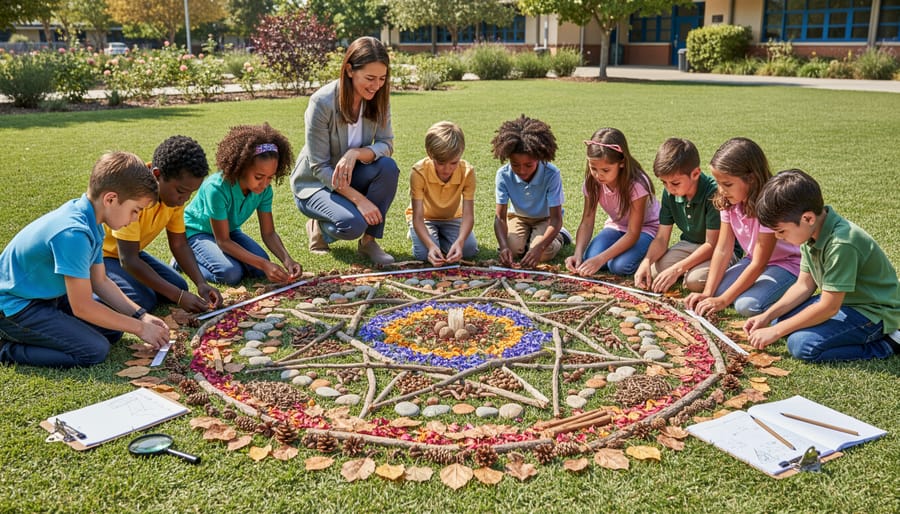
Transform your schoolyard into a dynamic learning gallery by guiding students to create temporary sculptures using natural materials like branches, leaves, and stones arranged in geometric patterns or representational forms. This hands-on approach helps connect them with nature while developing spatial reasoning and creative problem-solving skills across grade levels.
Designate specific outdoor zones for rotating student installations that remain accessible throughout the school year, establishing clear maintenance schedules and weather contingency plans. Assign classroom teams weekly responsibility for documenting changes through photography and written observations, creating opportunities for interdisciplinary learning in science, art, and language arts.
Integrate curriculum standards by linking installations to specific learning objectives: elementary students explore symmetry and patterns through land art mandalas, middle schoolers investigate environmental themes through recycled material sculptures, and high schoolers examine cultural perspectives by researching indigenous art traditions and contemporary outdoor artists.
Develop assessment rubrics that evaluate both artistic expression and collaborative process, measuring student engagement through self-reflection journals and peer feedback sessions. Document the educational impact by collecting student work samples, progress photos, and testimonials that demonstrate growth in creative confidence and environmental awareness.
Build community support by hosting seasonal unveiling events where families experience student creations firsthand, and establish partnerships with local artists who can mentor students through virtual workshops or on-site demonstrations. These connections strengthen your program’s sustainability while showcasing the authentic learning happening beyond classroom walls.
Why Outdoor Art Installations Belong in K-12 Education
The Science Behind Learning Outside
Research consistently demonstrates that outdoor learning environments enhance student engagement, creativity, and retention. Studies show that natural settings reduce stress, improve focus, and promote deeper cognitive processing compared to traditional indoor classrooms. When you introduce art installations into these spaces, you amplify these benefits significantly.
Outdoor art projects engage multiple senses simultaneously, creating stronger neural pathways and more memorable learning experiences. Students working with natural materials develop spatial reasoning and problem-solving skills while connecting abstract concepts to tangible outcomes. The physical movement involved in creating larger installations also supports kinesthetic learners and promotes healthy activity levels.
Furthermore, collaborative outdoor art experiences build social-emotional skills as students negotiate ideas, share responsibilities, and celebrate collective achievements. The combination of fresh air, natural light, and creative expression triggers dopamine release, making learning feel rewarding rather than obligatory. These installations also provide ongoing visual reminders of student accomplishments, reinforcing pride in their work and strengthening school community connections.
Cross-Curricular Connections That Work
Outdoor art installations provide natural opportunities for cross-curricular learning that goes beyond traditional art education. When students create sculptures from natural materials, they apply mathematical concepts like measurement, geometry, and spatial reasoning. Calculating dimensions for a large-scale installation or ensuring structural balance introduces practical problem-solving that reinforces math standards in an engaging context.
Science connections emerge organically as students investigate material properties, weather resistance, and environmental impact. They observe how sunlight, wind, and precipitation affect their creations over time, documenting changes through data collection and analysis. Social studies integration happens when students research land art movements, study cultural artistic traditions, or explore how public art shapes community identity and space.
Language arts skills strengthen throughout the entire process. Students write project proposals, create artist statements explaining their vision, and develop presentation skills when sharing their work with peers and community members. Documentation through photography and reflection journals builds writing proficiency while deepening artistic understanding. This interconnected approach demonstrates how outdoor art installations can serve as powerful anchors for comprehensive learning experiences that address multiple content areas simultaneously.
Planning Your Outdoor Art Integration Workshop
Setting Clear Learning Objectives
Begin by identifying which academic standards your outdoor art installation workshop will address. Whether you’re focusing on visual arts, science, environmental education, or language arts, explicitly connecting activities to curriculum benchmarks helps justify the project to administrators and provides clear assessment criteria. For example, a nature sculpture workshop might align with Next Generation Science Standards about ecosystems while simultaneously meeting arts standards for three-dimensional design.
The key is balancing structure with creative freedom. Start with 2-3 concrete learning objectives that serve as anchors—perhaps students will identify natural materials, demonstrate collaborative problem-solving, and create a site-specific artwork. These clear targets give your workshop direction without constraining imagination. Within this framework, students can explore their own creative pathways while you confidently assess meaningful outcomes.
Document your objectives in language that speaks to multiple stakeholders. Share them with students using age-appropriate terms that inspire rather than limit. Present them to parents and administrators using educational terminology that demonstrates rigor. This dual approach ensures everyone understands the workshop’s value while keeping the actual experience joyful and exploratory. Remember, the best outdoor art projects teach essential skills through discovery, not rigid instruction.
Choosing the Right Location and Scale
Selecting the right location starts with a careful walk-through of your school grounds. Look for spaces that offer natural protection from extreme weather, adequate visibility for student safety, and sufficient room for your chosen project. Consider accessibility for all students, including those with mobility challenges, and assess sun exposure, drainage, and proximity to water sources if needed.
Match your installation scale to student development levels. Primary students thrive with smaller, hands-on projects like decorated stepping stones or painted rock gardens that they can complete in shorter timeframes. Middle schoolers can tackle medium-scale installations such as mosaic walls or wind sculpture gardens that incorporate more complex techniques. High school students often excel with ambitious projects like large murals or sculptural elements that require sustained planning and collaboration.
Start small when introducing outdoor art to your school community. A successful pilot project builds confidence and demonstrates value to administrators and parents. Consider launching with a single class or grade level, then expand based on lessons learned. This approach allows you to refine your process, identify potential challenges, and gather evidence of student engagement before scaling up to whole-school initiatives.
Gathering Materials on Any Budget
Creating meaningful outdoor art installations doesn’t require a large budget. Start by looking at materials you already have access to. Recycled cardboard, plastic bottles, fabric scraps, and natural elements like pinecones, leaves, and stones can transform into stunning artworks. Reach out to local businesses for donations of materials they might otherwise discard, such as wood pallets, yarn remnants, or tile samples.
Building community partnerships opens doors to resources and support. Connect with parent organizations, local art councils, or environmental groups who may share materials, expertise, or volunteer time. Many communities have tool libraries or material exchanges specifically designed to support educational initiatives.
Grant opportunities exist specifically for arts education and outdoor learning projects. Check with your district’s grants coordinator, local arts foundations, and national organizations focused on environmental education. Even small grants of a few hundred dollars can significantly enhance your project scope.
Consider hosting a material drive where families contribute items from home. This approach not only reduces costs but also builds investment in the project from your school community. When students see their own donated materials transformed into collaborative art, it deepens their connection to the final installation and reinforces lessons about sustainability and creative resourcefulness.
Student-Friendly Installation Projects That Actually Work
Elementary Projects: Building Foundations
Elementary students thrive when outdoor art projects connect hands-on creativity with natural exploration. Nature mandalas offer an excellent starting point, inviting children to collect leaves, stones, petals, and twigs to arrange in circular patterns on the ground. This activity introduces symmetry, color theory, and biodiversity while encouraging careful observation of the natural world around them.
Painted rock gardens transform ordinary stones into lasting installations. Students can work individually or collaboratively to decorate rocks with weather-resistant paints, creating themed collections like inspirational messages, native wildlife, or geometric patterns. These gardens become conversation starters and welcoming features near school entrances or reading areas.
Stick sculptures develop spatial reasoning and engineering thinking. Challenge students to build free-standing structures using only materials found on school grounds—branches, vines, grasses. They’ll discover principles of balance and gravity through experimentation. Consider creating collaborative installations where small groups contribute connected pieces to form larger community artwork.
These foundational projects require minimal materials and naturally differentiate for varied skill levels. They build confidence in working with unconventional media while fostering environmental awareness. Document each installation with photographs to track seasonal changes and create opportunities for reflection on how weather and time transform outdoor artwork.
Middle School Projects: Expanding Skills
Middle school students are ready to tackle more sophisticated outdoor art installations that challenge their growing technical abilities and creative vision. These complex projects blend artistic expression with environmental awareness while reinforcing important STEM concepts.
Wind chimes made from recycled materials offer an excellent entry point for expanding skills. Students can collect aluminum cans, old keys, glass bottles, or bamboo pieces, then design musical instruments that respond to natural breezes. This project integrates physics principles about sound waves and vibration while encouraging creative reuse of everyday materials. Consider organizing students into small teams where they can experiment with different materials and tones, creating a diverse collection that transforms your outdoor space into an interactive sound garden.
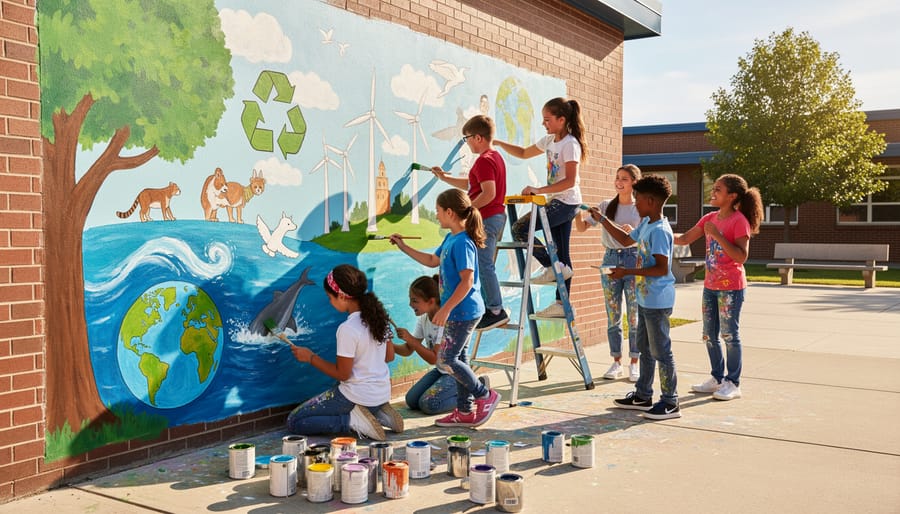
Outdoor murals provide opportunities for collaborative large-scale work. Whether painting on exterior walls, creating mosaic designs with broken tiles, or developing temporary chalk murals, these installations allow students to explore composition, color theory, and storytelling through visual art. Begin with sketches and scaled-down versions before moving to the final surface, helping students understand planning and proportion.
Botanical mobiles combine natural materials with engineering challenges. Students can construct hanging sculptures using branches, seed pods, leaves, and flowers arranged in balanced compositions. This hands-on project teaches principles of equilibrium and weight distribution while celebrating the beauty of local flora. These installations work beautifully in covered outdoor areas where they can move gently with air currents while remaining protected from harsh weather.
High School Projects: Advanced Integration
High school students bring sophisticated thinking and technical skills to outdoor art installations, allowing for complex projects that make lasting impacts on your school community. These advanced installations can incorporate golden ratio calculations in sculpture design, Fibonacci sequences in garden layouts, or geometric patterns that explore mathematical beauty in nature. Students at this level excel when given opportunities to address real-world issues through their work, creating pieces that communicate powerful messages about climate change, biodiversity, or social justice.
Consider permanent installations that become part of your school’s landscape. Metal sculptures designed in shop class, mosaic murals using recycled materials, or living walls that combine horticulture with visual design all provide meaningful learning experiences. Partner with local artists or environmental organizations to bring professional perspectives into student planning processes. These collaborations enhance the educational value while connecting classroom learning to community needs.
Integrate environmental messaging by having students research local ecosystems before designing installations that raise awareness about native species or watershed protection. Digital components like QR codes linking to student-created content can add interactive elements that engage viewers beyond the physical artwork. Document the entire process through photography and reflection journals, creating portfolios that demonstrate both artistic growth and environmental stewardship. These comprehensive projects prepare students for college-level work while beautifying your campus.
Facilitating the Creative Process
Brainstorming That Honors All Voices
Creating an inclusive brainstorming environment ensures every student contributes meaningful ideas to your outdoor art installation project. Begin with silent brainstorming, allowing students to sketch or write their thoughts independently before sharing with the group. This approach supports learners who need processing time and those who may feel hesitant speaking up immediately.
Use varied communication methods to capture diverse perspectives. Provide options like sticky notes, drawing stations, digital idea boards, or small group discussions. Students with different abilities and learning preferences will engage more fully when multiple pathways for expression exist.
Structure your sessions with clear prompts that spark creativity without limiting possibilities. Instead of asking “What should we build?” try “How can we make our playground tell a story about our community?” or “What natural materials could show something important to us?” These open-ended questions invite responses from all experience levels.
Consider rotating facilitation roles among students, empowering different voices to guide conversations. Establish ground rules together emphasizing that all ideas have value and build upon one another. When students see their suggestions genuinely considered and incorporated, they develop ownership over the project and confidence in their creative contributions.
Managing Group Dynamics in Outdoor Spaces
Working outdoors with students requires intentional strategies to maintain focus while honoring the freedom that natural spaces provide. Start by establishing clear boundaries before leaving the classroom. Walk the outdoor workspace together and designate specific zones for different activities, creative work areas, supply stations, and gathering spots for group discussions. This physical structure helps students understand expectations while still enjoying the open environment.
Consider grouping strategies that support both collaboration and accountability. Smaller teams of three to four students often work best for outdoor installations, allowing everyone to contribute meaningfully without losing cohesion. Assign rotating roles within groups, such as materials manager, design coordinator, or documentation specialist, giving each student ownership and responsibility.
Weather and environmental distractions present unique challenges. Build flexibility into your timeline, having alternative indoor tasks ready if conditions change suddenly. Use natural transitions like water breaks or rotation between stations to reset attention and energy levels. These brief pauses can actually enhance creativity and prevent frustration.
Voice projection becomes essential outdoors where ambient noise can interfere with communication. Establish non-verbal signals for gathering attention, such as raising a hand or using a small chime. Practice these signals during your first outdoor session so students respond automatically.
Encourage peer mentoring by pairing students with different strengths. One might excel at spatial planning while another has strong technical skills. This approach builds community while distributing leadership naturally throughout your class. Remember that some initial excitement and movement is normal; channel that energy into productive exploration rather than viewing it as disruption.
Weathering the Challenges: Common Obstacles and Solutions
Weather, Maintenance, and Longevity
Weather resistance starts with material selection. When planning permanent installations, guide students to choose durable materials like treated wood, sealed ceramics, weatherproof paint, and rust-resistant metals. This research process itself becomes a valuable learning opportunity as students investigate material properties and environmental science concepts.
However, embracing temporary art offers unique educational advantages. Seasonal installations teach students about natural cycles, change, and impermanence—powerful lessons that resonate across grade levels. Document transformation through photography, encouraging students to observe how rain, wind, and sun interact with their creations. This documentation becomes part of the artistic process and creates portfolio materials for assessment.
For maintenance planning, assign student teams rotating responsibilities for monitoring outdoor pieces. Create simple checklists appropriate to age groups, fostering ownership and ongoing engagement with completed projects.
Consider hybrid approaches: design installations with replaceable components, allowing students to refresh elements seasonally while maintaining core structures. This strategy extends project longevity while providing regular touchpoints for continued learning and creative expression throughout the school year.
Safety and Administrative Approval
Before launching your outdoor art installation, prioritize safety and administrative approval to create a secure, supported learning experience. Start by consulting with your school administrator early in the planning process to discuss your project goals and potential concerns. Document your plans including site selection, materials to be used, and supervision strategies.
Address liability by conducting a thorough site assessment to identify potential hazards like uneven terrain, sun exposure, or proximity to traffic. Establish clear boundaries for student work areas and ensure adequate adult supervision ratios. Create a simple safety checklist covering material handling, tool usage, and emergency procedures that students can review before beginning.
Secure necessary permissions from your district’s facilities department, especially if installations will remain semi-permanent or require ground modifications. Consider obtaining parent consent forms that outline the outdoor activities and any associated risks. Keep documentation of all approvals and safety protocols for future reference.
Maintain open communication with custodial staff about materials being used and cleanup requirements. This collaborative approach ensures everyone supports your project while keeping students safe and engaged in meaningful outdoor learning experiences.
Assessment and Documentation Strategies

Beyond the Grade Book
Traditional letter grades only capture a small part of what students learn through outdoor art installations. Consider implementing portfolios where students collect photographs of their work-in-progress, sketches, and final pieces alongside written explanations of their creative choices. These visual records powerfully demonstrate growth over time and help students articulate their artistic thinking.
Reflection journals offer another meaningful assessment tool. Prompt students to document their problem-solving processes, collaboration experiences, and connections between their artwork and natural environments. These entries reveal deeper learning that numeric grades might miss.
Peer evaluations strengthen community and critical thinking skills. Create structured feedback forms where students identify strengths in classmates’ installations and offer constructive suggestions. This approach validates multiple perspectives while building observation and communication abilities. When combined, these alternative assessments paint a complete picture of student achievement, celebrating creativity, perseverance, and collaborative spirit alongside technical skill development.
Showcasing Student Work
Celebrating your students’ outdoor art installations reinforces their sense of accomplishment and connects their learning to the broader community. Consider hosting a gallery walk where students guide families through the installations, explaining their creative process and the concepts they explored. This provides authentic opportunities for students to practice communication skills while taking pride in their work.
Digital documentation extends the reach of student achievements beyond your school grounds. Create a simple online gallery featuring photographs of the installations alongside artist statements written by students. Many schools successfully use free platforms or existing school websites to share these projects, making them accessible to relatives who live far away and preserving the temporary nature of outdoor work.
Engage your local community by inviting neighbors, local artists, or community leaders to view the installations during designated open hours. Some educators coordinate with local libraries or community centers to display photo documentation, expanding the audience for student creativity. When students see their work valued beyond the classroom, it validates their efforts and strengthens school-community relationships. These celebrations naturally lead to discussions about future projects and help build sustained support for arts integration in your curriculum.
Building Community Through Outdoor Art
Outdoor art installations offer a unique opportunity to bring people together around shared creative experiences. When students collaborate on projects that transform their school environment, they develop deeper connections with their peers while taking pride in their collective contributions. These visible, lasting artworks become conversation starters that invite families and community members to engage with what’s happening on campus.
Consider organizing family art days where students work alongside parents and guardians to create installations. This approach not only strengthens home-school partnerships but also demonstrates that learning extends beyond classroom walls. Local artists, business owners, and community volunteers can contribute their expertise, creating mentorship opportunities and building networks of support for your school.
Outdoor installations naturally draw attention from neighborhood residents and passersby, positioning your school as an active community hub. When visitors stop to admire a mural or sculpture created by students, they’re witnessing the creativity and capability of young people in action. This visibility helps build community pride and can lead to unexpected partnerships or resources.
Interactive elements within installations encourage ongoing engagement. A community chalk wall, rotating sculpture garden, or collaborative mosaic invites repeated participation from diverse groups. Schools that have implemented these approaches report increased attendance at school events and stronger relationships between staff, families, and local organizations. By creating spaces where art becomes a shared language, you’re fostering connections that support student success both inside and outside the classroom.
You have everything you need to begin transforming your students’ learning experiences through outdoor art installations. Remember, every successful program started with a single project, and yours can too. Whether you begin with a simple nature collage on the playground or a more ambitious semester-long sculpture garden, what matters most is taking that first step.
Start small and celebrate your initial efforts. A single successful outdoor art experience can build momentum for expanded programming. Perhaps begin with one class period outdoors, or integrate one art installation project into an existing unit. As you and your students grow more comfortable with outdoor creative work, you can gradually expand the scope and frequency of these activities.
The transformation you’ll witness goes beyond artistic skill development. Students who struggle in traditional classroom settings often flourish when given opportunities to create in natural spaces. Those quiet voices find confidence, collaborative skills deepen, and connections to both curriculum and environment strengthen in meaningful ways.
Your willingness to step outside conventional boundaries, quite literally, opens doors for students who need alternative pathways to learning. Trust in your ability to guide this process, lean on your community for support, and know that even imperfect attempts yield valuable lessons. The outdoor classroom awaits, and your students are ready for the creative journey you’re about to facilitate together.