**Teach young learners to “name it to tame it”** by helping them identify and label their emotions using simple feeling charts, emotion cards, or mirrors where they can observe their facial expressions. When children can verbally express “I feel frustrated” or “I’m worried,” they gain immediate power over overwhelming sensations that might otherwise lead to meltdowns.
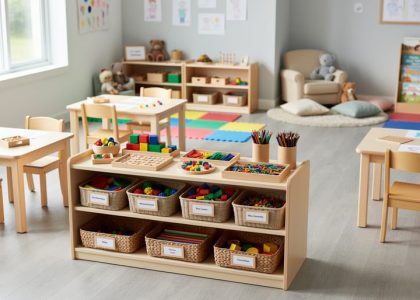
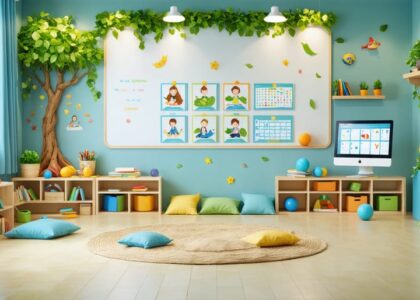
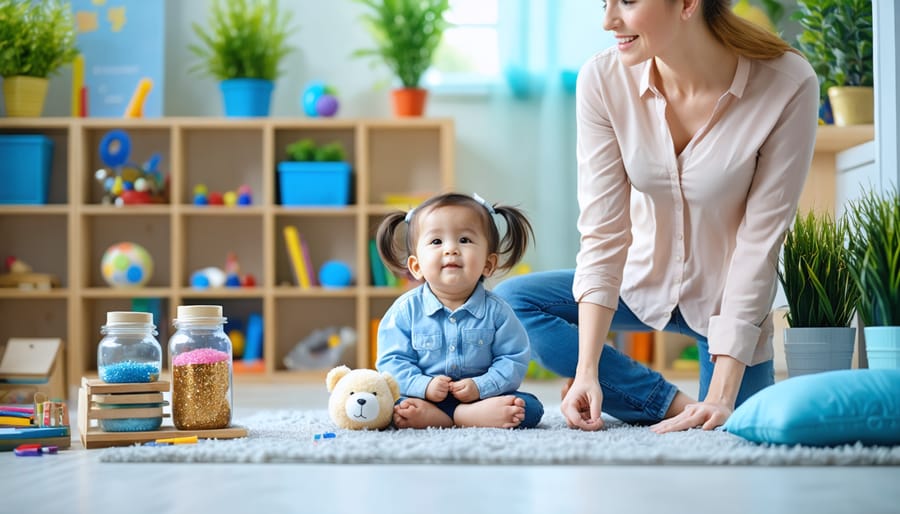
**Create a classroom calm-down corner stocked with sensory tools** like stress balls, breathing buddies (stuffed animals that rise and fall with belly breaths), glitter jars for visual focus, and noise-canceling headphones. Position this space away from high-traffic areas and introduce it during neutral moments so children associate it with self-care rather than punishment.
**Model co-regulation before expecting self-regulation** by narrating your own emotional management process aloud: “I’m feeling overwhelmed right now, so I’m going to take three deep breaths” or “That mistake frustrated me, but I can try again.” Young children learn emotional skills primarily through observation and guided practice with trusted adults.
**Implement brief sensory breaks throughout the day**—two-minute dance sessions, wall push-ups, or guided breathing exercises—rather than waiting for dysregulation to occur. These preventive strategies work with children’s developing nervous systems, acknowledging that early learners often lack the executive functioning skills to recognize their escalating emotions independently.
The reality is that emotional regulation doesn’t come naturally to young children. Their prefrontal cortexes are still developing, making impulse control and emotional management genuinely difficult tasks. But with consistent, developmentally appropriate techniques woven into daily routines, you can transform your classroom into a space where children build lifelong skills for managing life’s inevitable challenges. These strategies aren’t about controlling behavior—they’re about equipping young learners with tools for understanding themselves.
Why Emotional Regulation Matters in Early Childhood
The Developing Brain and Emotions
Understanding why young children experience intense emotions—and struggle to manage them—begins with recognizing that their brains are still under construction. The prefrontal cortex, the brain’s “control center” responsible for decision-making, impulse control, and emotional regulation, doesn’t fully mature until the mid-twenties. In early learners, this area is just beginning its development journey.
Think of it this way: young children feel emotions with the full intensity of their developing limbic system (the emotional center), but they’re working with limited “braking power” from their still-growing prefrontal cortex. This mismatch explains those seemingly sudden meltdowns over small frustrations or the difficulty transitioning between activities.
This isn’t a deficit or failure—it’s developmentally appropriate. When a five-year-old melts down because their tower fell, or a seven-year-old can’t calm themselves after recess, they’re not choosing poor behavior. Their brains simply haven’t developed the neural pathways needed for consistent self-regulation yet.
The empowering news? Your classroom strategies directly support this brain development. Each time you guide a child through calming techniques or help them name their feelings, you’re strengthening those crucial neural connections, building their capacity for emotional regulation one interaction at a time.
The Classroom Impact
When young learners develop strong emotional regulation skills, the positive effects ripple throughout your entire classroom. Students who can identify and manage their emotions show improved focus during lessons, leading to better academic performance and deeper engagement with learning materials. You’ll notice fewer disruptions, as children equipped with regulation strategies can navigate frustrations without melting down or acting out.
The classroom environment transforms when emotional regulation becomes a shared practice. Students feel safer taking academic risks and participating in discussions because they trust their ability to handle mistakes or disappointment. This emotional security strengthens peer relationships too—children become more empathetic listeners and better problem-solvers during conflicts, reducing the time you spend mediating disputes.
Perhaps most encouraging, these skills create a positive feedback loop. As your students experience success in managing their emotions, their confidence grows, which further supports their willingness to try challenging tasks. You’ll find yourself spending less energy on behavior management and more time actually teaching, while your students develop resilience that serves them far beyond the classroom walls. The investment in teaching emotional regulation today builds capable, self-aware learners for tomorrow.
Creating an Emotion-Friendly Classroom Environment
Design Your Calm-Down Space
Creating a dedicated calm-down space in your classroom provides students with a safe haven when emotions feel too big to handle. This isn’t a punishment area—it’s a supportive environment where children can practice the self-regulation skills you’re teaching them.
**Location and Setup**
Choose a quiet corner away from high-traffic areas but still visible enough for supervision. A small rug, bean bag chair, or floor cushions create an inviting, comfortable spot. Keep it simple and avoid overwhelming decorations that might add sensory stimulation rather than reducing it.
**Essential Sensory Tools**
Stock your space with items that engage different senses: soft stress balls, textured fabric swatches, noise-canceling headphones, and calming sensory bottles filled with glitter and water. Include fidget tools like putty or smooth stones that students can manipulate. These tangible objects give children something concrete to focus on while their emotions settle.
**Visual Supports**
Display simple visual aids showing breathing exercises with graphics—like “smell the flower, blow out the candle”—or emotion charts with faces depicting different feelings. A visual timer helps students understand how long they’ll spend in the space, providing structure and predictability.
**Clear Guidelines**
Establish simple rules: students can choose to visit the space independently or with teacher guidance, stay for a set time, and rejoin activities when ready. Model how to use the space during calm moments so it becomes a familiar resource during challenging ones.
Remember, this space empowers students to recognize their needs and take positive action toward managing their emotions effectively.

Set the Emotional Tone
Your emotional state sets the tone for your entire classroom. When you remain calm during challenging moments, you’re teaching children that strong emotions are manageable. Take a deep breath before responding to outbursts, speak in a measured voice, and maintain relaxed body language. Your students are watching and learning from every interaction.
Language matters tremendously in helping young learners understand their feelings. Instead of dismissing emotions with phrases like “you’re fine,” try validating responses: “I see you’re really frustrated right now” or “It’s okay to feel disappointed.” This acknowledgment helps children recognize that all emotions are acceptable, even when certain behaviors aren’t. Name emotions clearly and often, building their emotional vocabulary alongside your daily lessons.
Predictable routines are powerful anxiety-reducers for early learners. When children know what comes next, they feel safer and more capable of managing their emotions. Create consistent daily schedules with visual supports, use transition warnings (“in five minutes, we’ll clean up”), and establish regular calming rituals. Morning greetings, mindfulness activities after recess, or end-of-day reflections become anchors that help children regulate throughout the day.
Remember, you’re building an emotional foundation that extends far beyond your classroom. These seemingly small moments of modeling, validating, and establishing routines create lasting skills your students will carry forward. You’re not just managing behavior—you’re teaching emotional resilience.
Breathing and Body-Based Techniques
Simple Breathing Exercises for Young Children
Breathing exercises are foundational quick calming strategies that young children can master with practice. These techniques work because they activate the body’s natural relaxation response while giving children something concrete to focus on during big emotions.
**Balloon Breathing** is perfect for preschoolers through first grade. Have children place their hands on their bellies and imagine they’re inflating a balloon inside their tummy. As they breathe in through their nose for three counts, their belly expands like a balloon filling with air. Then they slowly let the air out through their mouth for four counts, feeling their belly deflate. The visual of a colorful balloon makes this technique memorable and engaging.
**Bunny Breathing** adds a playful element that captures young learners’ attention. Children take three quick sniffs through their nose (like a bunny sniffing a carrot) followed by one long exhale through their mouth. This technique is especially effective because it’s quick, silly enough to shift mood, and easy to remember during moments of frustration.
**Square Breathing** works well for kindergarten and up. Guide children to trace a square in the air or on their desk while breathing: breathe in for four counts along one side, hold for four counts along the next, breathe out for four counts, and hold for four counts to complete the square. The physical movement paired with counting helps children regulate more effectively than breathing alone.

Movement-Based Regulation
Young children carry emotional tension in their bodies, making movement-based activities powerful tools for regulation. When you notice a student becoming overwhelmed, simple physical exercises can help them release built-up stress and return to a calmer state.
**Stretching exercises** provide gentle release—try reaching for the sky, then melting down like ice cream on a hot day. **Jumping jacks** or hopping in place helps discharge excess energy quickly during transitions. **Wall pushes**, where children press their hands against a wall as if trying to move it, offer proprioceptive input that grounds anxious feelings.
**Child-friendly yoga poses** combine movement with mindfulness. “Tree pose” teaches balance and focus, while “child’s pose” creates a calming retreat. “Butterfly stretch” naturally encourages deep breathing while students open and close their “wings.”
You can integrate these seamlessly throughout your day—morning stretch routines, transition activities between subjects, or brain breaks when attention wanes. Keep a visual chart displaying different movements so students can independently choose what their bodies need.
The beauty of movement-based regulation is its dual benefit: it addresses immediate emotional needs while teaching children to recognize and respond to their body’s signals. With consistent practice, your students will develop a toolkit they can access whenever challenges arise.
Sensory Strategies
Sensory tools offer young learners concrete ways to manage big emotions while staying engaged in learning. Simple items like stress balls, fidget toys, textured fabrics, or weighted lap pads can provide the calming input many children need to self-regulate. Consider creating a sensory station in your classroom where students can access these tools independently when feeling overwhelmed.
Start by introducing one or two tools at a time, modeling appropriate use during calm moments. Notice which items resonate with individual students—some may prefer squeezing putty, while others find comfort in smooth stones or soft fabric squares. Weighted items like stuffed animals or vests can be particularly helpful during transitions or challenging activities.
Keep sensory tools accessible and normalize their use by framing them as helpful learning supports, not punishments or rewards. You might say, “I notice you’re having a hard time sitting still. Would a fidget help your body feel ready to learn?” This approach empowers students to recognize their needs and build self-awareness alongside emotional regulation skills.
Naming and Understanding Emotions
Emotion Vocabulary Building
Young children often struggle to communicate their feelings simply because they lack the words to describe what’s happening inside. When students can only identify emotions as “happy,” “sad,” or “mad,” they miss the nuanced language needed to understand and manage their feelings effectively. Building a rich emotional vocabulary gives students the tools to express themselves clearly and recognize what they’re experiencing.
**Emotion charts and feeling faces** serve as powerful visual aids in your classroom. Display colorful charts at children’s eye level showing various facial expressions paired with emotion words like “frustrated,” “proud,” “disappointed,” or “excited.” During circle time, invite students to point to faces that match their feelings, gradually introducing new vocabulary in context.
**Picture books** offer wonderful opportunities to explore emotions naturally. As you read together, pause to identify characters’ feelings and discuss the physical cues—clenched fists might signal anger, while slumped shoulders could indicate sadness or discouragement. Ask questions like “How do you think she feels right now?” to encourage emotional literacy.
**Daily check-ins** create routine practice with emotion vocabulary. Whether using a feelings chart, emotion wheel, or simple show of fingers (rating feelings 1-5), these brief moments help students develop self-awareness and comfort expressing emotions. You might notice patterns emerging that inform your support strategies.
Consider creating an “emotion word of the week” to deepen understanding. When students can identify feeling “overwhelmed” versus just “sad,” they’re better equipped to seek appropriate help and develop targeted coping strategies for their specific emotional experiences.
The Zones of Regulation Approach
The Zones of Regulation is a framework that uses four color-coded zones to help young learners identify and communicate their emotional states. Think of it as an emotional weather map that children can easily understand and reference throughout their day.
The **Blue Zone** represents low-energy states like sadness, tiredness, or boredom. The **Green Zone** is where students feel calm, focused, and ready to learn—this is our target zone for most classroom activities. The **Yellow Zone** indicates elevated emotions such as frustration, excitement, or anxiety, where children are starting to lose some control. Finally, the **Red Zone** signals intense emotions like anger or extreme excitement that require immediate intervention.
What makes this approach particularly effective for early learners is its visual simplicity. You can create a classroom zones display where students point to their current zone during check-ins, helping them build emotional vocabulary without needing complex explanations. When a child identifies they’re in the Yellow Zone, you can guide them toward appropriate coping strategies—perhaps deep breathing, taking a movement break, or using a fidget tool.
The beauty of this system is that it normalizes all emotions. You’re not labeling any zone as “bad,” but rather helping students understand that different zones require different strategies. Over time, children develop self-awareness and begin choosing their own regulation tools, building independence and emotional intelligence that extends far beyond the classroom.
Problem-Solving and Cognitive Strategies
Stop-Think-Choose Framework
The Stop-Think-Choose Framework gives young learners a concrete roadmap for managing big emotions in the moment. This three-step process transforms abstract emotional regulation into tangible actions children can remember and practice.
**Stop** means physically pausing—teach students to freeze their bodies, place hands on their belly, or step back from the situation. Visual cues like a red stop sign posted in calm-down corners help reinforce this first crucial step.
**Think** invites children to identify what they’re feeling and consider their options. Prompt them with simple questions: “How does my body feel right now?” or “What are two things I could do?” Emotion charts with faces displaying different feelings support students who struggle with emotional vocabulary.
**Choose** empowers students to select a helpful response. Guide them toward positive choices: “I can ask for help,” “I can take deep breaths,” or “I can use my words to tell my friend how I feel.”
Display this framework prominently with colorful posters featuring each step. Practice through role-playing during calm moments, so the sequence becomes automatic when emotions run high. Celebrate when students use the framework independently—acknowledging their growth reinforces these essential self-regulation skills and builds confidence in their ability to manage challenging situations.
Social Stories and Role-Playing
Social stories are short, personalized narratives that walk children through upcoming situations and model appropriate emotional responses. These simple stories help young learners understand what to expect and practice regulation strategies in a low-pressure way. For example, before a fire drill, you might read a social story about loud noises and how to stay calm by taking deep breaths.
Create your own social stories using photographs of your classroom or familiar settings. Keep language simple and focus on one challenging situation at a time—transitions, group work, or dealing with disappointment. Include clear descriptions of feelings and concrete coping strategies the child already knows.
Role-playing brings these stories to life through practice. Set up pretend scenarios where students can rehearse their responses to frustration, sharing conflicts, or unexpected changes. You might say, “Let’s pretend the blocks fell down. Show me what you could do with your hands and your words.” This rehearsal builds muscle memory for regulation before emotions run high.
Make role-playing feel safe and fun by starting with puppets or stuffed animals acting out scenarios. Celebrate efforts rather than perfection, emphasizing that everyone is learning together. These proactive techniques give students a mental script to follow when real challenges arise, building confidence alongside emotional skills.
Integration Strategies: Making It Work Daily
Morning Meetings and Daily Practice
Starting each day with intentional emotional check-ins creates a foundation for regulation success. Morning meetings offer a predictable, low-pressure time for students to practice identifying and expressing feelings before challenges arise. Begin with simple activities like emotion charts where children point to how they’re feeling, or circle time conversations using prompts like “I feel ___ because ___.”
These daily touchpoints build vocabulary and self-awareness when students are calm and receptive. Consider incorporating quick breathing exercises, stretching, or a feelings song into your routine. Even five minutes of practice helps children internalize strategies they can access later during stressful moments.
Create visual schedules that include “feelings check” times throughout the day, normalizing emotional awareness as part of learning. You might use a classroom feelings thermometer where students move their name cards to show their current state, fostering both personal reflection and community understanding.
The key is consistency—when emotional regulation becomes as routine as taking attendance, children develop the muscle memory to use these skills independently. Remember, you’re planting seeds during calm moments that will grow into lifelong coping abilities.

In-the-Moment Interventions
When emotions run high in your classroom, having go-to strategies can make all the difference. Start with naming and validating what the child is experiencing: “I see you’re feeling really frustrated right now.” This simple acknowledgment helps students feel heard and begins the calming process.
Guide students through quick breathing exercises—have them blow imaginary bubbles or smell a flower and blow out a candle. These playful approaches make calming accessible to young learners. Grounding techniques like “find five blue things in the room” can redirect attention and reduce intensity.
Create a calm-down corner stocked with sensory tools: stress balls, fidgets, or soft textures. Frame this space positively—it’s not punishment but a helpful resource. Keep your own voice low and calm, as children often mirror adult energy levels.
For physically escalating situations, offer movement breaks: “Let’s do five jumping jacks together” or “Can you help me carry these books?” Physical activity releases tension constructively. Remember, your goal isn’t immediate perfection but helping students gradually return to a regulated state where learning becomes possible again.

Partnering with Families
When emotional regulation strategies are consistent between home and school, children make significantly stronger progress. Building strong partnerships with families creates a unified support system that reinforces these essential skills across all environments where children learn and grow.
Begin by establishing regular communication channels that work for diverse family schedules and preferences. Share weekly updates through emails, classroom apps, or brief notes home highlighting specific emotional regulation techniques you’re practicing. For example, if you introduced the “belly breathing buddy” strategy this week, send home a simple explanation with a visual guide so parents can practice the same technique during homework time or bedtime routines.
Create accessible take-home resource packets that translate classroom strategies into family-friendly activities. Include laminated feeling faces charts, printable calm-down strategy cards, or links to short video demonstrations. Remember that families have varying literacy levels and home languages, so incorporate visual supports and offer translations whenever possible. These resources empower parents to become active participants in their child’s emotional development rather than feeling like outside observers.
Host brief family workshops or virtual coffee chats where you demonstrate regulation techniques and invite parents to share what works at home. This reciprocal exchange honors families’ expertise about their own children while building everyone’s toolkit. Partnering with families strengthens when we recognize that collaboration flows both ways.
Provide specific conversation starters that help families discuss emotions at home: “What made you feel proud today?” or “When did you need to use a calm-down strategy?” These prompts normalize emotional awareness as an ongoing family practice, not just a response to challenges.
Measuring Progress and Adjusting Your Approach
Tracking your students’ progress with emotional regulation doesn’t require complex assessments or additional paperwork. Start with simple observation notes that capture meaningful moments—perhaps a quick notation when a child successfully uses a calming strategy independently, or when they recognize their emotions before escalating. Consider keeping a brief weekly reflection log where you note patterns you’re seeing across your classroom.
Visual tracking tools work beautifully for both you and your students. Create a simple chart where children can add a sticker or mark each time they use a regulation technique. This provides concrete evidence of growth while reinforcing their sense of accomplishment. For younger learners, photo documentation of them using various strategies creates a powerful visual record of their developing skills.
Watch for these positive indicators of progress: students beginning to identify their emotions without prompting, reaching for calming tools independently, recovering from upset more quickly, or helping peers with their feelings. These milestones matter more than perfect behavior every time.
It’s equally important to recognize when additional support is needed. If a child shows minimal progress after consistent practice over several weeks, experiences frequent intense emotional responses that disrupt learning, or if their emotional challenges seem to intensify rather than improve, it may be time to loop in your school counselor or support team.
Remember that progress isn’t always linear—some weeks will show more growth than others. Adjust your approach based on what you’re observing: perhaps one child responds better to movement-based strategies while another needs more visual support. Stay flexible and trust your professional judgment. You know your students best, and your thoughtful attention to their emotional growth makes a profound difference in their development.
Teaching emotional regulation to young learners is undeniably challenging work. You’re not just managing a classroom—you’re helping to shape the foundation of how children will understand and manage their feelings for the rest of their lives. This is profound, important work, and it deserves recognition.
Remember that emotional regulation is a life skill that extends far beyond your classroom walls. When you teach a child to take three deep breaths before reacting, or help them identify what they’re feeling, you’re equipping them with tools they’ll use in friendships, family relationships, future workplaces, and their own parenting journeys. The impact of your efforts ripples outward in ways you may never fully see.
Be patient with yourself as you implement these techniques. Not every strategy will work with every child, and some days will feel more successful than others. This is completely normal. Your students are also learning, and emotional regulation takes time to develop—for children and adults alike. Celebrate small victories and view setbacks as learning opportunities rather than failures.
You don’t need to overhaul your entire approach tomorrow. Start with one technique that resonates with you and feels manageable to implement. Perhaps it’s introducing a calm-down corner or practicing belly breathing during transitions. Build your confidence and your students’ skills gradually, adding new strategies as earlier ones become routine. Every small step you take is moving your classroom toward a more emotionally aware, regulated environment where all learners can thrive.