
Learning engagement strategies are deliberate instructional techniques designed to capture student attention, sustain active participation, and deepen cognitive investment in the learning process. These methods move beyond passive listening to create classroom environments where students become co-creators of their educational experience.
Why does this matter right now? You’ve likely seen it firsthand: some students disengage within minutes of a lesson, others never quite commit to the work, and a few remain actively involved no matter the subject. The difference often isn’t ability or interest. It’s how the learning experience connects with their natural curiosity, leverages their strengths, and meets them where they are.
The stakes extend beyond classroom management. When students stay genuinely engaged, comprehension improves, material sticks longer, and the classroom culture shifts toward one of shared discovery rather than compliance. You get fewer behavior issues, more authentic questions, and students who actually want to be there.
This article breaks down what makes engagement strategies work at the cognitive and emotional level, then organizes proven techniques into categories you can apply tomorrow morning. You’ll see how active learning approaches differ from collaboration-based methods, when to use technology tools versus hands-on activities, and how to match strategies to your specific grade level and subject area.
We’ll also connect these strategies to practical classroom realities: tight schedules, diverse learning needs, limited resources, and the ever-present pressure to cover required content. You won’t find generic advice to “make it fun.” Instead, you’ll get research-backed methods paired with concrete examples from real K-12 classrooms, along with guidance on measuring whether your chosen strategies actually improve student outcomes. Whether you’re refining your practice or building your toolkit from scratch, you’ll leave with strategies ready to implement.
What Learning Engagement Strategies Mean for Your Classroom

Learning engagement strategies are the deliberate, purposeful techniques educators use to spark and sustain genuine student interest, active participation, and meaningful investment in the learning process. Unlike routine classroom management tactics that simply keep students quiet or on-task, these strategies aim to create authentic connections between learners and content, moments where students lean forward rather than tune out, where curiosity drives the lesson as much as curriculum does.
The distinction matters. Compliance looks like students sitting still, following directions, and completing assignments because they’re supposed to. Engagement looks different: students asking follow-up questions, making unexpected connections, choosing to continue working when the bell rings, or debating ideas long after class ends. One involves going through the motions; the other creates real learning momentum.
True engagement operates across three interconnected dimensions, and recognizing each helps you design more effective strategies:
- Behavioral Engagement
- The visible actions students take during learning, raising hands, participating in discussions, staying on-task during group work, and completing assignments thoroughly rather than rushing through them. In your classroom, this looks like consistent effort and active involvement.
- Emotional Engagement
- Students’ feelings about learning, their sense of belonging, and their connection to the classroom community. You see this when students express enthusiasm about a topic, support their classmates, feel safe taking risks, or show pride in their work.
- Cognitive Engagement
- The mental investment students make, thinking deeply, wrestling with complex ideas, applying strategies to solve problems, and making meaningful connections between concepts. This dimension shows up when students choose challenging tasks, persist through difficulty, and reflect on their own learning process.
The most powerful engagement strategies touch all three dimensions simultaneously. When you design a collaborative problem-solving activity with real-world relevance, for example, students actively participate (behavioral), feel invested in their team’s success (emotional), and grapple with authentic challenges (cognitive). That layered approach creates the conditions where deep learning happens naturally, not because you demanded it but because students genuinely care about the outcome.
How Learning Engagement Strategies Work in Practice
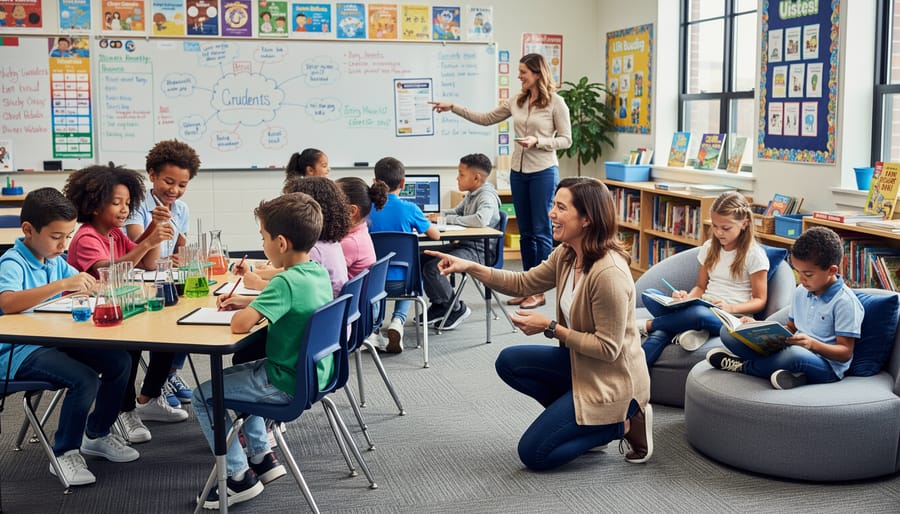
Learning engagement strategies succeed by tapping into how students naturally learn best. When you apply these strategies effectively, you’re not simply adding activities to keep students busy. You’re designing experiences that connect learning to what students care about, giving them reasons to invest their attention and effort.
The foundation of any engagement strategy lies in relevance. Students engage when they see how content relates to their lives, interests, or future goals. A math problem about calculating percentages becomes compelling when it involves analyzing statistics from a sport they follow or budgeting for something they want to buy. This connection transforms abstract concepts into meaningful challenges worth solving.
Autonomy plays an equally vital role. Engagement strategies that offer students choices about how they learn, what examples they explore, or how they demonstrate understanding activate their intrinsic motivation. Even small decisions, like choosing which problem to tackle first or selecting a partner for discussion, help students feel ownership over their learning rather than passive recipients of instruction.
The right level of challenge matters tremendously. Strategies work best when tasks stretch students just beyond their current comfort zone, what educational researchers call the zone of proximal development. Too easy and students disengage from boredom; too hard and they shut down from frustration. Effective engagement strategies include scaffolding that helps students tackle appropriately challenging work with support.
In practice, engagement strategies function as a continuous cycle. You plan a strategy based on your learning objectives and knowledge of your students. You implement it during instruction, then observe carefully: Are students participating? Do they seem confused, excited, or checked out? This observation informs your next move. Maybe you adjust the difficulty, add more structure, or shift to a different approach mid-lesson.
This cycle repeats constantly. The most engaged classrooms emerge when teachers treat strategies as flexible tools rather than rigid scripts. You notice what works for this group of students on this particular day with this specific content, then refine your approach accordingly. Over time, you build an intuitive sense of which strategies activate engagement for different learning situations.
Core Categories of Engagement Strategies
Interactive and Collaborative Strategies
Interactive strategies transform passive classrooms into dynamic learning communities where students construct knowledge together. These approaches work especially well when you want to deepen understanding through dialogue, build social skills, or help students see multiple perspectives on a topic.
Think-pair-share remains one of the most versatile techniques: pose a question, give students a moment to think individually, then have them discuss with a partner before sharing with the class. It’s perfect for processing new information, checking understanding mid-lesson, or warming up for deeper discussion. The individual thinking time ensures every student forms an idea before the social component begins, giving quieter learners a voice.
Peer teaching takes this further by positioning students as experts who explain concepts to classmates. When a student teaches something, they process it at a deeper cognitive level than when simply learning it. Assign small groups different aspects of a topic to master and teach, or pair students strategically so stronger performers support those still building skills.
Group projects work best when structured with clear roles, accountability measures, and regular check-ins. Without this scaffolding, a few students often carry the load while others disengage. Define what collaboration looks like, build in peer feedback moments, and assess both individual contributions and group outcomes.
Consider matching specific interactive strategies to your learning goals and student needs:
- Gallery walks for visual learners to examine multiple examples and provide peer feedback
- Jigsaw method for complex topics that can be divided into expert sections
- Socratic seminars for text-based discussions requiring evidence and critical thinking
- Numbered heads together for quick checks where every group member must be ready to answer
- Round robin for ensuring equal participation when brainstorming or reviewing
Discussion protocols provide the structure that makes conversations productive rather than chaotic. Establish norms for speaking, listening, and disagreeing respectfully. Teach students to build on each other’s ideas with sentence stems like “I’d add to what Maya said…” or “I see it differently because…” These protocols turn talk into genuine collaborative thinking, not just taking turns speaking.
The key to success with interactive strategies is starting small, teaching the process explicitly, and gradually building your students’ capacity for productive collaboration throughout the year.
Technology-Enhanced Engagement

Digital tools offer powerful ways to capture student attention and create interactive learning experiences that weren’t possible a decade ago. The key is choosing technologies that genuinely enhance participation rather than just digitizing traditional activities.
Educational games and gamification elements tap into students’ natural desire for challenge and achievement. Platforms like Kahoot, Quizizz, and Blooket transform review sessions into energetic competitions, while adaptive learning games adjust difficulty based on student performance. These work best when used strategically, once or twice a week rather than every lesson, to maintain their novelty and impact.
Interactive polling and response systems give every student a voice. Tools like Poll Everywhere, Mentimeter, or your learning management system’s built-in polling let you check understanding in real time, gather opinions on discussion questions, or conduct quick formative assessments. The immediate visual feedback (word clouds, bar graphs, response percentages) shows students their ideas matter and helps you adjust your pacing on the spot.
Virtual labs and simulations bring expensive or dangerous experiments into reach. Students can dissect virtual frogs, explore chemical reactions, manipulate physics variables, or tour historical sites without leaving the classroom. These experiences work particularly well when students can control variables and see immediate consequences of their choices.
Multimedia presentations, short videos, podcasts, interactive infographics, break up direct instruction and appeal to different learning preferences. The most effective approach layers these elements into lessons rather than replacing teacher-student interaction entirely. Start with one new tool per month, master it, then add another to avoid technology overload for everyone involved.
Student-Centered and Choice-Based Approaches
Student-centered and choice-based approaches shift decision-making power to learners, transforming them from passive recipients into active architects of their own education. When students have meaningful say in what they learn, how they learn it, or how they demonstrate mastery, their investment in the work deepens dramatically.
Choice boards offer structured autonomy: you present a grid of activities aligned to the same learning objective, and students pick the path that resonates with their interests or strengths. A social studies teacher might offer choices like creating a timeline, writing diary entries from a historical figure’s perspective, or building a model, all targeting the same content standard. The structure ensures rigor while honoring student preference.
Self-paced learning lets students move through material at their own speed, spending extra time on challenging concepts and accelerating through content they grasp quickly. Platforms supporting Z-Learning Zeta and similar personalized frameworks help you manage differentiated timelines without losing track of individual progress.
Student-led discussions position learners as facilitators. After teaching the protocol, you step back while students guide their peers through text analysis or problem exploration. They gain ownership and develop leadership skills you can’t teach through lecture.
Project-based learning extends choice across weeks: students identify real problems, design solutions, and present findings to authentic audiences. The key is setting clear learning targets and checkpoints so freedom doesn’t drift into confusion. When choice has scaffolding, students thrive within boundaries that still feel expansive.
Active Learning Techniques
Active learning techniques put students’ bodies in motion and their hands on materials, transforming passive listening into physical experience. These strategies work especially well for kinesthetic learners and students who struggle to stay focused during traditional instruction, but they benefit all learners by creating memorable, multisensory connections to content.
Manipulatives bring abstract concepts to life through tangible objects. Math teachers use base-ten blocks, fraction bars, or algebra tiles so students can literally see and feel mathematical relationships. In literacy, letter tiles or sentence strips let students physically rearrange words and build understanding through touch. The key is giving students time to explore and discover patterns themselves rather than just demonstrating with manipulatives at the front of the room.
Station rotations break learning into focused segments where small groups move through different activities. You might design five stations for a science unit: one for hands-on experiments, another for reading and note-taking, a third for digital simulations, a fourth for collaborative problem-solving, and a fifth for creative application. Students stay engaged because the activity and location change every fifteen minutes, and you can differentiate by adjusting what happens at each station.
Lab experiences and simulations immerse students in real-world applications. Science labs are obvious examples, but any subject can incorporate experiential learning. History students might role-play a constitutional convention, literacy students conduct author studies through investigation and analysis, or math students use measurement tools to solve practical design challenges. These experiences stick because students aren’t just learning about something, they’re doing it.
Where Engagement Strategies Make the Biggest Impact
Engagement strategies aren’t one-size-fits-all; their effectiveness depends heavily on context. Understanding where specific approaches shine helps you deploy them strategically rather than randomly.
In mathematics classrooms, collaborative problem-solving and manipulative-based activities consistently outperform passive instruction. Elementary students grasp fractions better through hands-on fraction bars and group discussions, while high school algebra students benefit from think-pair-share sequences that let them work through multi-step problems together. Science naturally lends itself to lab-based engagement and inquiry learning, where students generate their own questions and design investigations. The hands-on nature keeps participation high across all grade levels.
Literacy instruction sees strong results with choice-based reading strategies and peer discussion protocols. When students select texts within a themed unit, engagement increases substantially compared to assigned readings. Student-led book clubs and Socratic seminars work particularly well in middle and high school, while elementary literacy centers with varied activities keep younger learners actively involved.
Social studies benefits from simulation activities and role-play scenarios. Fifth graders debating historical perspectives or high school students running mock trials show deeper content retention than traditional lecture formats. These strategies transform abstract concepts into memorable experiences.
Grade level matters significantly. Elementary students need shorter activity bursts with clear transitions, so station rotations and brief collaborative tasks work best. Middle schoolers thrive with peer interaction strategies that channel their social energy productively. High school students can sustain longer inquiry projects and appreciate authentic choice in demonstrating learning.
For diverse learners, differentiated stations with varied entry points maintain engagement without isolating students. Reluctant learners often respond to low-stakes participation structures like exit tickets or pair shares that reduce public performance anxiety. Gifted students need extension opportunities and complex challenges, not just more work.
The key to knowing what works lies in measurement. Tools like instant learning feedback systems show you which students engage during specific activities, while R pathway analysis reveals patterns across different strategy types. Even simple journal learning analytics tracking participation over time helps you identify which approaches consistently generate active involvement versus passive compliance in your specific classroom context.
Using Learning Engagement Analytics to Strengthen Your Strategies

You already collect engagement data every time you teach, you notice which students participate, where energy drops, and when a strategy sparks genuine interest. Learning engagement analytics simply helps you capture these observations systematically and use them to refine what you do. Rather than relying solely on memory or impressions, you can track patterns over time and make adjustments grounded in real evidence.
Start with straightforward metrics that connect directly to your classroom experience. Participation rates show you how many students actively contribute during discussions, activities, or collaborative work. Completion patterns reveal whether students finish assigned tasks, rush through them, or abandon them partway. Interaction quality matters more than quantity: are students asking thoughtful questions, building on each other’s ideas, or just going through the motions? These indicators tell you whether your engagement strategies genuinely reach students or need rethinking.
Real-time engagement insights let you respond while a lesson unfolds rather than discovering gaps afterward. When you notice participation dropping during independent practice, you can shift to a quick pair discussion. If digital platform data shows students clustering around certain activities, you understand which formats resonate with your class.
Observable indicators give you concrete data points to track:
- On-task behavior during work periods and transitions
- Quality of contributions in discussions and written responses
- Persistence when students encounter challenging problems or concepts
- Peer collaboration patterns and group dynamics
- Voluntary participation beyond required minimums
Recording these observations weekly creates a running record that shows whether strategies improve engagement over time. Simple tracking methods work: a quick tally during group work, notes on which students contributed during discussion, or a brief reflection after trying a new approach. Digital tools streamline this process, but a notebook serves the same purpose.
The power comes from closing the loop between data and action. When you notice a pattern, perhaps morning discussions engage more students than afternoon ones, or certain groups consistently struggle with collaborative tasks, you adjust accordingly. Maybe you move high-engagement activities to afternoons or provide clearer collaboration protocols. Analytics transforms teaching from intuition alone into a combination of professional judgment and evidence, helping you understand which strategies genuinely work for your students right now.
Common Questions About Learning Engagement Strategies
Implementing engagement strategies raises practical questions for every educator. Whether you’re trying your first collaborative activity or refining techniques you’ve used for years, these common concerns deserve clear answers.
How much time does implementing engagement strategies really take?
Most engagement strategies add minimal time once you’ve practiced them a few times. A think-pair-share takes five minutes, while setting up learning stations might require 20 minutes of prep that pays off across multiple lessons. Start with low-prep strategies like cold calling or quick polls, then gradually add techniques that require more setup as you build confidence.
What should I do if a strategy completely flops?
A failed strategy offers valuable information about your students’ needs and your classroom dynamics. Debrief with students about what didn’t work, adjust one variable at a time (timing, grouping, instructions, or complexity), and try again with modifications. Even experienced teachers have strategies that bomb, it’s part of the learning process for everyone in the room.
How do I balance engagement with covering required content?
Engagement strategies aren’t separate from content delivery; they’re how you deliver content more effectively. Students retain more from 30 minutes of active discussion than from 50 minutes of passive listening. The question isn’t whether you have time for engagement, it’s whether you can afford not to use strategies that help students actually learn and remember the material.
How can I reach students who seem chronically disinterested?
Chronic disengagement usually signals a mismatch between your strategies and that student’s needs, not a character flaw. Try varying your approach: some students need movement, others need quiet reflection time, and many need to see clear relevance to their lives. One-on-one conversations about their interests can reveal entry points you haven’t considered, and giving them small leadership roles often sparks unexpected investment.
The difference between entertainment and engagement sometimes confuses educators who worry that making learning enjoyable means dumbing it down. Entertainment is passive and fleeting, students might enjoy a video but forget it by lunch. Engagement is active and sticky. When students debate a historical decision, build a model to test a scientific principle, or write for a real audience, they’re working hard and thinking deeply. The enjoyment comes from meaningful challenge and intellectual satisfaction, not from being amused.
You’ll know you’ve crossed from entertainment into genuine engagement when students keep working after the bell rings, when they reference the activity days later, or when they ask to do similar work again. That persistence signals cognitive and emotional investment, not just momentary fun.
Learning engagement strategies aren’t just add-ons to your teaching, they’re the foundation of meaningful classroom experiences that stick with students long after the lesson ends. You don’t need to overhaul everything at once. Start with one strategy that feels right for your classroom, observe how your students respond, and build from there. Each small step you take creates momentum.
The Teach Find community is here to support your journey. Connect with fellow educators in our forums to share what’s working, troubleshoot challenges, and discover fresh approaches that colleagues are testing in their own classrooms. Use our interactive tools to track what resonates with your students and refine your practice.
When you invest in engagement, you’re not just improving participation metrics, you’re showing students that their voices, curiosity, and active involvement matter. That’s the kind of teaching that transforms classrooms and shapes how students see themselves as learners for years to come.