Every time you grade a student’s work, you’re making a promise—that your assessment accurately measures what students know and that similar work will receive similar scores. Yet many educators discover their assessments fall short on these two fundamental qualities: validity (measuring what you intend to measure) and reliability (producing consistent results). When assessments lack validity, you might award high marks to students who haven’t mastered the content. When they lack reliability, two teachers could grade the same essay and arrive at vastly different scores, leaving students confused and parents frustrated.
The good news? You already possess the judgment needed to create strong assessments. What you may be missing are practical strategies to systematically strengthen both validity and reliability in your classroom. Small adjustments to how you design rubrics, align questions to learning objectives, and review student work can dramatically improve assessment quality. These improvements directly translate to better instructional decisions, more equitable grading practices, and clearer feedback that actually helps students grow.
This guide cuts through academic jargon to give you immediately applicable tools. You’ll discover why a well-crafted multiple-choice question can be more valid than a poorly designed essay prompt, how calibration sessions with colleagues can eliminate scoring inconsistencies, and which red flags signal that your assessment might be measuring test-taking skills rather than true understanding. Whether you’re refining a unit test, developing a performance task, or simply wanting more confidence in your grading, these evidence-based strategies will help you create assessments that truly serve your students and accurately capture their learning.

What Assessment Validity Really Means in Your Classroom
The Three Types of Validity Every Teacher Should Know
Understanding validity starts with recognizing that not all assessments measure what we think they measure. Let’s break down three essential types of validity that will help you design better assessments and interpret results more accurately.
Content validity asks a straightforward question: Does your assessment actually cover what you taught? Imagine teaching a unit on the water cycle, complete with lessons on evaporation, condensation, precipitation, and collection. If your test only asks questions about evaporation, it lacks content validity because it doesn’t represent the full scope of instruction. To strengthen content validity, create a simple chart matching your learning objectives to test questions. This ensures you’re assessing everything students should have learned, not just your favorite topics or the easiest concepts to test.
Construct validity goes deeper, examining whether your assessment truly measures the intended skill or concept. For instance, if you want to assess student understanding of main idea in reading, but your questions require complex vocabulary knowledge to answer, you might actually be measuring vocabulary instead. A math word problem meant to test multiplication skills might inadvertently measure reading comprehension if the language is too complex. Ask yourself: What is this question really measuring? Consider having a colleague review your assessments to spot these hidden barriers that can cloud your results.
Criterion validity looks at whether your assessment predicts future performance or relates to other measures of the same skill. Does your classroom writing rubric align with district writing benchmarks? Do students who score well on your science quizzes also succeed on end-of-year standardized tests? While you won’t always have comparison data available, being aware of criterion validity helps you understand whether your assessments prepare students for what comes next. This connection matters because our ultimate goal extends beyond individual classroom success to long-term student achievement.
Common Threats to Assessment Validity
Even with the best intentions, certain common pitfalls can compromise your assessment’s validity. Recognizing these threats helps you design better measurements of student learning.
Confusing or ambiguous wording frequently undermines validity. When a math word problem asks students to “determine the difference,” some may subtract while others interpret it as identifying what makes two items distinct. The assessment then measures language interpretation rather than mathematical understanding. Keep language direct and age-appropriate, testing one concept at a time.
Reading level barriers create particular challenges. A fifth-grade science test written at an eighth-grade reading level measures literacy skills instead of science knowledge. Students who understand photosynthesis may fail simply because they cannot decode the questions. Consider offering visual supports, simplified sentence structures, or oral administration when reading ability isn’t your learning target.
Cultural bias presents subtle validity issues. An assessment asking students to describe “traditional family dinners” assumes uniform cultural experiences. A question about snow activities disadvantages students from warm climates. Review assessments through diverse lenses, ensuring examples and contexts connect with all learners in your classroom.
Misalignment with learning objectives represents perhaps the most significant threat. If you taught students to analyze persuasive techniques but your test only asks them to identify thesis statements, you are not measuring what you intended. This disconnect makes results meaningless for instructional decisions. Strong effective classroom assessment techniques ensure tight alignment between objectives, instruction, and assessment items, creating valid measures of student progress.
Understanding Reliability: Why Consistency Matters
Types of Reliability in K-12 Assessment
Understanding the different types of reliability helps you choose and design assessments that work best for your specific classroom needs. Let’s explore three key types and how they apply to your daily teaching practice.
Test-retest reliability measures whether students get similar results when taking the same or equivalent assessment at different times. This matters most when you’re tracking student progress over time or using benchmark assessments. For example, if a student scores proficient on a reading assessment in September and then scores below basic on a similar assessment in October without any instructional changes, you might question the test-retest reliability. This type is particularly important for formative assessments you use repeatedly throughout the year.
Inter-rater reliability examines whether different teachers score student work consistently using the same criteria. This becomes essential when multiple teachers grade the same type of assignment, such as essays, projects, or performance tasks. Imagine three teachers scoring the same persuasive essay: if one gives it a 95, another assigns an 80, and the third marks it as 72, you have an inter-rater reliability issue. Regular calibration sessions with your colleagues can significantly improve this consistency, ensuring fairness across classrooms and helping students understand what quality work looks like.
Internal consistency checks whether different questions on the same assessment measure the same skill or concept reliably. If students who answer some multiplication problems correctly consistently miss others that test the same skill, the assessment might lack internal consistency. This type of reliability is especially valuable when you’re creating unit tests or comprehensive assessments. You can strengthen internal consistency by ensuring questions align closely with your learning objectives and by reviewing which items students find unexpectedly difficult or easy.
Each type serves a unique purpose in creating fair, trustworthy assessments for your students.
What Makes Assessments Unreliable?
Several common factors can undermine the reliability of your assessments, but the good news is that each has a practical solution you can implement right away.
Vague or poorly defined rubrics are among the most frequent culprits. When scoring criteria use subjective language like “excellent” or “needs improvement” without clear descriptors, different evaluators interpret these terms differently—and even the same teacher may score inconsistently over time. The solution is to create detailed rubrics with specific, observable criteria that describe exactly what performance looks like at each level.
Unclear or confusing directions can also compromise reliability. When students misunderstand what’s being asked, their responses reflect confusion rather than actual knowledge or skills. Before administering any assessment, test your directions with a colleague or small group of students, and revise based on their feedback.
Environmental factors matter more than we sometimes realize. Testing during a fire drill, in an uncomfortably hot room, or right before lunch can affect student performance in ways that have nothing to do with their actual understanding. While you can’t control everything, you can schedule assessments thoughtfully and create the most consistent testing conditions possible.
Inconsistent scoring practices present another challenge, especially when multiple teachers grade the same assessment or when you’re scoring many papers over several days. Regular calibration sessions with colleagues help ensure everyone applies criteria consistently. Even when working alone, score all responses to one question at a time rather than grading entire assessments sequentially—this helps maintain consistent standards throughout the scoring process.
The Connection Between Validity and Reliability
Understanding how validity and reliability work together is essential for creating effective assessments. Think of it this way: imagine a bathroom scale that consistently shows you weigh five pounds more than you actually do. That scale is reliable because it gives the same result each time, but it’s not valid because it’s not measuring your true weight. Now imagine a scale that gives you a different reading every time you step on it. Even if one of those readings happens to be correct, the scale isn’t reliable enough to be useful. You need both qualities for an assessment that truly serves your students.
Here’s a helpful visual metaphor to remember this relationship: picture a target with a bullseye. The bullseye represents what you’re actually trying to measure, like student understanding of fractions. If your assessment results cluster tightly together but miss the bullseye entirely, you have reliability without validity. You’re consistently measuring something, just not what you intended. If your results scatter all around the bullseye with no pattern, you have neither reliability nor validity. The goal is to have your results cluster tightly around the bullseye, demonstrating both consistency and accuracy.
In practical terms, a reliable but invalid assessment might consistently measure test-taking skills rather than content knowledge. A valid but unreliable assessment might have poorly worded questions that confuse students differently each time. When you strengthen both qualities in your assessments, you create tools that genuinely inform your data-driven instruction strategies and help students grow.
The good news? When you work on improving one quality, you often strengthen the other. Clear learning objectives, well-written questions, and consistent scoring all contribute to assessments that are both valid and reliable, giving you confidence in the decisions you make based on student results.
Calibration: Your Secret Weapon for Fair Assessment
What Calibration Looks Like in Practice
Calibration transforms abstract scoring criteria into shared, practical understanding among educators. The process begins when teachers bring student work samples to a collaborative session—perhaps a department meeting, professional learning community time, or dedicated calibration workshop. Each educator independently scores the same pieces of student work using the established rubric or scoring guide.
Here’s where the real learning happens. Teachers compare their scores and discuss discrepancies openly. Why did one teacher mark an essay as proficient while another scored it as developing? What specific evidence in the student work led to different interpretations? These conversations reveal how individual educators understand the standards differently, bringing hidden assumptions to light in a supportive environment.
Through guided discussion, the team works toward consensus. You might spend 15-20 minutes on a single piece of student work, examining specific elements like thesis statements, use of evidence, or mathematical reasoning. This isn’t about proving anyone right or wrong—it’s about developing a collective understanding of what quality looks like at each performance level.
As consensus emerges, the team creates anchor papers: exemplar student work samples that clearly represent each scoring level. These become your reference points for future scoring. Label them clearly, annotate key features that justify the score, and make them accessible to all teachers who will use the assessment.
Many schools find it helpful to document the calibration session through notes or recordings, capturing the reasoning behind scoring decisions. This documentation becomes invaluable when training new teachers or revisiting the rubric later. Digital platforms and community forums can facilitate ongoing calibration conversations beyond scheduled meetings, allowing teachers to share work samples and discuss scoring questions as they arise throughout the school year.

Building a Culture of Calibration in Your School
Creating a culture of calibration in your school doesn’t require a complete overhaul of your existing structures. Instead, you can weave calibration practices into the meetings and collaborative time you already have scheduled.
Start with department meetings by dedicating 20-30 minutes each month to collaborative scoring. Bring sample student work representing different performance levels, and have teachers score them independently before discussing their ratings. This process reveals where interpretations diverge and helps establish shared expectations. You’ll find that these conversations naturally lead to clearer rubrics and more consistent grading practices across your department.
Grade-level teams can build calibration into their regular planning sessions. Consider rotating which subject area you focus on each meeting. For example, this month you might calibrate math problem-solving assessments, while next month you tackle writing samples. This approach keeps the work manageable while steadily improving reliability across all subject areas.
Cross-curricular collaboration offers powerful opportunities to align expectations for skills that span multiple subjects, such as critical thinking, written communication, or research skills. Schedule quarterly sessions where teachers from different departments come together to examine how they assess these shared competencies. You might discover that your English and Social Studies teachers have very different expectations for citing sources, creating an opportunity to develop school-wide standards.
Make calibration sessions interactive and engaging by using online platforms where teachers can submit scores anonymously, then reveal and discuss the range of results. You can also create a shared digital library of anchor papers, annotated with comments explaining why they represent particular performance levels.
Remember that building this culture takes time. Start small, celebrate progress, and gradually expand your calibration practices as teachers experience the benefits. The goal isn’t perfection but continuous improvement in how reliably and fairly you assess student learning.
Practical Strategies to Improve Assessment Quality
Creating Clear, Aligned Assessment Items
Creating assessment items that truly measure what you intend to teach starts with a clear connection between your learning objectives and your questions. The key is ensuring every assessment task directly reflects the knowledge or skills you’ve identified as important.
Begin by reviewing your learning objective. Ask yourself: What would successful mastery of this objective actually look like in student work? If your objective states students will “analyze the causes of historical events,” your assessment should require analysis, not just recall of facts.
Let’s look at a practical revision example. A weak item might ask: “List three causes of the American Revolution.” This only measures memorization. A stronger version would be: “Choose two causes of the American Revolution and explain how they influenced each other.” This second version requires the analytical thinking your objective promises to measure.
Another common misalignment occurs with math objectives. If you’re teaching problem-solving strategies, avoid items that simply ask students to calculate answers using a single method. Instead, present a real-world scenario requiring students to choose and justify their approach.
When crafting your assessment methods, use action verbs from your objectives as guides. If the objective says “compare,” your item should ask students to compare. If it says “create,” students should produce something original.
Review each item with this simple checklist: Does this question require students to demonstrate the specific skill or knowledge from my objective? If you can’t draw a direct line between them, revision is needed.
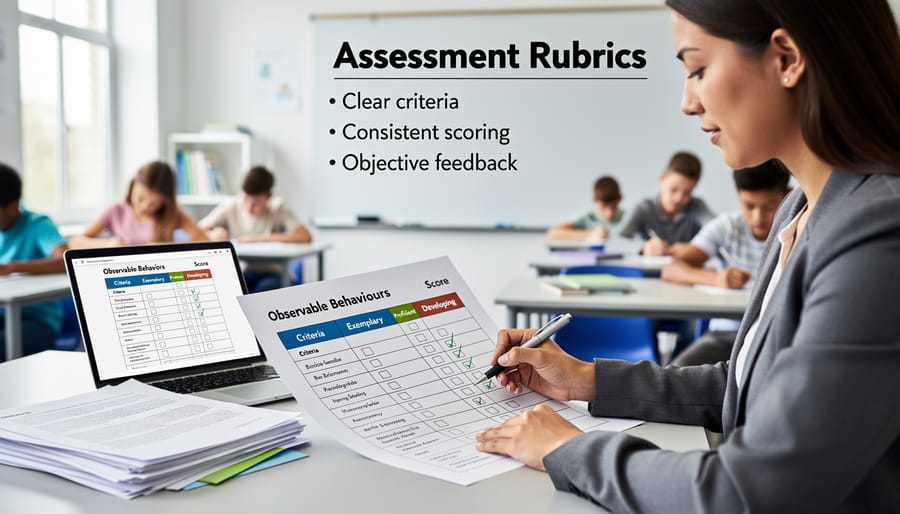
Developing and Using Effective Rubrics
Creating effective rubrics is one of the most powerful ways to strengthen both validity and reliability in your assessments. A well-designed rubric ensures you’re measuring what you intend to measure while enabling consistent scoring across different evaluators and time periods.
Start by identifying specific, observable criteria that directly align with your learning objectives. Instead of vague descriptors like “good understanding,” use concrete language such as “accurately identifies three main causes” or “provides textual evidence for each claim.” This specificity helps eliminate guesswork and personal interpretation.
Design your rubric with clear performance levels that distinguish between different degrees of mastery. Each level should describe what students actually do at that stage, not just assign point values. For example, rather than “5 points: excellent,” write “consistently uses appropriate vocabulary with fewer than two errors throughout the response.”
Test your rubric before full implementation by scoring sample student work with colleagues. This practice, which supports student-centered assessment approaches, reveals ambiguities and helps refine criteria. When multiple teachers independently arrive at similar scores using your rubric, you know it’s working effectively.
Share rubrics with students before assignments begin. Transparency about expectations not only improves validity by clarifying what you’re assessing but also empowers students to self-assess and track their progress. Many educators find that involving students in rubric creation deepens understanding and ownership of learning goals.
Consider starting with simple templates and gradually adding complexity as you become comfortable with the process.
Quick Checks You Can Do Tomorrow
You don’t need to overhaul your entire assessment system to start improving validity and reliability. Here are three practical checks you can implement right away with minimal preparation.
Start with an alignment check by taking one of your assessments and placing it side-by-side with your learning objectives. For each question or task, ask yourself: Does this directly measure what I intended to teach? You might discover that some questions test reading comprehension when you meant to assess science reasoning, or that you’re missing questions about key concepts entirely. This 15-minute exercise often reveals surprising gaps and helps you make quick adjustments.
Next, try a simple peer review exchange with a colleague. Share one assessment and ask them to identify what each question measures without seeing your answer key. Their interpretation will show you whether your questions communicate clearly or if students might misunderstand what you’re asking. This collaborative approach builds your professional community while strengthening your assessments.
Finally, gather student feedback using a brief exit survey after your next assessment. Ask students three questions: What did this assessment ask you to show? Was anything confusing? Did you have enough time? Their responses provide invaluable insights into whether your assessment actually measures what students understand or just who reads fastest or guesses well.
These strategies require minimal time investment but offer immediate insights into your assessment quality. Pick one to try this week, and you’ll start building stronger, more meaningful measures of student learning.
Addressing Special Considerations in K-12
Ensuring Equity Through Valid, Reliable Assessment
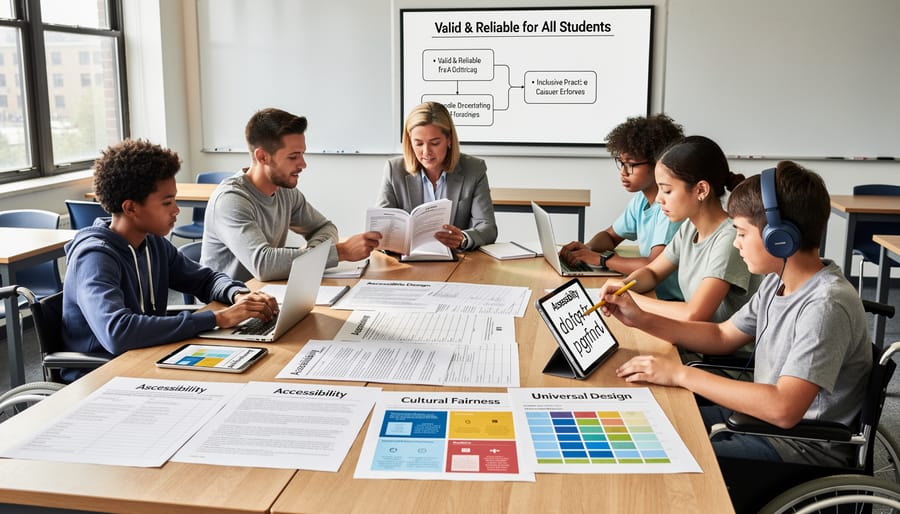
Creating fair assessments means ensuring every student has an authentic opportunity to demonstrate what they know, regardless of their learning differences, language backgrounds, or circumstances. When you design assessments with equity at the forefront, you actually strengthen both validity and reliability rather than compromising them.
Universal Design for Learning (UDL) principles offer a powerful framework for creating assessments that work for diverse learners from the start. Instead of creating one assessment and then adding modifications afterward, consider how you can build flexibility into the original design. For example, allow students to show understanding through multiple formats—written responses, oral explanations, visual representations, or demonstrations. This approach measures the learning target more validly because it removes barriers that might prevent students from showing what they truly know.
Accommodations and modifications serve different purposes in maintaining fairness. Accommodations change how students access or demonstrate learning without altering what’s being measured. Examples include extended time, reading questions aloud, or providing a quiet testing space. These preserve validity because they remove obstacles without changing the assessment’s purpose. Modifications, however, alter the content or expectations and should be applied thoughtfully when students have specific learning goals that differ from grade-level standards.
Consider implementing these inclusion strategies in your assessment design: provide clear instructions with visual supports, use plain language, offer choices in response format, ensure adequate spacing and readable fonts, and allow the use of assistive technology. When you pilot new assessments, actively seek feedback from students with diverse needs to identify unintended barriers.
Remember that fair assessments benefit all students. When you reduce unnecessary complexity and remove barriers to access, you create clearer, more reliable measurements of student learning across your entire classroom.
Grade-Level Differences in Assessment Design
Assessment design evolves significantly across grade levels, requiring different approaches to ensure validity and reliability. In elementary grades, assessments should emphasize concrete, observable skills with clear success criteria. Younger students benefit from performance-based tasks, visual demonstrations, and shorter assessment periods that accommodate developing attention spans. Consider using pictures, manipulatives, and oral responses alongside written work to capture authentic learning.
Middle school assessments can incorporate more complex thinking while maintaining clarity. Students at this level can handle multi-step problems and begin self-assessing their work, which supports both validity and reliability when guided properly.
High school assessments may include sophisticated analysis and extended projects, but the fundamental principles remain constant. Regardless of grade level, align assessments with learning objectives, provide clear rubrics, and ensure consistent scoring practices. Remember that younger students need more scaffolding and immediate feedback, while older students can engage in reflection and revision processes that deepen assessment quality. Adapt your methods to match developmental stages while maintaining rigorous standards for measuring what truly matters in student learning.
You’ve taken an important step by exploring how validity and reliability strengthen your assessment practices. Understanding these concepts empowers you to make more informed decisions about student learning and instructional next steps. When your assessments accurately measure what students know and do so consistently, you gain clearer insights into where each learner stands and how to support their growth effectively.
The journey to improving your assessments doesn’t require perfection from day one. Start small. Choose one assessment you use regularly and apply the strategies you’ve learned here. Perhaps you’ll develop a clearer scoring rubric, calibrate with a colleague, or revisit your test questions to ensure alignment with learning objectives. Each small refinement builds your confidence and expertise.
Remember that your professional judgment remains central to this work. You know your students, your curriculum, and your classroom context better than anyone. The tools and techniques for enhancing validity and reliability serve to support and strengthen the decisions you already make daily. They provide structure and evidence to back up what you observe and understand about student learning.
You’re not alone in this process. Connect with colleagues through community forums to share experiences, troubleshoot challenges, and celebrate successes. Explore interactive tools that can streamline your assessment development and analysis. Most importantly, trust that every effort you make toward more valid and reliable assessments directly benefits your students by ensuring they receive the accurate feedback and targeted instruction they deserve.