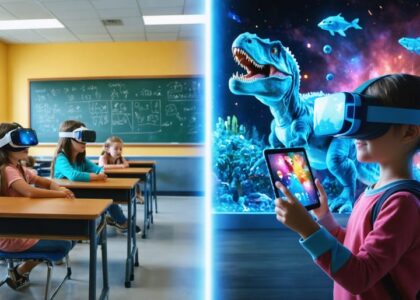
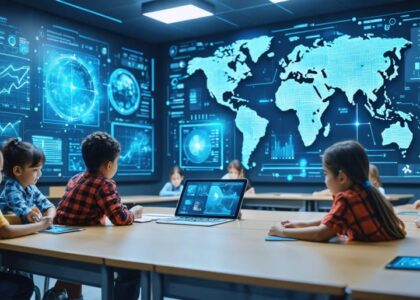
Imagine your students exploring the inside of a human cell, walking through ancient Rome at the height of its empire, or practicing complex surgical procedures—all without leaving your classroom. Full immersion virtual reality makes these experiences possible by creating computer-generated environments that engage multiple senses simultaneously, allowing learners to interact with digital content as if it were physically real.
Unlike traditional educational videos or even standard VR experiences, full immersion technology uses head-mounted displays, motion tracking, and sometimes haptic feedback to create a convincing sense of presence. When a student wearing a VR headset looks around, the virtual world responds naturally to their movements. They can reach out to manipulate objects, walk through spaces, and experience scenarios that would be impossible, dangerous, or prohibitively expensive in the physical world.
This technology represents more than just an exciting novelty for your classroom—it addresses a fundamental challenge you face daily: engaging diverse learners with varying needs and learning styles. Full immersion VR transforms abstract concepts into tangible experiences. A student struggling with geometry can physically walk around three-dimensional shapes. A history lesson becomes a journey through time. Science experiments too dangerous or costly for school laboratories become safe, repeatable learning opportunities.
You might wonder about the practical realities: the cost, the technical expertise required, or whether this technology truly improves learning outcomes. These are valid concerns that deserve honest answers. The truth is that full immersion VR has evolved significantly in recent years, with more affordable options, user-friendly platforms, and growing research supporting its educational impact.
This guide will help you understand exactly what full immersion VR is, how it works in real classrooms across different subjects, and practical steps for bringing this transformative technology to your students.

What Full Immersion Virtual Reality Really Means for Your Classroom
The Technology Behind True Immersion
Full immersion virtual reality brings together several key technologies to create learning experiences that feel remarkably real. Understanding these components helps you make informed decisions about bringing this technology into your classroom.
At the foundation are **360-degree visuals** delivered through a VR headset. Unlike watching a screen, students can look in any direction—up, down, around—and see a complete digital environment surrounding them. Modern educational VR headsets have become lighter and more comfortable, designed with students in mind.
**Spatial tracking** is what makes the magic happen. Sensors detect when students move their heads or bodies, instantly updating what they see. Turn left in a virtual museum, and the exhibits shift naturally with your movement. This responsive feedback creates the sense of truly “being there” rather than just watching.
**Sensory engagement** extends beyond vision. Many systems include spatial audio, so sounds come from specific directions—hear a dinosaur approaching from behind or a teacher’s voice from across a virtual lab. Some advanced systems add haptic feedback through handheld controllers, letting students “touch” and manipulate objects.
When these elements work together seamlessly, students stop thinking about the technology and start focusing entirely on learning. The classroom walls disappear, replaced by ancient Rome, the ocean floor, or the inside of a human cell—all accessible without leaving your building.
How It Differs From Other Immersive Technologies
Understanding where full immersion VR fits among VR and AR technologies helps you choose the right tool for your learning goals.
**Augmented Reality (AR)** overlays digital information onto the real world through tablets or phones. Students might point a device at a classroom wall to see the solar system projected there. AR keeps students grounded in their physical space while adding digital layers.
**360-degree videos** let students look around recorded environments using headsets or screens. While immersive, these are passive experiences—students observe but can’t interact with or change anything they see.
**Screen-based simulations** run on computers or tablets, offering interactive experiences without headsets. These work well for many learning activities but lack the sense of “being there” that headsets provide.
**Full immersion VR** creates completely digital environments where students can move, interact, and manipulate objects as if physically present. It offers the deepest level of engagement and presence, making it particularly powerful for experiences impossible in classrooms—like exploring ancient civilizations or practicing complex procedures in safe environments. Each technology has its place in your toolkit, depending on your learning objectives and available resources.
Why Full Immersion VR Creates Deeper Learning Experiences
The Science of Learning Through Experience
When students step into a full immersion VR environment, something remarkable happens in their brains. Unlike passive learning methods, these experiences activate multiple brain regions simultaneously—the visual cortex processes rich imagery, the motor cortex engages with physical interactions, and the hippocampus works overtime encoding these vivid memories for long-term storage.
Research shows that immersive learning creates stronger neural pathways because our brains process virtual experiences similarly to real ones. When a student explores the Amazon rainforest in VR, their brain responds as if they’re actually there, releasing the same neurochemicals that strengthen memory formation. This “learning by doing” approach taps into our most natural way of understanding the world.
The beauty of VR lies in its ability to support diverse learners simultaneously. Visual learners benefit from three-dimensional models they can examine from every angle. Kinesthetic learners thrive through hands-on manipulation of virtual objects. Even auditory learners engage through spatial sound that provides context and direction. This multi-sensory approach creates personalized learning experiences that meet students where they are.
Perhaps most importantly, immersive experiences trigger emotional engagement—a crucial ingredient for deep learning. When students feel present in a historical moment or scientific discovery, they’re not just memorizing facts; they’re building meaningful connections that last. This emotional resonance transforms abstract concepts into concrete understanding, making learning both effective and memorable.
Emotional Engagement That Drives Understanding
When students step into a full immersion VR experience, something remarkable happens—they don’t just observe content, they *feel* it. This emotional connection transforms passive learning into powerful personal experience.
Imagine your students standing on the deck of a slave ship, walking through a refugee camp, or experiencing life with a physical disability. The sense of presence—of truly *being there*—creates empathy in ways textbooks simply cannot achieve. Research shows that this embodied learning experience helps students retain information longer and develop deeper understanding of complex social issues.
The motivation factor is equally compelling. When learners feel personally connected to their virtual environment, engagement skyrockets. Students who typically struggle to focus during traditional lessons often become completely absorbed in VR experiences. This mirrors the engagement we see with game-based learning, but with an added layer of emotional authenticity.
You’ll notice this emotional investment translates to classroom discussions. Students return from VR experiences eager to share, question, and explore further. They’re not just completing an assignment—they’re processing meaningful experiences that matter to them personally, creating the foundation for genuine, lasting understanding.
Making Abstract Concepts Concrete
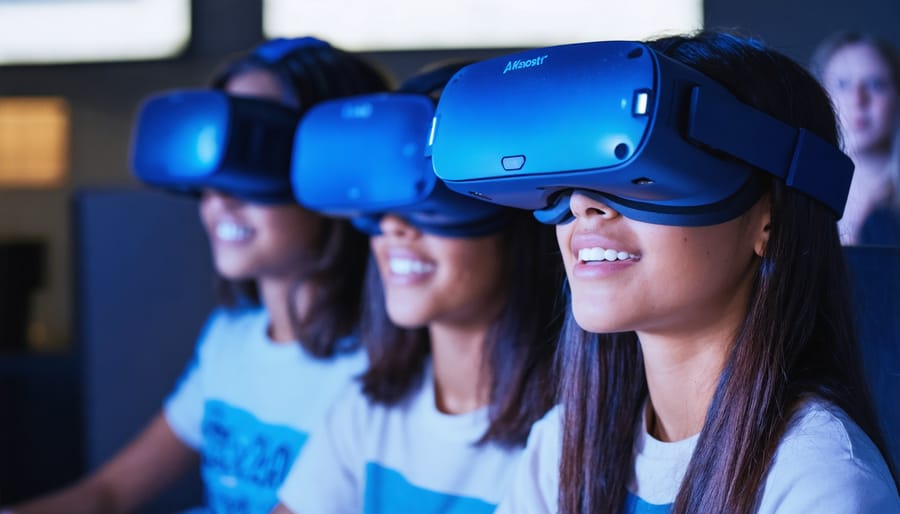
Full immersion VR transforms abstract concepts that students traditionally struggle to grasp into experiences they can see, touch, and explore. Imagine your chemistry students walking through a three-dimensional molecule, observing atomic bonds from every angle. History lessons come alive as learners step into reconstructed historical settings, experiencing events from multiple perspectives rather than simply reading about them. Mathematical concepts like geometric transformations or complex graphs become navigable spaces where students can physically manipulate variables and instantly see results. These concrete experiences help diverse learners—including visual, kinesthetic, and spatial thinkers—build deeper understanding. When students can interact with previously intangible ideas, they develop stronger mental models and retain information more effectively. This approach particularly supports learners who find traditional textbook explanations challenging, creating equitable access to complex concepts.
Practical Applications Across K-12 Subjects
Science and STEM Education
Full immersion VR opens extraordinary possibilities for science and STEM learning by transforming abstract concepts into tangible experiences. Your students can explore rainforest ecosystems from their classroom, observing biodiversity and ecological relationships up close without leaving campus. Virtual laboratories allow safe experimentation with chemical reactions or physics principles—students can manipulate variables and witness outcomes without equipment costs or safety concerns.
Anatomy lessons become three-dimensional journeys where learners walk through the human circulatory system or examine organs from every angle. Space exploration becomes accessible as students visit Mars, observe planetary movements, or experience gravitational forces firsthand. Physics concepts like momentum, energy transfer, and wave behavior transform from textbook diagrams into interactive simulations students can actually manipulate and test.
These experiences particularly benefit kinesthetic learners who grasp concepts better through interaction and movement. Teachers report increased engagement and retention when students can “do” science rather than just read about it. The technology also levels the playing field, providing enriching experiences to schools that may lack extensive lab equipment or field trip budgets. Consider starting with one subject area that aligns with your curriculum goals, then expand as you build confidence with the technology.
Social Studies and History
Full immersion VR transforms how students engage with history and social studies by placing them directly into the environments and events they’re studying. Instead of reading about ancient Rome, your students can walk through the Forum, experiencing the scale and atmosphere of daily life in a way textbooks simply can’t convey.
Virtual field trips become incredibly powerful learning tools. Students can explore the Great Wall of China, stand inside the Sistine Chapel, or navigate the geography of different continents—all without leaving your classroom. This technology particularly benefits schools where budget constraints limit physical field trips, ensuring equitable access to rich cultural experiences.
One of the most compelling applications is perspective-taking for civic education. Students can experience historical events from multiple viewpoints, building empathy and critical thinking skills. Imagine your class understanding the Civil Rights Movement by virtually walking through key moments, or exploring different communities to appreciate diverse cultural practices.
Geography lessons become experiential adventures as students navigate landscapes, understand climate zones, and see how geography shapes civilizations. These immersive experiences create lasting memories and deeper understanding than traditional map-based learning, making abstract concepts tangible and engaging for all learners.
Language Arts and Creative Subjects
Full immersion VR transforms language arts by placing students directly inside the stories they’re studying. Imagine your class exploring the setting of a novel they’re reading, walking through virtual environments that bring literature to vivid life. This spatial experience deepens comprehension and emotional connection to texts in ways traditional methods can’t match.
For creative writing, VR provides rich sensory inspiration. Students can visit virtual landscapes, historical settings, or fantastical worlds, then return to their desks brimming with details to incorporate into their stories. Virtual art galleries allow learners to examine masterworks up close, studying brushstrokes and techniques while hearing curator-style commentary.
Collaborative storytelling environments enable students to build narrative worlds together, developing communication and teamwork skills alongside literacy. These shared creative spaces particularly engage reluctant writers by making composition feel like adventure rather than assignment. Many educators report increased student enthusiasm and more descriptive, detailed writing after VR-enhanced lessons.
Mathematics and Spatial Learning
Full immersion VR transforms abstract mathematical concepts into tangible experiences your students can explore and manipulate. Imagine learners walking through three-dimensional geometric shapes, rotating complex functions to observe them from multiple angles, or physically placing data points in space to visualize statistical relationships. Students who struggle with traditional 2D representations often achieve breakthrough understanding when they can interact with fractals, tessellations, or coordinate systems in an immersive environment. This spatial approach particularly supports diverse learners, including those who think visually or kinesthetically. Many educators report that VR helps demystify challenging topics like volume, surface area, and calculus by making these concepts interactive rather than abstract. Your students can collaborate in virtual spaces, building mathematical models together and discussing their observations in real-time, fostering both conceptual understanding and communication skills.
Getting Started: What You Need to Know
Technology Requirements and Budget Considerations
Implementing full immersion VR doesn’t require breaking your school’s budget. Let’s explore options that work for different funding levels.
**Hardware Options for Every Budget**
Entry-level standalone headsets like the Meta Quest series ($300-500) offer excellent starting points, requiring no additional computers or complex setup. Mid-range options ($500-800) provide enhanced graphics and tracking, while premium systems ($1,000+) deliver the highest fidelity experiences. Consider starting with 2-4 headsets for rotation among students rather than full classroom sets.
**Space and Infrastructure Needs**
Most classroom VR requires just 6×6 feet of clear space per user. Wireless headsets eliminate tripping hazards and simplify management. Reliable WiFi is essential—work with your IT department to ensure adequate bandwidth for simultaneous users.
**Software Platform Choices**
Many educational VR platforms offer free educator accounts or affordable school licenses. Popular options include Google Expeditions successor programs, ClassVR, and subject-specific applications with educational pricing. Start with free trials to identify what resonates with your students.
**Budget-Friendly Strategies**
Explore these funding avenues:
– Technology grants from organizations like DonorsChoose or your state’s education department
– STEM-focused corporate sponsorships
– Parent-teacher organization fundraising
– District technology refresh programs
– Partnerships with local universities or tech companies for equipment loans
Consider pooling resources with neighboring schools to share VR libraries. Many educators successfully launch VR programs through phased implementation, starting small and expanding as they demonstrate student impact.
Classroom Management and Safety Protocols
Successfully managing VR sessions starts with clear expectations and structured routines. Begin by establishing time limits—10-15 minutes per student initially—to prevent motion sensitivity while maximizing participation. Create a designated “VR zone” with adequate space, removing obstacles and using floor mats to define boundaries.
Supervision is essential. Always maintain visual contact with students wearing headsets, and assign “spotters” from waiting students to alert you of any safety concerns. This approach doubles as a leadership opportunity while keeping everyone engaged.
Address motion sensitivity proactively by explaining symptoms beforehand and encouraging students to remove headsets immediately if they feel uncomfortable. Keep a quiet rest area available and remind students that sensitivity is common and not a weakness.
For equitable access, implement fair rotation systems using timers or digital sign-up sheets. Consider pairing students as “navigator and explorer” teams where one wears the headset while the other guides using mirrored screen displays—this promotes collaboration and ensures no one feels left out.
Accommodate diverse learners by adjusting controller settings, providing audio descriptions where available, and offering alternative viewing options for students who cannot use headsets. Creating these inclusive practices from day one normalizes accessibility and builds a supportive classroom culture around this exciting technology.
Finding Quality Educational VR Content
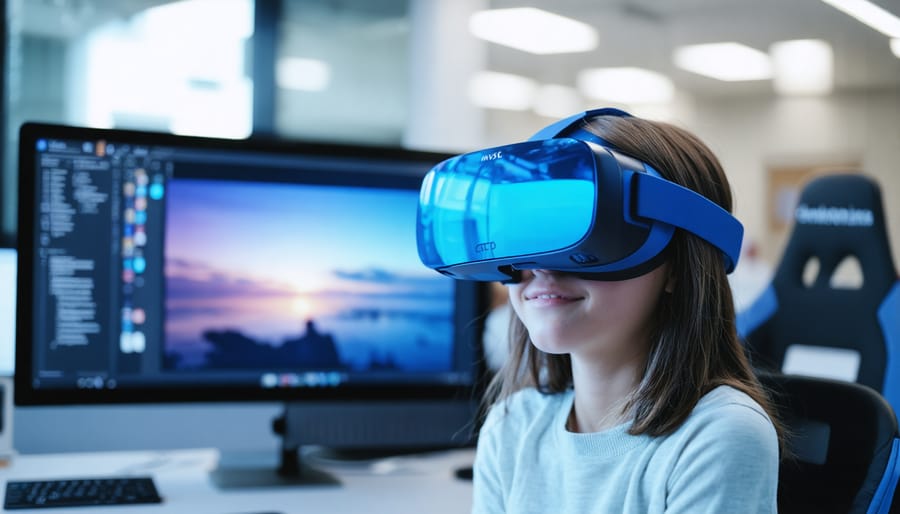
Finding quality VR content that aligns with your curriculum doesn’t have to be overwhelming. Start by exploring established platforms like Google Expeditions, Nearpod VR, and ClassVR, which offer curated libraries designed specifically for K-12 education. When evaluating apps, look for content that clearly maps to learning standards in your state or district—many quality platforms provide curriculum alignment guides.
Consider these practical criteria: Does the experience actively engage students in learning rather than passive watching? Are instructions clear enough for students to navigate independently? Does it work within your technical limitations? Reading educator reviews through community forums can provide real-world insights beyond marketing claims.
Don’t hesitate to request free trials or demos before committing. Many developers offer educator previews, allowing you to test experiences firsthand. Remember, the most effective VR content complements your existing teaching strategies rather than replacing them entirely. Start with one or two high-quality experiences that truly enhance understanding, then gradually expand your library based on student response and learning outcomes.
Overcoming Common Implementation Challenges
Working With Limited Time and Resources
You don’t need a dedicated VR lab or unlimited budget to bring full immersion experiences into your classroom. Start with what you have: even a single headset shared across classes can create memorable learning moments. Consider a rotation system where students take turns experiencing key curriculum concepts—a five-minute VR field trip can spark discussions that last the entire period.
Focus on strategic integration rather than frequent use. Reserve VR for concepts that truly benefit from immersion: exploring the solar system, walking through historical events, or visualizing complex molecular structures. These targeted applications deliver maximum impact without overwhelming your schedule or resources.
Partner with other teachers to share equipment and lesson plans, creating a collaborative approach to integrating technology effectively. Many educators find that two or three well-planned VR sessions per unit provide sufficient engagement while keeping implementation manageable.
Look for free or low-cost content libraries aligned with your curriculum standards. Platforms like Google Expeditions and educational VR apps offer ready-made experiences that require minimal preparation time. Remember, you’re enhancing—not replacing—your existing lessons, so even small additions can create significant learning gains.
Supporting All Learners
Full immersion VR presents unique opportunities for supporting all learners, but requires thoughtful planning to ensure every student can participate meaningfully. Start by assessing your students’ individual needs—some may experience motion sensitivity or visual impairments that require adjustments to VR settings like reducing movement speed or increasing text size.
Create comfort zones by introducing VR gradually. Allow students to opt for alternative experiences initially, perhaps observing through screen mirroring before trying the headset themselves. Many students who initially hesitate become enthusiastic participants once they see peers enjoying the experience.
Address equity concerns proactively by exploring funding options like grants, district technology budgets, or partnerships with local businesses. Consider starting with a small VR station that rotates through your class rather than requiring full sets immediately.
For students with disabilities, investigate adaptive controllers and accessibility features built into many VR platforms. Seated experiences work beautifully for students with mobility challenges, while audio descriptions can support visually impaired learners.
Remember, successful implementation isn’t about having the most equipment—it’s about creating inclusive experiences where every student feels capable and engaged.
Building Stakeholder Support
Gaining buy-in starts with sharing concrete evidence. Document student engagement through photos, videos, and learning assessments that showcase outcomes. Create brief demonstration sessions where administrators and parents can experience VR firsthand—nothing builds understanding like trying it themselves.
Address screen time concerns proactively by emphasizing that VR experiences are typically brief, focused learning sessions, not passive consumption. Highlight how immersive technology promotes active problem-solving and physical movement, distinguishing it from traditional screen use. Share research on educational VR’s cognitive benefits and establish clear usage guidelines that balance innovation with wellness. Consider hosting a community forum where families can ask questions and voice concerns in a supportive environment, building trust through transparency and dialogue.
Measuring Impact and Learning Outcomes
What to Look For
Measuring the impact of full immersion virtual reality in your classroom doesn’t require complex data systems. Start by observing your students during VR experiences—look for sustained attention, voluntary exploration, and spontaneous collaboration with peers. These behavioral indicators often reveal deeper engagement than traditional worksheets.
Student self-reporting provides valuable insights you might otherwise miss. Simple exit tickets asking “What surprised you today?” or “What do you want to explore further?” can reveal conceptual breakthroughs. Consider creating brief reflection journals where students describe their VR experiences in their own words, helping you assess both engagement and comprehension.
When comparing outcomes to traditional instruction, focus on retention and application rather than just test scores. Students who experience photosynthesis in a virtual rainforest often recall details weeks later and make connections to real-world scenarios more readily. Track how students transfer VR learning to other contexts—do they reference their virtual experiences during subsequent lessons?
Remember, positive indicators include increased question-asking, student-initiated discussions, and requests to revisit virtual environments. These organic responses often signal meaningful learning that standardized assessments may not capture immediately.
Simple Documentation Strategies
Tracking the impact of full immersion VR doesn’t require complex evaluation systems. Start with simple before-and-after snapshots: ask students to draw or describe their understanding of a concept before the VR experience, then repeat immediately after. These comparisons vividly demonstrate learning gains you can share with administrators and parents.
Create a dedicated reflection journal—digital or paper-based—where students record what surprised them, what they learned, and how the experience changed their thinking. These authentic voices become powerful evidence of engagement and deeper understanding.
Consider using exit tickets with just two questions: “What did you experience?” and “How does this connect to what we’re learning?” These quick check-ins take minutes but provide meaningful documentation over time.
Photography also works wonders. Capture students during VR sessions and display these images alongside their written reflections in hallway showcases or newsletters. Visual documentation helps your school community understand why this technology matters, building support for future implementation while celebrating student growth.
Full immersion virtual reality represents a transformative opportunity for education, offering students experiences that transcend traditional classroom boundaries. From exploring ancient civilizations to conducting complex science experiments in safe, controlled environments, this technology opens doors that were previously unimaginable. Yet it’s important to remember that full immersion VR is one powerful tool among many in your educational toolkit—not a replacement for effective teaching, but an enhancement that can deepen engagement and understanding when thoughtfully applied.
The journey toward integrating full immersion VR into your classroom doesn’t require a giant leap. Start small: pilot a single lesson, partner with a colleague, or explore one subject area where VR can make a meaningful impact. Many educators have found success by beginning with free or low-cost applications before scaling up their initiatives.
You’re not alone in this exploration. Vibrant communities of educators are actively sharing lesson plans, troubleshooting technical challenges, and celebrating successes in dedicated forums and online groups. These spaces offer invaluable support as you navigate implementation, providing practical advice from peers who understand your specific context and constraints.
The future of learning is being shaped right now, and you have the opportunity to be part of that evolution. Your willingness to explore new tools, adapt your teaching practices, and prioritize student engagement positions you as a leader in education. Take that first step today—whether it’s researching available platforms, attending a virtual demonstration, or joining an educator community. Your students are ready for experiences that inspire wonder and ignite curiosity. Are you ready to guide them there?