Virtual reality is revolutionizing nursing education, offering unprecedented opportunities to transform classroom learning through VR into dynamic, hands-on clinical experiences. As nursing programs face increasing challenges in securing clinical placements and providing consistent training experiences, VR technology emerges as a game-changing solution that bridges the gap between theoretical knowledge and practical application. This innovative approach allows nursing students to practice critical procedures, develop clinical decision-making skills, and experience high-stakes scenarios in a risk-free environment. Studies show that VR-based training can improve student confidence, reduce anxiety during real patient interactions, and enhance clinical competency scores by up to 40% compared to traditional teaching methods. For nursing educators seeking to prepare the next generation of healthcare professionals, virtual reality offers a scalable, cost-effective way to standardize clinical education while providing immersive, engaging learning experiences that meet the demands of modern healthcare training.
How VR Revolutionizes Clinical Skills Training
Hands-on Practice Without Risk
Virtual reality creates a safe, controlled environment where nursing students can practice critical procedures without risk to real patients. This innovative approach allows learners to make mistakes and learn from them in a consequence-free setting, building confidence before working with actual patients.
Students can repeatedly practice complex procedures, emergency scenarios, and rare medical conditions that they might not encounter during traditional clinical rotations. For instance, they can manage a cardiac arrest, handle difficult birthing complications, or respond to severe allergic reactions multiple times until they feel completely comfortable with the procedures.
The virtual environment provides immediate feedback, helping students understand the impact of their decisions without putting anyone at risk. They can see the outcomes of their actions in real-time and adjust their approach accordingly. This experiential learning is particularly valuable for high-stakes procedures where mistakes in real-life situations could have serious consequences.
Furthermore, instructors can customize scenarios to match specific learning objectives and adjust difficulty levels based on student progress. They can also record sessions for later review and discussion, enabling detailed feedback and reflection on performance. This structured approach to skill development helps build muscle memory and decision-making capabilities in a systematic way.
This risk-free practice environment particularly benefits students who may feel anxious about performing procedures for the first time on real patients, helping them develop both technical skills and clinical confidence simultaneously.

Real-time Feedback and Assessment
One of the most powerful advantages of virtual reality in nursing education is its ability to provide immediate, detailed feedback to students as they practice clinical skills. Unlike traditional learning environments, VR systems can track and analyze every movement, decision, and response in real-time, offering personalized guidance when students need it most.
During simulated procedures, students receive instant notifications about their technique, timing, and accuracy. For example, when practicing IV insertion, the system can highlight improper needle angles or alert students to potential complications before they occur. This immediate feedback helps prevent the development of incorrect habits and reinforces proper clinical procedures.
The assessment capabilities extend beyond technical skills to include decision-making and critical thinking. VR platforms can measure how quickly students respond to emergency situations, evaluate their prioritization of tasks, and assess their ability to follow proper protocols. These metrics provide valuable insights for both educators and learners.
Many VR systems also incorporate performance analytics dashboards that track progress over time. Students can review their improvement across multiple sessions, while instructors can identify common struggles and adjust their teaching strategies accordingly. This data-driven approach enables more targeted instruction and helps ensure that learning objectives are being met effectively.
The combination of immediate feedback and comprehensive assessment creates a safe, supportive learning environment where students can practice until they achieve mastery, building confidence before working with real patients.
Implementing VR in Nursing Curricula
Essential Equipment and Setup
To successfully implement virtual reality in nursing education, programs need a carefully planned equipment setup. Before making any purchases, educators should focus on choosing the right virtual technology that aligns with their program’s goals and budget.
The basic equipment requirements typically include:
– VR headsets (standalone or PC-connected)
– Motion controllers
– Adequate space for movement (minimum 6×6 feet per station)
– Charging stations and storage solutions
– A reliable Wi-Fi connection
For most nursing programs, standalone VR headsets like the Meta Quest series offer a good balance of functionality and cost-effectiveness. These devices don’t require external computers or sensors, making them ideal for classroom settings. Plan for one headset per 4-5 students to ensure adequate practice time.
Supporting infrastructure requirements include:
– Sanitization supplies for shared equipment
– Backup controllers and charging cables
– A secure storage area for equipment
– Basic maintenance tools and cleaning supplies
– A device management system for tracking usage
Consider setting up a dedicated VR learning space with:
– Non-slip floor mats for safety
– Clear boundaries marked on the floor
– Adequate ventilation
– Good lighting (adjustable preferred)
– Nearby seating for observing students
Remember to factor in ongoing costs such as software subscriptions, equipment maintenance, and potential upgrades. Starting with a pilot program using 2-3 stations can help determine the most effective setup for your specific needs before scaling up.

Curriculum Integration Strategies
Integrating virtual reality into nursing education requires a thoughtful, systematic approach that aligns with existing curriculum objectives. Start by identifying specific learning outcomes where VR can enhance understanding, such as complex medical procedures or patient assessment scenarios. Create a blend of traditional teaching methods with gamified learning approaches to maintain student engagement while meeting educational standards.
Consider implementing VR sessions in three distinct phases: pre-briefing, immersive experience, and debriefing. During pre-briefing, introduce students to the technology and set clear learning objectives. The immersive experience should focus on specific skills or scenarios relevant to the lesson plan. Follow up with structured debriefing sessions where students can reflect on their experience and connect it to theoretical concepts.
Schedule VR activities strategically throughout the semester, starting with simple scenarios and progressing to more complex situations. This gradual approach helps students build confidence while mastering both the technology and nursing concepts. Consider creating rotating stations where some students engage in VR while others work on complementary activities, maximizing resource utilization and maintaining efficient class flow.
Develop assessment rubrics that specifically evaluate VR-based learning outcomes. Include both technical proficiency and clinical reasoning skills in your evaluation criteria. Remember to maintain flexibility in your implementation strategy, allowing for adjustments based on student feedback and technological capabilities. Regular collaboration with IT support staff and fellow educators can help ensure smooth integration and identify opportunities for cross-disciplinary learning experiences.
Measuring Success: VR Training Outcomes
Student Performance Metrics
Measuring student performance in VR-based nursing education reveals encouraging results across multiple learning dimensions. Studies show that students using VR simulations demonstrate improved clinical decision-making skills, with assessment scores typically 20-30% higher compared to traditional learning methods.
Key performance indicators include technical skill acquisition, knowledge retention, and critical thinking abilities. Students engaging with VR scenarios show markedly improved confidence levels, with 85% reporting feeling better prepared for real-world clinical situations. Assessment data indicates that VR learners typically achieve competency benchmarks 40% faster than those using conventional methods.
Practical skills assessment through VR provides immediate feedback, allowing educators to track progress in real-time. Students demonstrate stronger performance in areas such as patient assessment, emergency response, and procedural accuracy. The data shows particularly significant improvements in high-stress scenarios, where VR-trained students maintain composure and follow protocols more consistently.
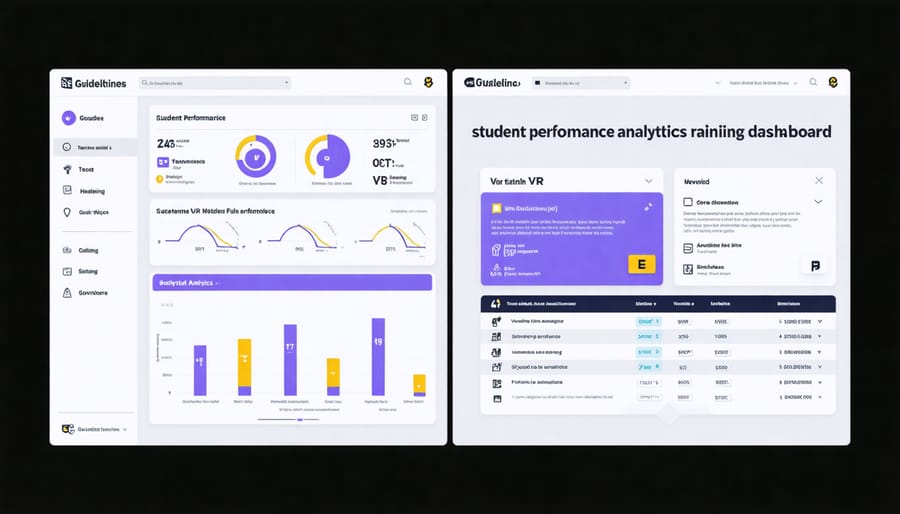
Documentation of student progress through VR platforms offers detailed analytics, including time spent on tasks, error rates, and decision-making patterns. These metrics help educators identify areas needing additional focus and customize learning paths for individual students. Notably, retention rates for procedural knowledge remain 30% higher after six months compared to traditional teaching methods.
The comprehensive nature of VR performance tracking allows for more objective evaluation of student competencies, supporting both formative and summative assessment strategies in nursing education.
Clinical Confidence Improvement
Virtual reality simulations have shown remarkable success in boosting nursing students’ clinical confidence levels. When students engage with VR scenarios repeatedly, they develop a stronger sense of self-assurance in performing medical procedures and interacting with patients. This increased confidence stems from the safe, controlled environment that VR provides, where mistakes become learning opportunities rather than critical errors.
Studies have demonstrated that nursing students who regularly practice in VR environments report feeling more prepared for real-world clinical situations. The immersive nature of VR allows them to develop muscle memory and decision-making skills without the pressure of working with actual patients. Students can practice complex procedures multiple times, gaining mastery and confidence with each attempt.
The improvement in clinical confidence is particularly noticeable in high-stress scenarios. Through VR training, students become more comfortable managing emergency situations, communicating with distressed patients, and coordinating with healthcare team members. This enhanced confidence often translates into better performance during clinical rotations and ultimately in their professional practice.
Educators have observed that students who participate in VR training display increased willingness to take on challenging cases and show greater initiative in clinical settings. The technology creates a bridge between theoretical knowledge and practical application, helping students feel more competent and prepared for their future roles as healthcare providers.
Future Applications and Possibilities
The future of virtual reality in nursing education holds tremendous promise, with emerging technologies opening new doors for innovative teaching and learning experiences. As VR technology becomes more sophisticated and accessible, we can expect to see increasingly immersive and interactive real-world learning applications that transform how nursing students develop their skills.
One exciting development is the integration of haptic feedback technology, which will allow students to feel physical sensations when performing virtual procedures. This advancement will create more authentic experiences in skills practice, from taking pulses to administering injections. Additionally, artificial intelligence integration will enable more sophisticated patient scenarios that adapt in real-time to student responses, creating truly dynamic learning environments.
Multi-user VR environments are expected to become more prevalent, enabling collaborative learning experiences where students and instructors can interact within the same virtual space regardless of physical location. This capability will revolutionize distance learning programs and facilitate international knowledge exchange between nursing schools worldwide.
Augmented reality (AR) integration with VR systems will allow students to overlay digital information onto physical training mannequins, combining the benefits of hands-on practice with digital guidance. This hybrid approach will bridge the gap between virtual and physical learning environments.
We’re also likely to see the development of comprehensive learning analytics systems that track student performance in VR scenarios with unprecedented detail. These systems will provide educators with valuable insights into student progress and areas needing improvement, enabling more personalized learning paths.
As costs decrease and technology becomes more user-friendly, VR implementation in nursing programs will likely become standard practice rather than an innovative exception. This shift will democratize access to high-quality simulation training, particularly benefiting programs in remote or underserved areas.
Virtual reality in nursing education represents a transformative approach that brings numerous benefits to both educators and students. Through immersive learning experiences, VR technology enables nursing students to practice critical skills in a safe, controlled environment while building confidence before working with real patients. The evidence supporting VR’s effectiveness in improving learning outcomes, increasing student engagement, and enhancing clinical decision-making skills makes it a valuable tool for modern nursing education.
As we look to the future of healthcare education, the adoption of VR technology is not just an option but a necessity. The ability to simulate complex medical scenarios, practice rare procedures, and experience diverse patient interactions makes VR an invaluable asset in preparing the next generation of nursing professionals. Moreover, the cost-effectiveness and scalability of VR solutions make them increasingly accessible to nursing programs of all sizes.
We encourage nursing educators to embrace this innovative technology and begin incorporating VR elements into their curriculum. Start small, perhaps with basic simulation modules, and gradually expand as comfort and expertise grow. Remember that the journey toward VR implementation is collaborative – connect with other educators, share experiences, and learn from each other’s successes and challenges.
By taking steps today to integrate VR technology into nursing education programs, we can better prepare our students for the complexities of modern healthcare while ensuring they develop the confidence and competence needed for successful nursing careers.