
Focus your coaching conversations on the three interconnected elements that define the instructional core: the teacher’s knowledge and skill, the student’s engagement with content, and the rigor of the academic task itself. When you understand how these components work together, you unlock the most powerful lever for improving student learning in any classroom.
Observe each element systematically during classroom visits. Notice not just what the teacher is doing, but how deeply students are thinking about meaningful content. A teacher may be delivering an engaging lesson, yet if students are completing low-level tasks with minimal cognitive demand, learning remains superficial. Conversely, rigorous tasks fall flat when teachers lack the pedagogical skills to scaffold student thinking or when students disengage from the material.
Ground your feedback in the relationships between these elements rather than isolated observations. Instead of simply noting that a teacher asked good questions, explore how those questions elevated the task’s complexity and shifted student thinking to higher levels. This interconnected analysis helps educators see beyond surface-level fixes to understand the deeper structural changes that transform instruction.
Use the instructional core framework to diagnose persistent challenges in your school or classroom. When achievement stalls, examine which element needs strengthening and how adjustments in one area cascade through the others. This systematic approach replaces random improvement efforts with targeted, evidence-based interventions that address root causes rather than symptoms.
The instructional core provides a shared language for meaningful collaboration. It transforms abstract conversations about teaching quality into concrete discussions about what students are actually learning and why.
What Is the Instructional Core?
The Three Essential Elements
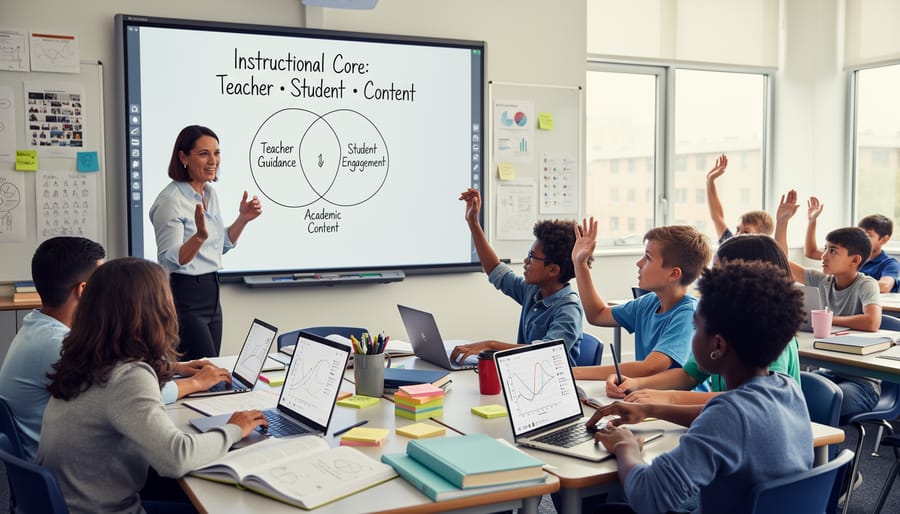
The instructional core rests on three interdependent pillars that work together to create meaningful learning experiences. Understanding each element helps you identify where to focus your improvement efforts and how to support growth in your classroom or when coaching others.
Teacher knowledge and skill encompasses your content expertise, pedagogical understanding, and ability to make instructional decisions in real time. This means knowing your subject deeply while also understanding how students learn best. Strong teacher knowledge allows you to anticipate misconceptions, ask probing questions, and adjust your approach based on what students demonstrate. You bring this element to life through your preparation, assessment practices, and moment-to-moment interactions with learners.
Student engagement and effort goes beyond simple compliance or participation. This element focuses on the intellectual work students perform and their active involvement in constructing understanding. When students are genuinely engaged, they wrestle with challenging concepts, ask questions, and persist through difficulty. Your role involves creating conditions where students invest mental energy and take ownership of their learning journey.
Academically appropriate content refers to material that challenges students at the right level while connecting to important learning goals. The content should be rigorous enough to promote growth without being so difficult that students disengage. This element requires carefully selecting tasks, texts, and problems that push thinking forward while remaining accessible with appropriate support.
These three elements don’t operate in isolation. The magic happens in the relationships between them, where your expertise meets student effort through well-chosen content.
Why Relationships Matter More Than You Think
Here’s the truth that transforms teaching: it’s not about having the perfect curriculum or the most qualified teacher in isolation. What truly drives student learning is the dynamic interaction between all three elements of the instructional core working together.
Think of it like a three-legged stool. You might have exceptional content and a highly skilled teacher, but if students aren’t genuinely engaged in the learning process, results will suffer. Similarly, motivated students working with weak materials won’t reach their potential, regardless of teacher expertise. The magic happens in the spaces between these elements—in how teachers present content, how students interact with materials, and how the teacher-student relationship supports risk-taking and growth.
This relational view shifts how we approach improvement. Instead of asking “What professional development does this teacher need?” we ask “How can we strengthen the connections between what’s being taught, how it’s being taught, and how students are experiencing it?” This perspective empowers you to diagnose learning challenges more accurately and design interventions that address the real issues. When you focus on relationships within the instructional core, you’re targeting the actual engine of learning.
How the Instructional Core Changes Your Classroom Practice
Moving From Teacher-Centered to Core-Centered Thinking
When you shift from teacher-centered to core-centered thinking, your lesson planning transforms from “What will I teach today?” to “How will all three elements work together to create deep learning?” This reframe opens up powerful possibilities for your classroom.
Consider a traditional approach to teaching fractions. A teacher-centered lens focuses primarily on delivering clear explanations and demonstrations. However, when you engage all three core elements simultaneously, the lesson evolves. You might design tasks that require students to represent fractions using multiple models, discuss their reasoning with peers, and explain their thinking processes. You’re now considering not just your explanation, but how the content complexity challenges students appropriately and what interactions will deepen their understanding.
This approach naturally leads to more effective teaching strategies. For example, instead of planning a lecture followed by independent practice, you might organize a lesson where students work collaboratively on progressively challenging problems while you circulate, ask probing questions, and adjust instruction based on their responses.
The instructional core lens also helps you identify why lessons sometimes fall flat. Perhaps the content was too basic for student engagement, or your questioning didn’t push thinking forward, or students worked in isolation when collaboration would have strengthened learning. By examining all three elements together, you can pinpoint specific adjustments that will make a real difference, transforming your practice from good to exceptional.
Real Classroom Scenarios
Let’s explore how the instructional core comes alive in real classrooms across different contexts.
In a third-grade mathematics classroom, Ms. Rivera noticed her students struggling with fraction concepts despite her clear explanations. By examining the instructional core, she realized the task itself needed adjustment. She shifted from worksheet-based practice to hands-on activities using fraction tiles and real-world scenarios like sharing pizza. This change in the task component strengthened the entire triangle, as students engaged more deeply with the content, and Ms. Rivera could better assess their understanding through observation and discussion. By incorporating innovative lesson plans that emphasized concrete manipulation, she transformed student learning outcomes.
At the high school level, Mr. Thompson’s history class was experiencing low engagement with primary source analysis. Focusing on the teacher-content relationship, he deepened his own understanding of document-based questioning techniques through professional learning. He then redesigned tasks to include collaborative document investigations where students acted as historical detectives. This dual focus on his expertise and the nature of student tasks created meaningful learning experiences.
In both scenarios, educators didn’t try to fix everything at once. They identified one relationship within the instructional core that needed attention and made targeted adjustments. This strategic approach demonstrates how understanding the framework leads to practical, sustainable improvements that benefit all students.
Using the Instructional Core Framework for Coaching Conversations

Observation Through the Instructional Core Lens
When you step into a classroom with the instructional core framework in mind, you’re looking for something deeper than isolated teacher actions or student compliance. You’re observing the dynamic relationship between all three elements working together.
Start by positioning yourself where you can see both the teacher and students engaging with the content. Notice what students are actually doing with the material, not just what the teacher is presenting. Are they grappling with complex problems, or simply listening? This shift in focus reveals the true nature of the learning experience.
Pay attention to the cognitive demand of the tasks. Ask yourself: What level of thinking does this content require from students? How is the teacher scaffolding that thinking? You might observe a beautifully organized lesson that still falls short if students aren’t actively wrestling with meaningful content.
Take notes on the interactions you witness. When a student asks a question, how does the teacher use that moment to deepen everyone’s understanding of the content? When students collaborate, what quality of academic conversation happens around the material?
Consider recording specific examples rather than general impressions. Instead of noting “good questioning,” capture the actual question posed and how students responded. These concrete details become powerful conversation starters during post-observation discussions.
Remember, you’re not evaluating the teacher in isolation. You’re examining how effectively the three elements connect to create genuine learning opportunities. This approach opens up collaborative problem-solving rather than criticism, making your observations more useful for growth.
Questions That Open Dialogue
Thoughtful questions can transform coaching conversations from evaluative to reflective. Here are questions organized by each element of the instructional core that invite deeper thinking:
For the Teacher element, try asking: “What strategies did you use to engage students during that activity?” or “How did you decide when to intervene and when to let students work independently?” These questions honor teacher decision-making while encouraging reflection.
When focusing on the Student, consider: “What patterns did you notice in how different learners approached the task?” or “Which students seemed most engaged, and what might have contributed to that?” These prompts shift attention to student experience without assigning blame.
To explore the Content, ask: “How did you help students connect today’s learning to what they already know?” or “What made this particular concept challenging to teach?” Such questions acknowledge the complexity of content delivery.
Finally, addressing the Relationships between elements: “How did your instructional choices affect student interaction with the material?” or “What might you adjust to strengthen the connection between your teaching moves and student learning?” These questions promote systems thinking and collaborative problem-solving, creating space for meaningful growth without judgment.
Building Teacher Agency, Not Compliance
The instructional core framework trusts your professional expertise. Rather than mandating rigid lesson plans or scripts, it provides a lens for analyzing and improving your practice. You decide how to adjust content complexity, engage students differently, or modify your approach based on what you observe in the learning environment. This professional autonomy means you can respond to your students’ actual needs instead of following one-size-fits-all directives.
When you understand the dynamic relationships between teacher, student, and content, you’re equipped to make strategic choices throughout your day. You might recognize that struggling learners need different content scaffolding, or that your questioning technique needs adjustment. These insights emerge from your classroom observations, strengthened through teacher collaboration strategies where colleagues examine practice together. The framework doesn’t tell you what to do—it helps you see what matters most and empowers you to act purposefully.
Strengthening Each Part of Your Instructional Core
Deepening Your Content Knowledge
Strengthening your content knowledge begins with honest self-assessment. Take time to identify areas where you feel less confident in your subject matter, then create a targeted learning plan. Connect with colleagues who excel in those areas, observe their teaching, and engage in thoughtful dialogue about their approaches.
Dive into current research and resources related to your subject area. Subscribe to educational journals, join online communities where teachers share effective strategies, and participate in subject-specific workshops. These connections help you stay current with best practices while building a network of support.
Pedagogical content knowledge goes beyond knowing your subject—it’s about understanding how students learn it. Study common misconceptions in your content area and develop strategies to address them. Analyze student work regularly to identify patterns and adjust your instruction accordingly.
Collaborate with peers through lesson study or professional learning communities. These collaborative spaces allow you to test new approaches, receive feedback, and refine your practice. Consider pursuing professional development opportunities that offer ongoing support rather than one-time sessions.
Remember, deepening content knowledge is an ongoing journey. Celebrate small victories and view challenges as opportunities for growth. Your commitment to continuous learning directly benefits your students’ understanding and achievement.
Elevating Student Engagement and Ownership
When students take ownership of their learning, the instructional core becomes dramatically more powerful. The key is creating authentic opportunities for choice, voice, and reflection within the learning experience.
Start by inviting students to co-create success criteria for assignments. When learners understand what quality work looks like and have contributed to defining it, they develop greater investment in achieving those standards. This simple shift transforms passive recipients into active partners.
Implement regular reflection practices that help students monitor their own progress. Consider using learning journals, exit tickets, or digital portfolios where students track their growth over time. These tools encourage metacognition and help learners recognize their own development.
Offer meaningful choices in how students demonstrate understanding. While learning objectives remain consistent, allowing flexibility in assessment formats honors diverse strengths and interests. A student might show mastery through a presentation, written piece, or creative project.
Create opportunities for peer feedback and collaboration. When students teach each other or provide constructive input on classmate work, they deepen their own understanding while building community. Structure these interactions with clear protocols to ensure they remain productive and respectful.
Remember that authentic engagement grows gradually. Start small with one strategy, gather student feedback, and adjust based on what you learn. Your willingness to share decision-making communicates trust and respect, fundamental elements in building student ownership.

Refining Your Instructional Skills
Strengthening the instructional core begins with intentional teaching practices that bring students, teachers, and content into meaningful alignment. Start by designing tasks that require active engagement rather than passive listening. When students grapple with challenging content through discussion, problem-solving, or hands-on exploration, you create dynamic interactions that deepen learning.
Focus on making your instructional choices visible and purposeful. Before each lesson, ask yourself: Does this task match the rigor of what students need to learn? Am I providing the right scaffolding without diminishing the cognitive challenge? These reflective questions help you fine-tune the delicate balance between all three elements.
Build in regular opportunities for student-to-student interaction around the content. Collaborative learning structures transform the classroom into a community where ideas are tested, refined, and understood more deeply. You’re not just delivering content; you’re facilitating meaningful exchanges that make learning stick.
Finally, observe and adjust in real-time. Notice when students disengage or struggle, then modify your approach. This responsive teaching keeps the instructional core strong and adaptive. Remember, refining these skills is an ongoing journey. Each lesson offers fresh insights into how effectively you’re orchestrating the vital relationship between yourself, your students, and the content you’re exploring together.
Common Pitfalls (And How to Avoid Them)
Focusing on Only One Element
A common pitfall in educational improvement efforts is focusing exclusively on one element while neglecting the others. For instance, schools might invest heavily in new curriculum materials without providing adequate teacher training or considering how students will engage with the content. Similarly, professional development focused solely on teaching techniques may fall short if teachers lack quality instructional materials to support their practice.
This siloed approach often leads to disappointing results because the three elements work interdependently. Strong curriculum materials require skilled teachers to implement them effectively. Even the most talented educators need appropriate content and strategies to reach diverse learners. And student engagement depends on both meaningful content and responsive teaching practices.
To avoid this trap, approach instructional improvement holistically. When planning changes, ask yourself: How will this affect all three elements? What support do teachers need? Are materials appropriate for our students? By maintaining this balanced perspective, you create conditions where real, sustainable improvement can take root and flourish across your learning community.
Confusing Activities With Learning
One of the most common pitfalls in education is mistaking activity for learning. Students might be engaged, busy, and compliant, yet not actually deepening their understanding of content. When examining your instructional core, ask yourself: Are students truly grappling with challenging material, or are they simply completing tasks?
To keep your focus on genuine learning, regularly assess whether activities require students to think critically, make connections, and demonstrate understanding in meaningful ways. A colorful poster project might look impressive, but does it require the same cognitive work as analyzing primary sources or solving complex problems?
Observe student work and conversations closely. Are they wrestling with important ideas, asking questions, and building on each other’s thinking? Or are they following directions without deeper engagement? Strong instructional practices prioritize tasks that make thinking visible and push students beyond surface-level compliance.
Remember, the goal isn’t to eliminate engaging activities, but to ensure they serve as vehicles for substantial learning rather than substitutes for it.
Understanding the instructional core isn’t about overhauling your entire practice overnight. Instead, it’s about recognizing that meaningful change happens through small, intentional shifts in how you think about the relationship between teacher, student, and content. When you grasp this framework, you gain a powerful lens for examining and improving every aspect of your teaching or coaching work.
Start where you are. Perhaps you’ll begin by more carefully observing student engagement with content during one lesson each day. Maybe you’ll adjust your questioning techniques to deepen the cognitive demand of tasks. Or you might focus on building stronger relationships with students to increase their investment in learning. Each small adjustment creates ripple effects throughout your instructional core.
Remember, you don’t have to navigate this journey alone. The Teach Find community offers ongoing support through interactive tools designed specifically for educators exploring these concepts. Our coaching and mentoring resources provide practical guidance tailored to your unique context, whether you’re a classroom teacher refining your practice or a school leader supporting others.
Connect with colleagues through professional learning communities where you can share insights, troubleshoot challenges, and celebrate progress together. Engage in our community forums to ask questions, exchange strategies, and learn from educators across diverse settings.
The transformation you seek is within reach. By focusing on the instructional core, you’re investing in what matters most: creating powerful learning experiences that help every student thrive.