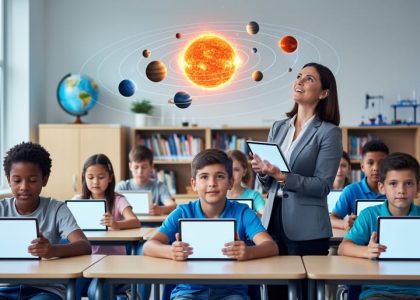
Virtual reality education apps are revolutionizing K-12 classrooms by transforming abstract concepts into immersive, interactive experiences. Through these powerful digital tools, students can now dissect virtual frogs, walk through ancient Roman streets, or explore the human bloodstream in stunning 3D detail. Recent studies show that VR-enhanced lessons increase student engagement by 92% and improve knowledge retention by up to 75% compared to traditional teaching methods.
The intersection of VR technology and education creates unprecedented opportunities for experiential learning, breaking down geographical barriers and making previously impossible educational experiences accessible to all students. From virtual field trips to interactive science simulations, these applications offer cost-effective solutions for schools while providing students with memorable, hands-on learning experiences that spark curiosity and deep understanding.
Whether you’re a tech-savvy educator or just beginning to explore digital learning tools, VR education apps represent a significant leap forward in pedagogical innovation. With hundreds of educational VR apps now available across multiple platforms, teachers can easily integrate these powerful tools into their existing curriculum to create more engaging, effective, and inclusive learning environments.
How VR Education Apps Are Revolutionizing Learning

Enhanced Student Engagement
Virtual reality education apps have revolutionized student engagement by creating immersive learning experiences that capture and maintain students’ attention in ways traditional methods often struggle to achieve. When students step into virtual environments, they become active participants rather than passive observers. This shift from conventional learning to interactive experiences naturally increases motivation and participation levels across all grade levels.
Teachers report that even previously hesitant students show increased willingness to participate when learning through VR apps. The technology’s ability to provide safe spaces for experimentation and trial-and-error learning helps build confidence, particularly in subjects like science and mathematics where students might typically feel intimidated.
The interactive nature of VR apps also supports different learning styles simultaneously. Visual learners benefit from the rich graphics, kinesthetic learners engage through movement and interaction, and auditory learners can process information through accompanying narrations and sound effects. This multi-sensory approach ensures that every student has the opportunity to engage with the material in ways that best suit their learning preferences, leading to deeper understanding and better retention of the subject matter.
Improved Learning Retention
Recent studies have shown that virtual reality creates a powerful impact on improved learning retention among K-12 students. When learners engage with educational content through VR, they typically retain 75% of the information, compared to just 10% through traditional reading methods. This significant difference stems from VR’s ability to create immersive, multi-sensory experiences that actively engage students in the learning process.
The effectiveness of VR in education is particularly evident in subjects requiring spatial understanding and complex concept visualization. For example, students studying cellular biology through VR can explore 3D models of cells, leading to better comprehension and longer-lasting memory of the subject matter. Similarly, history classes using virtual field trips to ancient civilizations report higher student engagement and stronger recall of historical events.
These benefits are attributed to VR’s capacity to create emotional connections with learning material, which neuroscience research indicates is crucial for long-term memory formation. When students feel personally involved in their learning experiences, they’re more likely to remember and understand the content meaningfully.

Top VR Education Apps for K-12 Classrooms
Science and STEM Applications
Virtual reality brings STEM subjects to life in ways traditional teaching methods simply can’t match. Students can explore complex molecular structures in chemistry, dissect virtual organisms in biology, and manipulate 3D geometric shapes in mathematics – all within immersive, risk-free environments.
Popular apps like Lab VR enable students to conduct dangerous experiments safely, while Space Explorer VR lets them journey through solar systems and galaxies. Engineering concepts become tangible through apps like Engineering Studio VR, where students can build and test virtual machines, understanding cause and effect in real-time.
Mathematics apps like GeoGebra AR transform abstract concepts into interactive 3D models. Students can walk around geometric shapes, explore functions from multiple angles, and visualize mathematical relationships in ways that enhance understanding and retention.
For coding and computer science, apps like CoSpaces Edu allow students to create their own virtual worlds while learning programming basics. This hands-on approach makes complex concepts more accessible and engaging for learners of all abilities.
The most effective STEM VR apps include features like:
– Step-by-step tutorials
– Interactive simulations
– Real-time feedback
– Collaborative learning spaces
– Progress tracking tools
These tools not only make learning more engaging but also help students develop crucial spatial reasoning and problem-solving skills essential for future STEM careers. Teachers report increased student participation and better concept retention when incorporating these VR applications into their STEM curriculum.
Social Studies and History
Virtual reality has revolutionized how students experience history and social studies, transforming static textbook content into immersive learning adventures. Through virtual field trips, students can explore ancient civilizations, walk through historical landmarks, and witness pivotal moments in history firsthand.
Popular apps like Google Expeditions and Discovery VR allow classes to visit the Egyptian pyramids, walk through ancient Rome, or experience life in colonial America. These virtual experiences create lasting impressions that help students retain information more effectively than traditional teaching methods.
Historical simulations provide another powerful learning tool. Students can participate in historical events, making decisions and experiencing consequences in a safe, controlled environment. For example, Mission 1790 lets students experience life during the American Revolution, while Versailles VR transports them to the French court during the reign of Louis XIV.
Teachers report that these immersive experiences help develop historical empathy and critical thinking skills. Students gain a deeper understanding of historical contexts, social structures, and cultural differences when they can virtually “live” through different time periods.
For diverse learners, VR applications offer multiple ways to engage with historical content. Visual learners benefit from detailed reconstructions, while kinesthetic learners appreciate the interactive elements. Many apps include built-in accessibility features and can be adapted to various learning needs and abilities.
To maximize learning outcomes, educators often combine VR experiences with traditional teaching methods, using virtual visits as launching points for discussions, writing assignments, and group projects.
Language Arts and Creative Expression
Virtual reality has revolutionized language arts education by creating immersive environments where students can experience literature and develop their creative expression skills. Apps like VR Stories allow students to step into classic narratives, exploring settings and interacting with characters in ways previously impossible through traditional reading methods.
Language learning applications in VR provide authentic conversational experiences, enabling students to practice speaking and listening skills with virtual native speakers. Programs such as VirtualSpeech and Mondly VR create realistic scenarios where learners can engage in contextual dialogue, from ordering at a restaurant to giving business presentations.
For creative writing, apps like Tilt Brush and Quill enable students to visualize and create their stories in three-dimensional space. Students can build entire worlds around their narratives, making abstract concepts tangible and enhancing their storytelling abilities. These tools are particularly effective for visual learners and students who struggle with traditional writing methods.
Interactive poetry and drama applications allow students to perform and analyze literature from new perspectives. By embodying characters or manipulating visual representations of metaphors and symbols, students develop deeper comprehension of literary devices and dramatic elements.
Teachers report increased engagement and retention when using VR for language arts instruction, particularly among reluctant readers and English language learners. The multi-sensory experience helps bridge the gap between abstract language concepts and concrete understanding.
Implementation Strategies for Teachers
Getting Started with VR
Getting started with VR in your classroom doesn’t have to be overwhelming. Like other interactive technologies, VR requires some initial setup, but with the right approach, you’ll be ready to engage your students in immersive learning experiences.
First, assess your available space. You’ll need a clear area of about 6×6 feet for each VR station, ensuring students can move safely while wearing headsets. Consider creating designated VR zones in your classroom with clearly marked boundaries.
For equipment, start small. Many schools begin with 2-4 VR headsets, which work well in rotation or station-based learning. Popular options include standalone headsets like the Meta Quest or ClassVR sets designed specifically for education. These don’t require additional computers or complex setup.
Essential safety considerations include:
– Setting clear usage guidelines
– Keeping sessions to 15-20 minutes per student
– Having sanitizing wipes ready for shared equipment
– Ensuring proper ventilation
– Establishing a “spotter” system where students work in pairs
Before introducing VR to your class, familiarize yourself with the basic controls and practice launching the apps you plan to use. Many educational VR platforms offer teacher training modules or tutorial videos. Remember, you don’t need to be a tech expert – learning alongside your students can create valuable collaborative learning opportunities.

Lesson Planning with VR
Incorporating VR into your lesson plans doesn’t have to be overwhelming. Start by identifying specific learning objectives that would benefit from immersive experiences. For example, a history lesson about ancient civilizations could be enhanced through virtual tours of historical sites, while science concepts might be better understood through 3D molecular visualization.
Consider structuring your VR lessons in three phases: pre-VR preparation, VR experience, and post-VR reflection. During preparation, introduce key vocabulary and concepts students will encounter in the virtual environment. Set clear expectations about behavior and safety protocols when using VR equipment.
Time management is crucial – plan for 15-20 minute VR sessions, as longer periods may cause discomfort for some students. Create alternative activities for students waiting their turn or those who prefer not to use VR. Remember to include time for technical setup and cleanup in your planning.
Develop assessment strategies that align with VR experiences. This could include student journals, group discussions, or creative projects that demonstrate understanding of the virtual content. Consider creating rubrics that evaluate both content knowledge and digital literacy skills.
Collaborate with fellow educators who use VR in their classrooms. Share lesson plans, troubleshooting tips, and success stories. Many online educational communities offer forums specifically for VR teaching strategies.
Always have a backup plan ready in case of technical difficulties. Your VR lessons should seamlessly integrate with traditional teaching methods, ensuring learning continues even if technology challenges arise.
Virtual reality education apps are transforming the way students learn, offering immersive experiences that bring abstract concepts to life. As technology continues to advance and become more accessible, we can expect to see even more innovative educational applications emerge. The future of VR in education looks promising, with developments in haptic feedback, improved graphics, and more affordable devices on the horizon.
For educators, now is the perfect time to begin incorporating these tools into your teaching practice. The growing availability of educational VR content, combined with increasing student engagement and demonstrated learning outcomes, makes this technology a valuable addition to any modern classroom. By starting small and gradually expanding your VR toolkit, you can create more dynamic, inclusive, and effective learning environments that prepare students for an increasingly digital world.
Remember that success with VR education apps comes from thoughtful implementation and clear learning objectives. As we move forward, the community of VR-enabled educators continues to grow, sharing best practices and innovative teaching strategies that benefit students across all grade levels and subject areas.